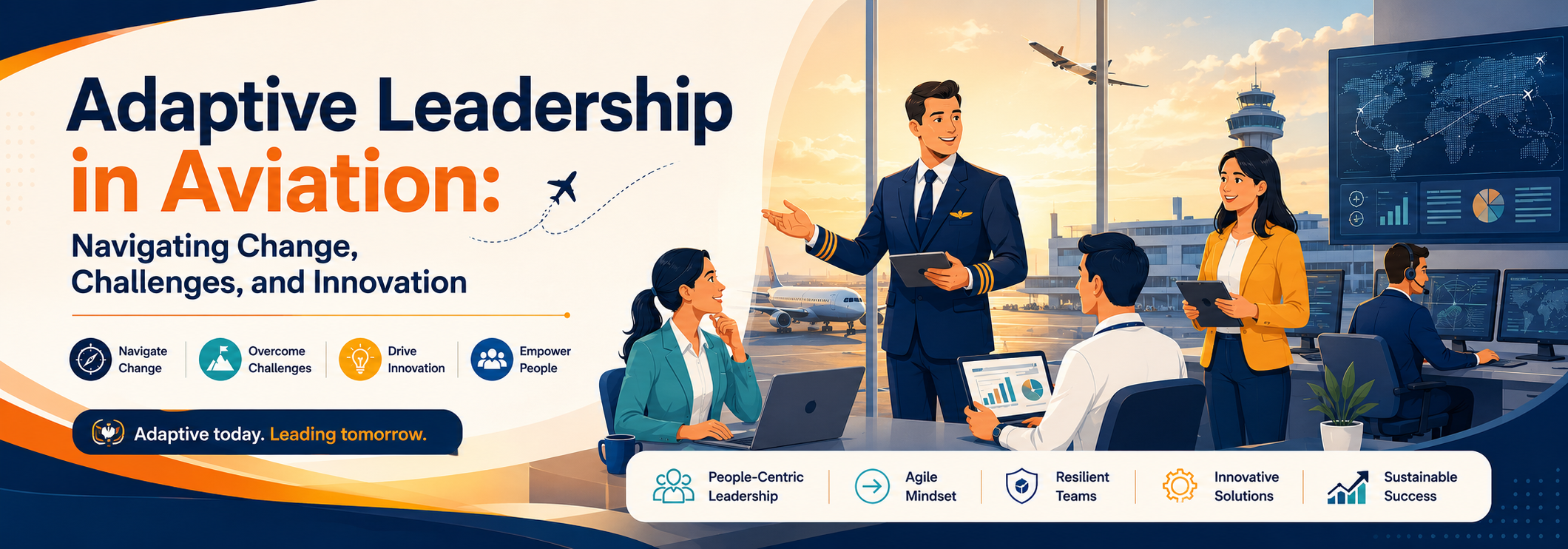
Adaptive Leadership in Aviation: Navigating Change, Challenges, and Innovation
Aviation has always demanded exceptional leadership. Few industries operate under such strict requirements for safety, precision, coordination, and accountability, and every single flight is really the combined effort of pilots, engineers, ground teams, air traffic professionals, operations leaders, and support functions all working toward one outcome: getting people and goods where they need to go, safely.
What's shifting is what leadership actually requires now. Technology is moving faster, customer expectations keep rising, the workforce looks different than it did a decade ago, sustainability has become a genuine priority rather than a talking point, operations have grown more complex, and the industry is navigating a level of global uncertainty that would have felt unusual not long ago. Traditional leadership built around hierarchy and routine decision-making simply doesn't stretch far enough to cover that anymore. Aviation organisations need leaders who can adjust quickly, think strategically, and get their teams through uncertainty without letting safety or performance slip.
That's essentially what adaptive leadership is for. It isn't about reacting to every change that comes along. It's the ability to read a new situation clearly, make an informed call, bring people with you, and build a solution when the existing playbook no longer applies. For aviation organisations, that capability often determines how well they handle a challenge while still holding the line on operational excellence.
Why Aviation Needs Adaptive Leaders
Aviation has always been a highly structured industry, and that's exactly as it should be. Standard operating procedures, regulation, checklists, defined processes these are the backbone of safe operations, and none of that is going away.
But the real leadership challenges tend to show up precisely where none of those systems have an immediate answer. A sudden operational disruption, a workforce shortage, a technology transition, an unexpected safety concern, a shift in the market these ask a leader to assess the situation on its own terms, pull in different perspectives, communicate clearly, and decide under competing priorities, often with no procedure telling them exactly what to do.
Adaptive leaders understand that leadership isn't only about technical knowledge. It's knowing when to apply what already exists and when to actually rethink it. Take something as concrete as rolling out a new digital aviation system it's never really just a technology project. It involves changing behaviour, building people's confidence in the new tool, addressing the concerns that inevitably come up, and helping teams understand how the change actually improves their work. A leader focused purely on the technical rollout will miss the human factors that decide whether it succeeds. Adaptive leadership is what connects operational excellence to people leadership, rather than treating them as two separate jobs.
Moving From Command-and-Control to Genuine Collaboration
Much of aviation has historically run on command-and-control leadership, and for good reason clear authority matters enormously in safety-critical, emergency-driven decisions. That's not disappearing either.
But most of modern aviation now needs collaboration at every level underneath that. Leaders have to build environments where people actually feel comfortable sharing what they've noticed, raising a concern, or offering an idea. A maintenance engineer who spots a potential risk, a cabin crew member who notices something off with a passenger, an operations professional with a genuine efficiency suggestion all of them need the confidence to actually say something, not just the theoretical permission to.
Adaptive leaders build that culture deliberately, through open communication and real psychological safety, because they understand that useful knowledge doesn't sit only with senior executives or department heads. It's scattered throughout the organisation, wherever people take responsibility and solve problems day to day. For HR and L&D leaders, that's a real opportunity leadership development needs to move past the traditional management-skills curriculum and start building the behaviours that support collaboration, accountability, and steady improvement.
Emotional Intelligence Increasingly Separates Good Leaders From Exceptional Ones
Technical capability still matters enormously in aviation. But emotional intelligence is what increasingly draws the line between a good leader and an exceptional one, particularly given how much of aviation work happens under real pressure. Leaders have to manage operational demands while still supporting their teams through stress, uncertainty, and change often at the same time.
In practice, that shows up as understanding team dynamics, listening properly before jumping to a decision, noticing when someone's genuinely concerned about something, giving feedback that actually helps rather than just critiques, and managing their own reaction when the pressure is on. A leader's behaviour shapes team performance more directly than most people give it credit for when a leader stays calm, communicates clearly, and holds their composure through a difficult moment, teams tend to respond in kind.
This matters even more as aviation manages generational shift in its workforce. Newer employees increasingly expect transparency, real development opportunities, work that feels meaningful, and leaders who are genuinely invested in their growth rather than just their output.
Building Teams That Are Actually Ready for Change
Change management tends to get treated as a process on a slide deck, but successful change is fundamentally a leadership responsibility, not a project plan. Aviation organisations are constantly rolling out new technology, operational models, safety practices, and business strategy, and whether any of it actually lands depends on whether leaders can bring their people along with it.
Adaptive leaders handle this differently. They don't just announce a decision and expect immediate adoption. They explain why the change is happening, involve employees in shaping how it rolls out, and meet resistance with understanding rather than frustration. Take automation and AI, which are touching everything from predictive maintenance to operational planning right now. These technologies open up real opportunity, but they also raise genuine concerns about changing roles, new skills people don't yet have, unfamiliar systems they're expected to trust. The leaders who handle this well take those concerns seriously and focus on building capability, helping people see how the technology strengthens their expertise rather than threatens it.
None of that happens without real collaboration between business leaders, HR, and learning functions. Leadership development needs to prepare managers to actually guide people through a transition, not just keep daily operations ticking along.
Developing the Next Generation of Aviation Leaders
Aviation needs a genuinely strong leadership pipeline, and the usual path into it technical experts getting promoted because they were excellent operationally doesn't automatically produce good leaders. A brilliant engineer, pilot, or operations specialist may understand the systems inside and out, but leading a team calls for a different set of muscles entirely: communication, strategic thinking, conflict management, coaching, and sound decision-making.
Organisations have to build these capabilities on purpose rather than hoping they emerge. A genuinely future-ready leadership programme tends to cover a few things deliberately. Strategic thinking, so leaders understand business priorities beyond their own function. People leadership, so managers can actually motivate, coach, and build a team that performs well together. Decision-making under uncertainty, so leaders can weigh a situation, consider the risk, and land on a balanced call. An innovation mindset, so leaders keep looking for improvement without ever loosening their grip on safety. And cross-functional collaboration, so people can work effectively across departments and, increasingly, across global teams.
None of this belongs in a single training event. It needs to become part of how the organisation actually thinks about talent and culture, not a box checked once a year.
Where HR and L&D Leaders Come In
For CHROs, Chief Learning Officers, and L&D leaders, adaptive leadership deserves to sit near the top of the strategic priority list. Aviation organisations can't simply hire their way into strong leadership from outside they need to build the internal capability and get high-potential employees ready for what's coming next.
That takes a deliberate approach: identifying which leadership capabilities actually align with where the business is headed, building development journeys suited to different leadership levels, blending classroom learning with genuine hands-on experience, offering real coaching and mentoring rather than a one-off workshop, and actually measuring whether behaviour and business outcomes have shifted as a result.
The strongest leadership programmes I've seen tie learning directly to real organisational challenges, giving leaders the chance to apply a new skill while working through an actual business problem rather than a hypothetical case study. That's what moves leadership development from theory into something you can point to as measurable performance improvement.
Preparing Aviation Leaders for What's Ahead
Aviation isn't going to get any less complex. New technology, shifting workforce expectations, environmental responsibility, and global operational challenges are all going to keep asking leaders to adapt without ever losing sight of safety and excellence in the process.
Adaptive leadership gives leaders a way to actually navigate that complexity: it makes them more thoughtful decision-makers, stronger communicators, and better at supporting the people who report to them. More than that, it builds organisations that are genuinely ready to respond when circumstances shift, rather than scrambling to catch up.
For aviation companies, leadership development was never really just about preparing people for a bigger title. It's about building a workforce that can handle uncertainty, keep improving, and actually shape where the industry goes next. The leaders who come out ahead will be the ones who combine operational discipline with the ability to adapt, keep learning, and bring others along through change not just manage it from the front of the room.
At Trainify360, we help organisations develop future-ready leaders through practical learning built around real business challenges, not generic case studies. Our leadership programmes help aviation and aerospace professionals strengthen decision-making, collaboration, and leadership capability for an industry that keeps changing shape.
Train smarter. Grow faster. Lead with confidence.