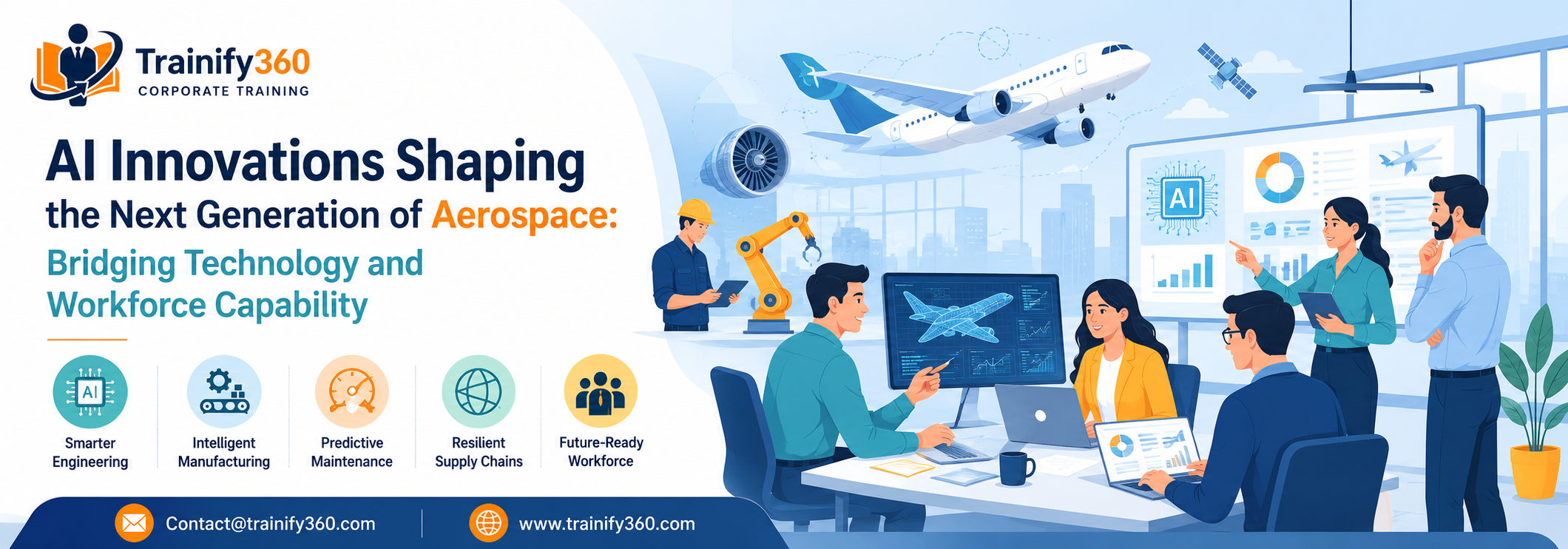
AI Innovations Shaping the Next Generation of Aerospace: Bridging Technology and Workforce Capability
The aerospace industry has never had the luxury of getting things "almost right." Every aircraft that takes off, every component that goes into production, and every maintenance decision made on the ground is backed by years of engineering expertise, strict compliance standards, and an unwavering focus on safety.
Innovation has always been central to the industry's progress. From lighter materials and advanced propulsion systems to digital engineering, aerospace organisations have consistently embraced new technologies to solve increasingly complex challenges. Artificial Intelligence is now becoming part of that journey not as a replacement for human expertise, but as a practical tool that helps organisations make faster, better-informed decisions.
Across the industry, AI is moving beyond pilot projects and experimental use cases. It's finding a place in engineering, manufacturing, maintenance, supply chain management, and business planning. More importantly, it's helping organisations solve real business problems rather than simply introducing another layer of technology.
For CHROs, Learning & Development leaders, and business executives, this shift has important implications. AI adoption isn't just about implementing new software. It's about preparing people to work differently, make smarter decisions, and confidently use technology as part of their everyday roles.
AI Has Moved Beyond Automation
A few years ago, most conversations about AI centred on automating repetitive tasks. While automation remains valuable, aerospace organisations are now using AI in far more meaningful ways.
Engineering teams are analysing design options more quickly. Manufacturers are identifying production issues before they become costly defects. Maintenance teams are predicting equipment failures before they disrupt operations. Leadership teams are using data to make more informed business decisions.
These applications aren't replacing established engineering practices. Instead, they strengthen them by providing insights that would have taken teams significantly longer to uncover through traditional methods.
The result is better decision-making supported by data, without compromising the expertise that has always been the foundation of the aerospace industry.
Smarter Engineering Starts with Better Insights
Designing an aircraft is one of the most demanding engineering challenges in the world.
Every design decision affects multiple outcomes, including structural performance, fuel efficiency, manufacturing costs, maintenance requirements, and regulatory compliance. Even a small design modification can have implications across the entire product lifecycle.
This is where AI is making a measurable difference.
Modern generative design tools can evaluate thousands of possible design configurations within a fraction of the time required through conventional analysis. Engineers define the objectives and constraints, while AI explores potential solutions that balance weight, strength, performance, manufacturability, and cost.
The technology doesn't replace engineering judgement.
It simply gives engineers better options to evaluate.
Instead of spending weeks analysing every possible alternative, teams can focus their expertise on validating the most promising solutions. That shortens development timelines while maintaining the high standards expected across the aerospace sector.
Predictive Maintenance Is Reshaping Fleet Management
Maintenance has always been one of the largest operational expenses for aerospace organisations.
Traditionally, maintenance schedules have been based on fixed inspection intervals or estimated component lifecycles. While these approaches have served the industry well, they don't always reflect the actual condition of equipment.
Some components are replaced long before they're worn out, while others may develop issues earlier than expected.
AI offers a more intelligent approach.
By analysing data from onboard sensors, maintenance records, environmental conditions, and operational history, AI systems can detect early warning signs that may indicate future equipment failures.
Instead of reacting to unexpected breakdowns, maintenance teams can plan interventions before disruptions occur.
The business benefits are significant.
Aircraft spend less time grounded, maintenance resources are used more efficiently, spare parts inventories become easier to manage, and operational reliability improves.
Most importantly, predictive maintenance supports the industry's primary objective—keeping aircraft operating safely.
Manufacturing Is Becoming Smarter, Not More Automated
Aircraft manufacturing demands extraordinary precision.
Every component must meet exact specifications, and even minor inconsistencies can create delays, additional costs, or quality concerns further along the production process.
AI is helping manufacturers improve consistency without replacing the people responsible for building aircraft.
Computer vision systems can inspect thousands of components with remarkable accuracy, identifying surface defects, alignment issues, or material irregularities that require further investigation.
Production planning is also benefiting from AI-driven insights.
Manufacturers can optimise schedules, balance workloads across facilities, monitor equipment performance, and anticipate production bottlenecks before they affect delivery timelines.
The objective isn't to remove human involvement.
It's to reduce repetitive analytical work so engineers, technicians, and quality specialists can focus on solving complex problems where their experience adds the greatest value.
That balance between technology and human expertise is becoming one of the defining characteristics of modern aerospace manufacturing.
Stronger Supply Chains Through Better Visibility
The aerospace supply chain is one of the most complex in the world.
A single aircraft programme may involve thousands of suppliers spread across multiple countries. Delays in raw materials, transportation disruptions, geopolitical uncertainty, or shortages of specialised components can quickly affect production schedules and customer commitments.
This is another area where AI is proving its value.
Instead of relying solely on historical reports, organisations can analyse supplier performance, inventory levels, logistics data, and demand forecasts in real time.
This gives procurement and operations teams greater visibility into potential risks before they become operational problems.
With earlier insights, organisations can adjust sourcing strategies, improve inventory planning, and make more informed decisions that reduce disruption across the supply chain.
For business leaders, that means greater operational resilience and more predictable programme delivery.
AI Supports People, It Doesn't Replace Them
One of the biggest misconceptions surrounding AI is that it will eventually replace highly skilled professionals.
In aerospace, that simply isn't realistic.
Engineering decisions, maintenance approvals, safety inspections, and regulatory compliance require professional judgement built through years of experience.
AI can analyse enormous amounts of data, recognise patterns, and recommend possible actions.
People remain responsible for interpreting those insights and making the final decisions.
The organisations seeing the greatest value from AI understand this distinction.
They treat AI as a decision-support tool rather than a decision-maker.
That approach not only builds trust among employees but also ensures technology is introduced responsibly and in a way that complements existing expertise.
Preparing People for an AI-Enabled Future
Technology often gets the headlines, but successful transformation has always been about people.
Many aerospace organisations are investing in AI platforms, advanced analytics, and intelligent automation. Yet not every organisation sees the business results they expected. The challenge usually isn't the technology itself—it's ensuring that employees understand how to use it confidently and effectively.
Introducing AI changes the way teams make decisions, interpret information, and solve problems. It requires employees to think differently, collaborate across functions, and become comfortable working alongside intelligent systems.
That's why workforce readiness has become just as important as technology readiness.
For Learning & Development teams, this represents a significant shift. Training can no longer focus only on technical skills or compliance requirements. Organisations need learning programmes that help employees understand how AI supports their role, where human judgement remains essential, and how data can be used to make better business decisions.
Building these capabilities isn't about creating AI specialists in every department. It's about giving people the confidence to work with new technologies while continuing to apply their professional expertise.
Some of the capabilities organisations are now prioritising include:
- AI awareness for business professionals
- Data literacy and analytical thinking
- Responsible and ethical use of AI
- Cross-functional collaboration
- Problem-solving and critical thinking
- Adaptability in a changing work environment
These skills are becoming valuable across every business function—not only for engineers and data scientists, but also for managers, procurement teams, HR professionals, operations leaders, and executives.
The Role of Leadership in AI Adoption
Technology doesn't transform organisations—leaders do.
Employees naturally have questions whenever new technologies are introduced. Some wonder whether AI will change their roles. Others may hesitate because they're unfamiliar with the tools or unsure how much they can rely on AI-generated insights.
This is where leadership makes all the difference.
Successful leaders communicate why AI is being introduced, how it supports business objectives, and what it means for employees. They create an environment where learning is encouraged, questions are welcomed, and experimentation is seen as part of growth rather than a risk.
More importantly, they position AI as a tool that supports people rather than replacing them.
The organisations making the greatest progress with AI tend to follow a few common principles.
Start with business priorities.
AI initiatives should solve genuine operational challenges or improve customer outcomes—not simply introduce new technology for its own sake.
Invest in people as much as technology.
Every investment in AI should be matched with investment in workforce capability. Employees who understand the technology are far more likely to adopt it successfully.
Create clear governance.
Responsible AI requires clear guidelines around data privacy, security, compliance, and ethical decision-making. Strong governance builds confidence across the organisation.
Encourage continuous learning.
AI will continue to evolve, and so will the skills employees need. Organisations that promote ongoing development will adapt more quickly to future changes.
When these elements come together, AI becomes part of the organisation's culture instead of remaining a standalone technology project.
Human Expertise Will Always Matter
One question continues to surface whenever AI is discussed:
"Will AI eventually replace aerospace professionals?"
The reality is much simpler.
The aerospace industry depends on experience, engineering judgement, regulatory knowledge, and accountability. These responsibilities cannot be delegated to software.
AI is exceptionally good at analysing large datasets, identifying trends, and highlighting potential risks or opportunities. What it cannot do is apply context, exercise professional judgement, or take responsibility for critical decisions.
That responsibility will always belong to people.
The most successful organisations recognise this balance.
They don't see AI and human expertise as competing forces. Instead, they view them as complementary strengths. AI provides speed and analytical capability, while experienced professionals provide judgement, creativity, and decision-making.
Together, they create stronger outcomes than either could achieve alone.
A New Opportunity for HR and Learning Leaders
For CHROs, HR Directors, Chief Learning Officers, and L&D Heads, AI presents an opportunity to play a more strategic role within the business.
As organisations rethink how work gets done, workforce capability becomes a competitive advantage.
This means moving beyond traditional training programmes and focusing on the skills that will define future success—digital confidence, analytical thinking, collaboration, adaptability, and leadership.
Learning teams are uniquely positioned to guide this transition.
By working closely with business leaders, they can identify emerging skill requirements, design practical learning journeys, and ensure employees are prepared not only for today's technologies but also for tomorrow's opportunities.
Forward-thinking organisations are already embedding AI capability into leadership development, technical training, onboarding, and talent development programmes. They're helping employees understand not just how to use AI, but why it matters to the business.
That shift transforms learning from a support function into a strategic driver of business performance.
Looking Ahead
The aerospace industry has always embraced innovation to overcome complex challenges.
Artificial Intelligence is the latest chapter in that story.
Its impact extends far beyond automation. AI is helping organisations improve engineering design, strengthen manufacturing quality, optimise maintenance, build more resilient supply chains, and support better decision-making at every level of the business.
Yet technology alone will never define the industry's future.
The organisations that succeed over the next decade will be those that invest in their people with the same commitment they invest in technology. They will develop leaders who understand change, create learning cultures that encourage continuous improvement, and build workforces that are confident using AI responsibly.
That's where sustainable competitive advantage will come from.
Final Thoughts
AI is changing the aerospace industry in meaningful ways, but its greatest value isn't found in algorithms alone.
Its real impact lies in helping talented people make better decisions, solve problems more efficiently, and deliver stronger business outcomes.
For business leaders, HR professionals, and Learning & Development teams, the focus should be clear: prepare the workforce to succeed alongside AI, rather than simply introducing new technology.
At Trainify360, we partner with organisations to build practical AI capability through leadership development, digital upskilling, and corporate learning solutions designed for real business challenges. Our approach helps organisations develop the confidence, skills, and mindset needed to turn AI investments into measurable business results.
The future of aerospace won't be shaped by technology alone. It will be shaped by organisations that combine innovation with capable leaders, skilled employees, and a culture of continuous learning.
Frequently Asked Questions
1. How is AI changing the aerospace industry?
AI is helping aerospace organisations improve engineering design, predictive maintenance, manufacturing quality, supply chain planning, and business decision-making while supporting safety and operational efficiency.
2. Why is workforce readiness important for AI adoption?
Technology creates value only when employees know how to use it effectively. A well-prepared workforce improves adoption, builds confidence, and helps organisations achieve better returns on their AI investments.
3. What role does Learning & Development play in AI transformation?
L&D teams help employees build AI literacy, digital skills, change readiness, and leadership capability, ensuring technology adoption delivers long-term business value.
4. Will AI replace aerospace professionals?
No. AI supports professionals by analysing data and providing insights, but engineers, technicians, and operational leaders remain responsible for critical decisions, safety, and regulatory compliance.
5. How can aerospace organisations prepare for an AI-driven future?
By combining AI technology with leadership development, employee upskilling, responsible governance, and a strong culture of continuous learning, organisations can build the capabilities needed for long-term success.