Organisations rarely fail because they lack a strategy. More often, they fail because people don’t embrace the strategy.
You can launch a new platform, announce a restructure, or approve a digital roadmap and still see low adoption, persistent resistance, and missed outcomes months later. The transformation itself isn’t usually the problem. The gap is how the human side of change is managed.
For CHROs, HR leaders, and L&D heads, Change Management and Organisational Transformation have moved from supporting projects to becoming strategic capabilities. In a world of digital disruption, shifting workforce expectations, and rapid market change, the organisations that adapt well are the ones that win, not necessarily those with the best strategy on paper.
Why change initiatives stall
Many programmes start with strong sponsorship and good business cases, yet they stall because leaders underestimate people issues. Employees are asked to learn new ways while keeping the business running. Without structure, resistance grows.
Common failure points:
- Lack of leadership alignment
- Poor or inconsistent communication
- Employee resistance and low engagement
- Limited stakeholder involvement
- Insufficient capability-building
- Weak reinforcement after launch
- Overlooking middle managers
- Unclear benefits and expectations
Change succeeds when people understand what is changing and, critically, why it matters.
Change Management vs Organisational Transformation
These terms are often used interchangeably, but they play different roles.
Change Management
Focus: Help individuals and teams move from current to desired ways of working.
Goal: Adoption.
Key areas: communication, stakeholder engagement, readiness, training, and reinforcement.
Organisational Transformation
Focus: Fundamental shifts in how the organisation delivers value and operates.
Scope: Digital and cultural shifts, operating model redesign, leadership and workforce changes.
Role: Transformation sets the destination; change management navigates the journey.
Why change capability is strategic
Markets, technology, and customer needs are evolving faster than ever. Adaptability is a competitive advantage. Strong change capability helps organisations:
- Speed up transformation
- Improve employee engagement and adoption
- Reduce resistance and disruption
- Build resilience and agility
- Deliver better business outcomes from investments
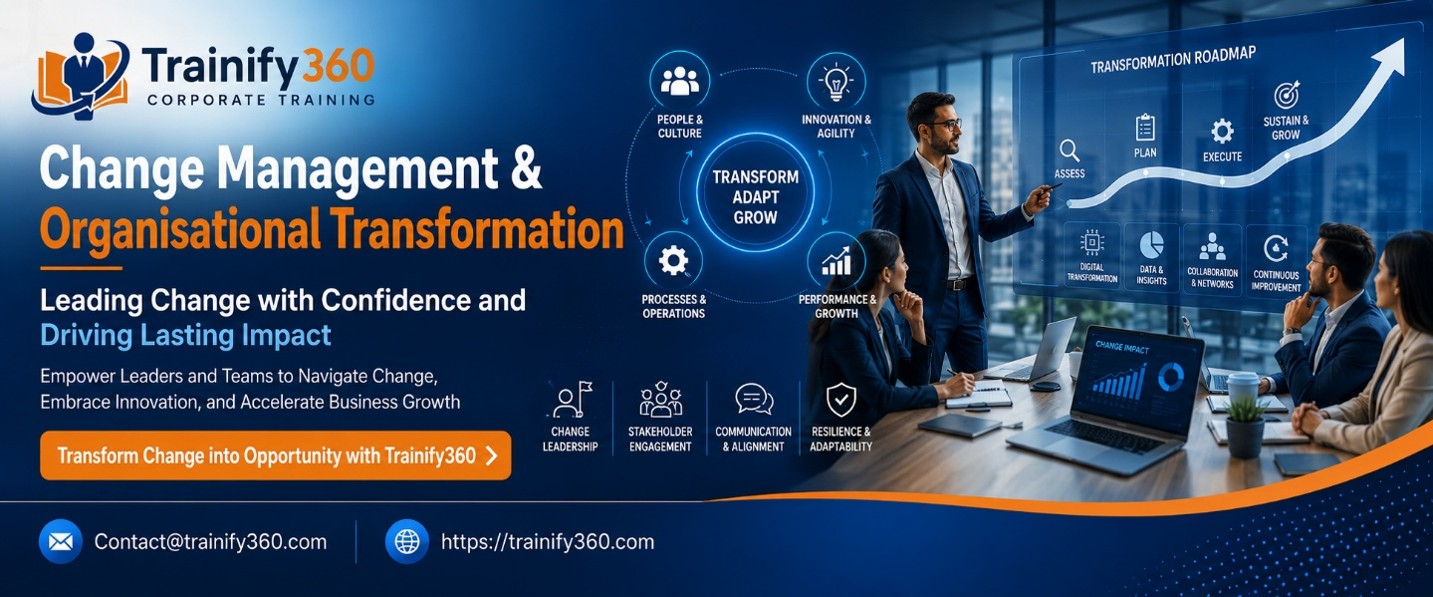
Five drivers of successful transformation
- Leadership alignment and sponsorship
Transformation starts at the top. Employees watch leaders closely; mixed messages breed doubt. Leaders must communicate consistently, model new behaviours, and reinforce priorities. Visible sponsorship keeps momentum. - Clear and consistent communication
People need three answers: Why is this happening? How will it affect me? What support is available? Communicate early, often, and across multiple channels to reduce uncertainty and build trust. - Employee engagement and involvement
People support what they help create. Involve employees in design and rollout to increase ownership, surface practical concerns, and accelerate adoption. - Capability building and learning
New structures and tech demand new skills. Embed learning into every transformation: leadership development, behavioural skills, technical training, coaching, and readiness programs. L&D becomes a strategic enabler. - Reinforcement and sustainability
Launch activities are not enough. Sustain change with ongoing communication, leader reinforcement, recognition, performance alignment, and coaching. Without reinforcement, organisations slip back into old habits.
Business impact of effective change management
When organisations treat change as a capability, results are tangible:
- Higher engagement and morale
- Faster adoption of systems and processes
- Improved productivity during transitions
- Lower attrition among affected employees
- Increased organisational agility
- Better return on transformation investments
Common mistakes to avoid
- Treating change as only a communications task
- Ignoring middle managers (they are crucial implementers)
- Underestimating resistance
- Focusing only on processes, not behaviours
- Declaring victory immediately after launch
The future of transformation
Change will only accelerate. AI, automation, hybrid work, and evolving customer needs require continuous adaptation. Future-ready organisations will prioritise:
- Change agility and leadership adaptability
- Continuous learning cultures
- Employee experience and resilience
- Human-centred transformation approaches
Why L&D must lead the change agenda
For HR and L&D leaders, change capability is not optional. Building change-ready leaders and adaptable teams enables faster strategy execution and sustained outcomes. Programmes that develop leadership, communication, emotional intelligence, coaching, and stakeholder management move L&D from a support function to a strategic business partner.
Practical first step for CHROs
Start with a focused capability audit: identify the top three business problems your leaders must solve this year. Run a 90-day action-learning pilot tied to clear business KPIs and report outcomes to your executive sponsors.
At Trainify360, we help organisations build change-ready leaders, resilient teams, and future-ready workforces. Our practical, business-aligned programs accelerate adoption, reduce friction, and embed sustainable behaviours so transformation delivers real value.
Because transformation isn’t just about new processes, it's about helping people embrace the future.