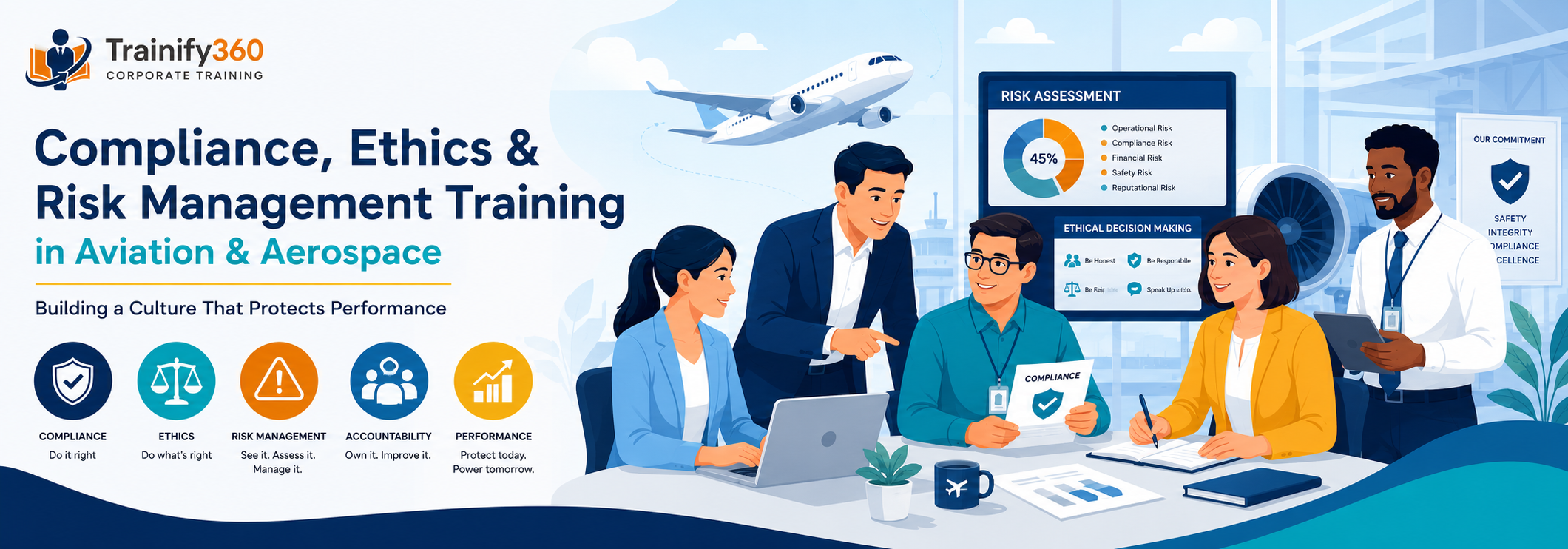
Compliance, Ethics & Risk Management Training in Aviation & Aerospace: Building a Culture That Protects Performance
Walk through any aircraft manufacturing facility, maintenance hangar, airline operations centre, or aerospace engineering office, and one thing hits you almost immediately: precision is everywhere. Every inspection follows a documented process. Every component is traceable. Every maintenance task gets recorded, and every engineering decision sits inside a framework of strict regulatory standards.
These systems didn't appear by accident. Aviation has learned, often the hard way, that consistency saves lives.
And yet, despite comprehensive regulations, sophisticated technology, and genuinely skilled people, compliance failures still happen. Almost never because someone deliberately ignored a procedure. More often, they start with something much smaller , a decision that, in isolation, barely registers as a decision at all.
Someone assumes a colleague has already completed a verification. A procedural shortcut gets taken because time is short. An employee notices something that doesn't look quite right but decides it probably isn't serious enough to flag. A supervisor postpones a difficult conversation because the production schedule feels more urgent right now.
None of these moments look risky on their own. Put enough of them together, though, and you get exactly the kind of operational risk that no amount of technology can fully engineer away. This is why the aviation and aerospace organisations that consistently perform well have stopped treating compliance as a department, or a checklist. They treat it as culture. And culture, as every HR leader already knows, is built through people not policy documents.
Compliance Has Quietly Become a Strategic Capability
Most organisations still associate compliance training with the mandatory annual e-learning module. Someone completes the course, a certificate gets generated, the requirement is marked done. From a regulatory standpoint, the box is ticked. From a business standpoint, not much has actually changed.
Real compliance doesn't show up on a completion dashboard. It shows up in the hundreds of small decisions employees make every day , how confidently they raise a concern, how consistently they follow procedure when nobody's watching and the pressure is on, how a leader actually responds the moment a risk surfaces.
For CHROs, HR Directors, Chief Learning Officers, and L&D leaders, that's the real opportunity here. Compliance training shouldn't be designed purely as regulatory education. It should be designed to sharpen organisational judgement. The organisations that consistently outperform their peers have understood something the rest are still catching up on: ethical decision-making, accountability, and risk awareness aren't compliance topics. They're operational ones, and they show up directly in reliability, customer confidence, employee engagement, and business resilience.
Why Compliance Keeps Getting More Complicated
Aircraft are more connected than they've ever been. AI is now supporting predictive maintenance decisions. Digital twins are reshaping how engineering teams work. Supply chains stretch across continents, and remote collaboration is simply how work happens now.
Every one of these advances opens up genuine opportunity. Every one also introduces a new kind of risk. Employees today are making judgment calls involving cybersecurity, digital data handling, supplier governance, intellectual property, sustainability requirements, AI-assisted decisions, and an increasingly tangled web of international regulation often without realising that's what they're doing.
Compliance, in other words, is no longer just about knowing the aviation standards. It's about understanding how business ethics, technology, operational risk, and regulatory expectation intersect, and that kind of understanding doesn't come from a once-a-year certificate. It comes from continuous learning. The organisations getting this right have shifted their investment from compliance awareness to genuine capability-building, because their real goal was never just avoiding a fine. It's building a workforce that can make sound calls in situations where the policy manual simply doesn't have an answer.
Ethics Shapes Decisions Long Before Any Policy Does
Policies define what's acceptable. Culture decides whether people actually follow that, especially when nobody's checking. That distinction matters more than most organisations give it credit for.
Every company has documented procedures. Far fewer have employees who feel genuinely comfortable questioning a decision that seems inconsistent with them. Ethics training, done well, isn't about memorising a code of conduct, it's about building judgement. Employees need the confidence to spot a potential conflict of interest, understand why a shortcut today creates a bigger problem down the line, push back on questionable behaviour respectfully, and make calls that protect both the customer and the organisation.
The strongest ethical cultures I've seen aren't built on fear of disciplinary action. They're built on trust the quiet, accumulated belief that raising a concern will be met with support rather than defensiveness, and that leaders will actually behave the way they say they expect others to. That consistency is what creates psychological safety, and psychological safety remains one of the strongest predictors of a healthy reporting culture in any safety-critical industry.
Risk Management Isn't a Department. It's Everyone's Job.
One of the more significant shifts happening across aerospace right now is the recognition that risk can't live exclusively inside quality or safety functions anymore. Everyone manages some version of it. Engineers weigh design trade-offs. Maintenance teams flag potential mechanical issues before they become failures. Supply chain professionals size up vendor reliability. Project managers balance delivery pressure against operational reality. HR manages organisational capability. IT watches for cybersecurity exposure. Senior leaders make strategic calls that shape the organisation's resilience for years to come.
Every one of those decisions carries risk, whether or not the person making it thinks of it that way. The most resilient organisations make sure people understand not just what decisions they're expected to make, but how to actually think about risk before they make them. That's a different kind of training entirely one built around critical thinking, structured decision-making, and accountability, not procedural memorisation. And it's what allows an organisation to respond to problems proactively instead of scrambling after the fact.
Compliance Culture Starts at the Top , Whether Leaders Intend It To or Not
Every organisation has compliance policies. What separates the ones that merely meet regulatory requirements from the ones that consistently perform well almost always comes down to leadership behaviour.
Employees watch what their managers do far more closely than they read what the policy says. If a leader skips a step to save time, the team quietly concludes that the procedure is optional. If a manager brushes off a concern raised by someone on the front line, reporting dries up not because people stop noticing problems, but because they stop believing it's worth saying anything. On the other hand, when leaders talk openly about ethical dilemmas, invite questions instead of deflecting them, and actually follow the same process they expect from everyone else, that sends its own message, loud and clear: compliance isn't a department's job. It's everyone's.
This is exactly why leadership development and compliance training shouldn't be treated as separate initiatives. Managers need the skill to spot emerging risk, respond constructively when someone raises a concern, and hold the line on safety and integrity even when operational pressure is pushing the other way. For L&D teams, that means designing programmes that go well beyond the regulation itself, and focus instead on the leadership behaviours that reinforce good judgement day to day.
Building a Genuinely Ethical Workplace
Ethics tends to get discussed purely in terms of preventing misconduct, but its real value runs deeper than that. A strong ethical culture creates consistency employees know roughly what's expected of them even in the grey areas where policy doesn't give a clean answer.
That matters enormously in aviation and aerospace, where operational decisions constantly involve competing priorities: delivery schedules, customer expectations, budget pressure, supplier constraints, regulatory obligation, often all at once. A genuinely ethical workforce understands, almost instinctively, that a short-term win isn't worth trading away long-term trust.
The organisations that build this mindset well don't rely solely on an annual code-of-conduct module. They create space for people to talk through realistic scenarios, sit with difficult decisions, and actually understand the business impact of the choice in front of them. Those conversations build judgement in a way that reciting rules never quite manages, and over time, employees get noticeably more confident making decisions that protect customers, colleagues, and the organisation's reputation not because they memorised a rulebook, but because they've practised the thinking.
Compliance Shouldn't Only Show Up Before an Audit
Plenty of organisations become intensely focused on compliance in the weeks before an external audit. Documentation gets reviewed, records get tidied up, training completion suddenly matters a great deal. Then the audit ends, and attention drifts elsewhere.
The higher-performing organisations don't work this way. For them, compliance is baked into daily operations rather than concentrated around the audit calendar. Managers bring lessons learned into regular team meetings. Risk assessment becomes part of how a project gets planned, not a separate exercise bolted on afterward. Near misses and operational observations get reviewed regularly, treated as learning material rather than evidence for blame.
That continuous rhythm builds real operational discipline, because compliance stops being a periodic event and becomes simply how the business runs. More importantly, it means organisations tend to spot their own risks before a regulator or a customer does it for them.
Making Training Actually Change Behaviour
Here's the problem most compliance programmes run into: employees remember the course just long enough to pass the assessment, then the learning quietly evaporates a few months later. Changing that requires a genuinely different approach, not just a better module.
The aerospace organisations getting real traction combine several learning methods rather than leaning on one. Scenario-based workshops let people actually practise responding to a realistic ethical dilemma, rather than just reading about one. Facilitated discussions give teams a structured way to unpack a recent operational challenge and talk through what a better response might have looked like. Manager-led coaching reinforces the right behaviours in the flow of everyday work, where it actually counts. Short, regular digital sessions keep reinforcing the learning throughout the year instead of cramming it into a single annual event.
Perhaps most usefully, the strongest programmes get employees reflecting on situations they've actually lived through. That's what makes the learning stick .when someone can connect a compliance principle to something they ran into last Tuesday, they're far more likely to apply it the next time it matters.
Where HR and Learning Leaders Fit Into This
For HR leaders and Chief Learning Officers, compliance training deserves a bigger seat at the strategy table than it usually gets. It isn't just a regulatory obligation to satisfy, it's a genuine investment in organisational capability, and one with a fairly direct line to business outcomes.
Strong compliance cultures reduce operational disruption because people catch issues earlier. They strengthen customer confidence, since organisations that demonstrate consistent governance simply come across as more trustworthy partners. They improve engagement, because people tend to stay longer and work harder somewhere that feels fair and transparent. And they build resilience, because teams facing uncertainty tend to make better calls when they've actually practised making them.
Getting there requires HR and L&D to work closely with operational leaders identifying where behavioural risk actually shows up, understanding where compliance challenges keep recurring, and designing interventions around the real conditions employees are working in, not a generic template. When compliance education lines up with operational reality, it stops being a box-ticking exercise and starts genuinely strengthening performance.
Measuring What Actually Matters
Compliance programmes have traditionally leaned on completion rates as the main measure of success. Participation is worth tracking, certainly, but most executive leaders now want to know something more useful: is any of this actually changing behaviour?
A few indicators tend to tell that story far better than a completion percentage ever could, a rise in near-miss and safety-observation reporting, fewer repeat findings in audits, a drop in operational errors traceable to procedural shortcuts, greater employee confidence in speaking up, stronger leadership engagement in ethics conversations, better cross-functional collaboration during risk assessments, and steadier regulatory readiness across the year rather than a scramble right before the audit.
These signals paint a much clearer picture of organisational maturity than attendance ever could, and they give L&D something concrete to point to when demonstrating its contribution to the business not just "we ran the training," but "here's what changed because of it."
Getting Ready for the Risks Just Over the Horizon
Aviation and aerospace compliance is expanding well past its traditional boundaries. Organisations are now navigating risk tied to artificial intelligence, cybersecurity, environmental sustainability, digital engineering, data privacy, and supply chains that span the globe.
That shift is changing what compliance actually asks of employees. It's no longer enough to follow the procedure in front of you. People now need to interpret data responsibly, understand the ethical weight of AI-assisted decisions, protect sensitive information properly, and recognise risks that simply didn't exist a few years ago.
Future-ready programmes need to widen their scope accordingly, building capability in areas like ethical decision-making in AI-supported environments, cybersecurity awareness for operational teams, responsible data handling and privacy practice, risk identification and escalation, regulatory awareness across global operations, business integrity and anti-bribery practice, supply chain governance and third-party risk, and personal accountability in safety-critical settings. None of these sit in isolation. Together, they shape whether an organisation can keep operating responsibly while the technology and the regulation around it keep shifting underneath it.
Compliance as a Genuine Competitive Advantage
Plenty of organisations still treat compliance as something they're obligated to do. The ones leading their sector see it rather differently. A strong compliance culture does more than satisfy a regulator, it strengthens customer confidence, builds trust with the people overseeing your industry, protects reputation, reduces disruption, sharpens decision-making, and supports resilience over the long haul.
For aviation and aerospace specifically, that matters more each year. Customers expect their suppliers to demonstrate strong governance. Regulators expect transparency as a baseline, not a bonus. Investors are paying far closer attention to ESG performance than they were even a few years ago. And business partners increasingly want assurance that ethical standards run through the entire supply chain, not just the parts they can see. Organisations with mature compliance cultures are simply better positioned to meet all of that, because responsible behaviour is already how they operate not something bolted on for appearances.
What CHROs and L&D Leaders Should Focus On Next
The challenge in front of most HR and Learning leaders isn't delivering more compliance training. It's delivering training that actually changes behaviour, and that starts with understanding where the organisation's real risk sits not just from a regulatory angle, but from a people one.
A few questions worth sitting with: Do employees genuinely feel safe reporting a concern, without worrying it'll come back on them? Are managers actually equipped to have a real conversation about ethics and accountability, or just to forward a policy link? Where does operational pressure create the strongest temptation to cut a corner? Do contractors and suppliers understand compliance expectations as clearly as internal teams do? And is the learning built around real operational scenarios, or just generic examples that could apply to any industry?
Working through those questions honestly is what lets an organisation design something that addresses its actual risk, rather than defaulting to standardised content that people forget within the month. The most effective compliance strategies weave learning into everyday work, so ethical thinking and risk awareness become part of how decisions get made routinely not an occasional reminder that shows up once a year.
Final Thoughts
Aviation and aerospace have earned their reputation the hard way through rigorous standards, disciplined process, and an unwavering commitment to safety. Those foundations aren't going anywhere, and they shouldn't.
But as the technology and the operating environment keep getting more complex, strong systems and detailed regulation aren't quite enough on their own anymore. Organisations need people who understand not just what the rules are, but why they exist in the first place. They need leaders who show integrity through what they do, not just what they say. And they need employees who notice risk, speak up about it, and make the sound call even when nobody's watching.
That's what turns compliance into something closer to instinct than obligation. For CHROs, HR Directors, Chief Learning Officers, and business leaders, investing in compliance, ethics, and risk management training isn't really about avoiding penalties anymore. It's about strengthening organisational capability, protecting reputation, and building a workforce that can carry the business forward sustainably.
At Trainify360, we help aviation and aerospace organisations build compliance capability that goes well beyond the regulatory minimum. Our learning solutions bring together behavioural development, leadership capability, ethical decision-making, and risk awareness, so that safety, accountability, and operational excellence end up reinforcing each other rather than competing for attention.
Because the strongest organisations were never just compliant. They're the ones where people consistently choose to do the right thing even when no one's checking.
Frequently Asked Questions
1. Why is compliance training essential in the aviation and aerospace industry? It helps employees understand regulatory requirements while building the judgement needed to make safe, ethical, and responsible decisions under real conditions. Done well, it reduces operational risk, strengthens governance, and supports steadier business performance overall.
2. How is ethics training different from compliance training? Compliance training centres on understanding laws, regulations, and internal policy. Ethics training builds the judgement needed for the situations policy doesn't fully cover. The two work best together, not as substitutes for one another.
3. What role does HR and L&D play in strengthening compliance? HR and Learning leaders help embed compliance into culture designing learning experiences that actually reflect the business, supporting leadership development, reinforcing the right behaviours, and making sure learning ties back to business objectives rather than regulatory box-ticking alone.
4. How can organisations measure the effectiveness of compliance training? Beyond completion rates, it's worth tracking audit outcomes, safety-observation reporting, employee confidence in raising concerns, reductions in procedural deviation, leadership engagement in ethics conversations, and overall risk management performance.
5. Why should aviation and aerospace organisations invest in risk management training? Because it helps people catch potential issues early, weigh operational risk more effectively, and make informed decisions that protect safety, compliance, reputation, and long-term business performance often in moments where there isn't time to consult a manual.
About Trainify360
Trainify360 partners with enterprise organisations to strengthen workforce capability through practical, business-focused learning. Our programmes span Compliance, Ethics & Risk Management, Leadership Development, Behavioural Skills, Workplace Effectiveness, and AI Readiness all designed to tie learning to measurable business outcomes.
We work alongside CHROs, HR Directors, Chief Learning Officers, L&D Heads, and business leaders to build learning journeys that strengthen organisational capability, reinforce ethical leadership, and prepare teams for what's coming next.
Train Smarter. Grow Faster. Lead with Confidence.
Website: www.trainify360.com Email: Contact@trainify360.com
Call to Action
A culture of compliance isn't built through annual certifications alone. It takes leaders who model integrity, employees who understand risk, and learning programmes that actually shape everyday decision-making.
If your organisation is looking to strengthen compliance, ethics, governance, or risk management capability across aviation and aerospace teams, Trainify360 can help. Our customised corporate learning solutions are built to develop confident leaders, accountable employees, and resilient organisations meeting regulatory expectations while driving long-term business performance.