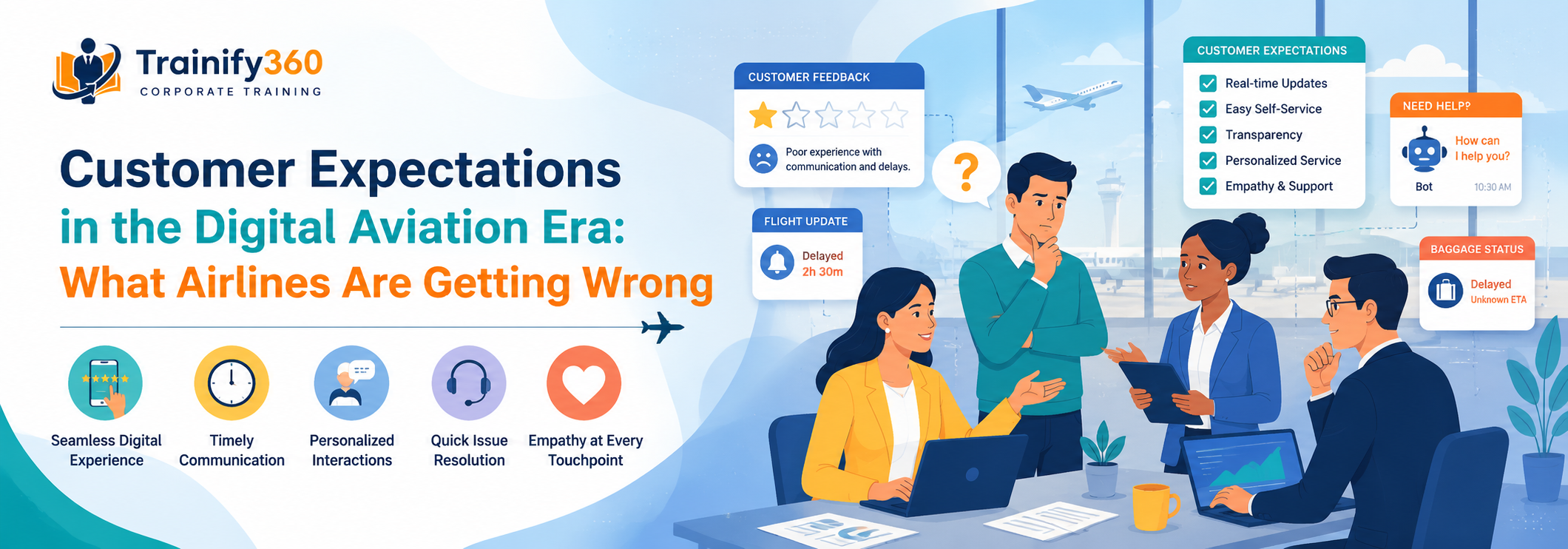
Customer Expectations in the Digital Aviation Era: What Airlines Are Getting Wrong
A few months ago, I sat in a workshop with the L&D team of a mid-sized regional airline. Their app had just been redesigned. Self-service kiosks were rolling out at three more airports. Chatbots were handling nearly 40% of first-touch queries.
On paper, it looked like a modern airline. Then their Head of Customer Experience said something that stuck with me: "Our technology has moved five years ahead of our people."
That single sentence explains most of what's going wrong in aviation customer service right now. The industry has spent heavily on digital infrastructure. It has spent far less on preparing the people who sit at the intersection of that infrastructure and a frustrated, delayed, or simply confused passenger.
Passengers Aren't Comparing You to Other Airlines Anymore
This is the part most airline leadership teams still underestimate.
A passenger booking a flight isn't measuring your check-in process against a competing airline's check-in process. They're measuring it against the last food delivery app they used, the last bank transfer they made, the last hotel booking they completed in ninety seconds flat.
That's the real benchmark now. Speed, personalisation, and effortlessness set by companies entirely outside your industry.
So when a passenger hits a broken self-check-in kiosk, or waits eleven minutes for a chatbot to connect them to a human finally, the disappointment isn't measured against "typical airline service." It's measured against everything else in their digital life that worked instantly.
A few shifts worth naming plainly:
- Passengers expect real-time, accurate flight status, not vague delay announcements.
- They expect one consistent experience across app, website, and airport counter, not three disconnected systems.
- They expect staff to have already context: booking history, loyalty tier, prior complaints — without having to repeat themselves.
- They expect resolution, not just acknowledgement, when something goes wrong.
None of this is unreasonable. It's just new, and it demands a different kind of employee than the ones most airlines trained five years ago.
The Skills Gap Nobody Budgeted For
Here's where it gets uncomfortable for HR and L&D leaders.
Most frontline aviation staff were trained for a world of scripted service — check the boarding pass, confirm the bag tag, follow the standard operating procedure. That training still matters. Compliance and safety protocols aren't going anywhere.
But layered on top of that, staff are now expected to:
- Navigate digital systems fluently, not just use them, but troubleshoot them in real time when a passenger's app fails at the gate.
- Read emotional cues fast: a delayed passenger at hour three of a wait behaves very differently from one at hour one, and staff need to adjust tone accordingly.
- Own a problem end-to-end: passengers hate being bounced between departments almost as much as they hate the original delay.
- Use data without being trained on data: many staff have access to CRM and loyalty information they were never formally taught to interpret or act on.
This is where the gap sits. Not in a lack of technology, and often not in a lack of effort from frontline teams, but in a training model that hasn't caught up to what the job actually requires now.
Why Traditional Training Programs Fall Short Here
A lot of airline training still follows a fairly rigid format: classroom sessions, a compliance module, an annual refresher. It works reasonably well for procedural knowledge. It works poorly for judgment-based skills like de-escalation, digital troubleshooting, or reading a passenger's emotional state.
The truth is that a once-a-year workshop cannot prepare someone for the two hundred small, unscripted decisions they'll make during a single irregular operations day.
What tends to work better, based on what we've seen across aviation and travel clients:
- Scenario-based microlearning delivered in short bursts, tied to real situations staff actually encounter a system outage, a missed connection, an angry loyalty-tier passenger.
- Blended digital-and-human training, so staff aren't just learning the technology but learning how to recover gracefully when it fails.
- Manager-led coaching moments, built into shift huddles rather than separate training calendars, so learning happens close to the job.
- Cross-functional shadowing, where frontline staff spend time understanding what happens on the digital and operations side, so they can explain delays or issues with real context instead of a vague apology.
None of this requires reinventing an airline's entire L&D function. It requires being honest about where the current model is thin, and rebuilding those specific pieces with intent.
What This Means for CHROs and CLOs Right Now
If you're leading HR or L&D for an aviation or travel business, the conversation with your executive team needs to shift slightly. It's no longer just "how do we train staff on the new system?" It's "how do we train staff to be the recovery mechanism when the system, the weather, or the schedule doesn't cooperate?"
That reframing matters because it changes what you measure. Instead of only tracking module completion rates, it's worth tracking:
- Time to resolution on escalated passenger issues
- Repeat complaints from the same passenger within a single journey
- Staff confidence scores when handling digital-system failures
- Net Promoter Score movement tied specifically to service recovery moments, not just on-time performance
These are the metrics that tell you whether training is actually changing outcomes, not just attendance.
The Real Opportunity Here
There's a version of this story where airlines simply keep adding technology and hope service quality catches up on its own. It rarely does. Technology reduces friction for the ninety per cent of journeys that go smoothly. Training determines what happens in the ten per cent that don't, and that ten per cent is exactly where loyalty is won or lost.
The airlines getting this right aren't necessarily the ones with the newest app. They're the ones whose staff can stand in front of a stressed, delayed passenger and turn a bad day into a manageable one. That's a trainable skill. It just needs a training model built for 2026, not one carried over from a decade ago.
Key Takeaways
- Passenger expectations are shaped by every digital experience they have, not just other airlines.
- The real skills gap sits in judgment, troubleshooting, and emotional handling not basic procedure.
- Annual, classroom-heavy training doesn't match how frontline decisions actually get made.
- Scenario-based, manager-supported, continuous learning closes this gap far more effectively.
- Measure resolution and recovery, not just completion rates.
If your frontline teams are confident with the systems but still struggling when things go wrong, that's usually a training design problem, not a people problem. Trainify360 works with aviation and travel businesses to close exactly this gap. If you'd like to talk through what that could look like for your teams, we're happy to have that conversation.
Frequently Asked Questions
Q: Why are customer expectations changing so fast in the aviation industry specifically? Passengers now compare airlines to every other digital service they use daily — banking apps, food delivery, retail checkouts — not just to competing airlines. That cross-industry comparison is what's driving the pace of change.
Q: What's the biggest training gap in airline customer service today? It's rarely technology literacy on its own. The bigger gap is judgment under pressure — knowing how to recover a situation when a system fails, a flight is delayed, or a passenger is visibly frustrated.
Q: How often should frontline aviation staff be retrained? Continuously, in small doses, rather than through a single annual session. Short, scenario-based refreshers tied to real situations tend to stick far better than long infrequent workshops.
Q: Can technology alone fix the customer experience problem? No. Technology reduces friction when things go right. It's trained staff who determine the outcome when things go wrong, and that's often where loyalty is decided.
Q: What should CHROs measure to know if training is working? Look beyond completion rates. Track resolution time, repeat complaints within a journey, and staff confidence in handling digital-system failures.