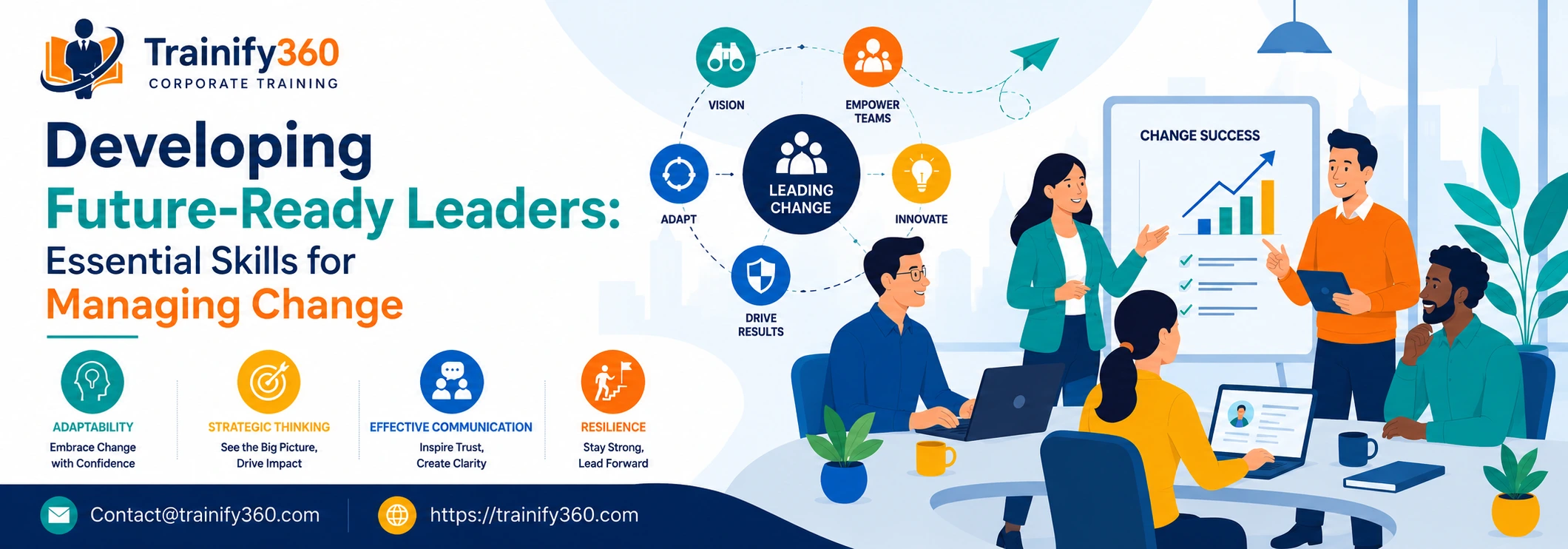
Developing Future-Ready Leaders: Essential Skills for Managing Change
There was a time when organisations could develop leadership capability based on relatively predictable business conditions.
Markets changed gradually. Technology adoption followed a manageable pace. Organisational structures remained stable for years, sometimes decades. Leaders were expected to deliver results, manage teams effectively, and execute business strategy within relatively well-defined environments. That reality no longer exists.
Today, most organisations operate in a state of continuous adjustment. New technologies emerge before existing ones are fully embedded. Customer expectations shift rapidly. Workforce dynamics continue to evolve. Business leaders are expected to manage performance while simultaneously navigating uncertainty, transformation, and increasing complexity.
In conversations with HR leaders and executives across industries, one challenge consistently emerges regardless of company size or sector: leadership capability has become one of the most significant factors determining whether organisational change succeeds or fails.
Technology can be implemented. Processes can be redesigned. Operating models can be restructured. But none of these initiatives deliver lasting value unless leaders can bring people through change effectively.
This is why leadership development has moved well beyond being simply an HR or learning initiative. It has become a business priority.
The question organisations should be asking is not whether they have leaders. It's whether they have leaders who are prepared for the environment they are now operating in.
Why Many Traditional Leadership Approaches Are Struggling
For many years, organisations followed a fairly logical leadership development model.
Employees who demonstrated strong technical expertise, operational excellence, or commercial performance were promoted into management positions. Leadership development then focused on helping them improve planning, execution, performance management, and operational oversight.
In stable business environments, this approach worked remarkably well. The challenge is that today's leaders are expected to operate in conditions that are anything but stable.
They are leading hybrid teams, responding to economic uncertainty, managing workforce expectations, adopting emerging technologies, and making decisions in situations where complete information rarely exists.
As a result, organisations often discover that highly capable managers struggle when confronted with ambiguity, rapid change, and competing priorities. This isn't because they lack talent. More often, it's because they were prepared for a different kind of leadership challenge.
The leadership capabilities required for the next decade will look very different from those that shaped successful careers over the previous two decades.
Adaptability Has Become a Defining Leadership Characteristic
If there is one characteristic that consistently distinguishes effective leaders during periods of disruption, it is adaptability. Adaptable leaders don't necessarily have all the answers. In fact, they rarely do.
What they do possess is the ability to remain open, curious, and composed while navigating uncertainty. They adjust their approach when circumstances change, encourage experimentation, and help others maintain confidence during difficult periods.
Employees pay close attention to how leaders respond when things don't go according to plan.
When leaders become defensive, resistant, or visibly overwhelmed, uncertainty spreads quickly throughout teams. Conversely, when leaders demonstrate calm judgement and openness to change, employees are far more likely to remain engaged and productive.
One observation that emerges repeatedly during organisational transformation programmes is that employees don't usually resist change itself. They resist uncertainty.
Strong leaders help reduce that uncertainty by providing clarity where possible, acknowledging ambiguity when necessary, and maintaining honest communication throughout the process.
Developing adaptability isn't something that can be taught through a single workshop or leadership seminar. It requires experience, coaching, reflection, and exposure to increasingly complex business challenges.
The organisations developing the strongest leadership pipelines today are intentionally creating opportunities for leaders to work outside their comfort zones long before major business disruptions occur.
Strategic Thinking Distinguishes Leadership From Management
One of the clearest differences between effective management and effective leadership lies in perspective.
Managers naturally focus on execution. They solve problems, deliver results, manage resources, and ensure operational performance. Leaders must do all of this while also considering broader organisational implications.
They need to understand how market trends affect strategy, anticipate risks before they become significant issues, and balance immediate business demands with long-term organisational objectives.
This ability to think beyond day-to-day operations has become increasingly important as business environments become more complex.
Future leaders need to develop the ability to:
- Understand changing market conditions
- Identify strategic risks and opportunities
- Connect business decisions to organisational strategy
- Make informed decisions despite uncertainty
- Balance competing stakeholder priorities
Unfortunately, many organisations postpone strategic leadership development until employees reach senior leadership roles.
By that point, leaders are often expected to think strategically without having had sufficient opportunities to develop those capabilities earlier in their careers.
Strategic thinking, however, is not an innate capability reserved for executives. Like any leadership skill, it can be developed through experience, mentoring, structured learning, and exposure to increasingly complex business scenarios.
Organisations that intentionally build strategic capability throughout their leadership pipeline often demonstrate greater organisational resilience and adaptability.
Communication Becomes More Important When Certainty Declines
Periods of organisational change create one immediate need among employees: information.
When communication is inconsistent, incomplete, or unclear, people naturally begin filling those gaps themselves. Rumours emerge, anxiety increases, and trust can erode surprisingly quickly.
This is why communication should never be viewed as a secondary leadership competency. Future-ready leaders need to communicate with clarity, empathy, transparency, and consistency. Employees don't simply want to know what decisions have been made. They want to understand why those decisions were made, what they mean for the business, and how they affect people personally.
Equally important, effective communication during change involves listening.
Employees need opportunities to ask questions, express concerns, and challenge assumptions. Leaders who create that environment foster psychological safety, strengthen trust, and improve organisational performance.
Trust remains one of the most valuable assets any organisation possesses during periods of change. And leaders play the single greatest role in building it.
Emotional Intelligence Has Become a Business Capability
For many years, emotional intelligence was often described as a "soft skill." That description no longer reflects reality.
The ability to understand people, manage emotions, build relationships, and respond effectively under pressure has become a fundamental leadership capability.
Organisational change affects employees differently. Some individuals embrace uncertainty, while others experience stress, anxiety, or resistance.
Future-ready leaders recognise these differences and adjust their approach accordingly. Employees don't necessarily expect leaders to eliminate uncertainty. What they expect is authenticity, empathy, and support.
Leaders who demonstrate emotional intelligence consistently build stronger teams, improve employee engagement, and create healthier organisational cultures.
As organisations continue to navigate increasingly complex environments, these human capabilities may ultimately become the greatest differentiator between effective leaders and ineffective ones.