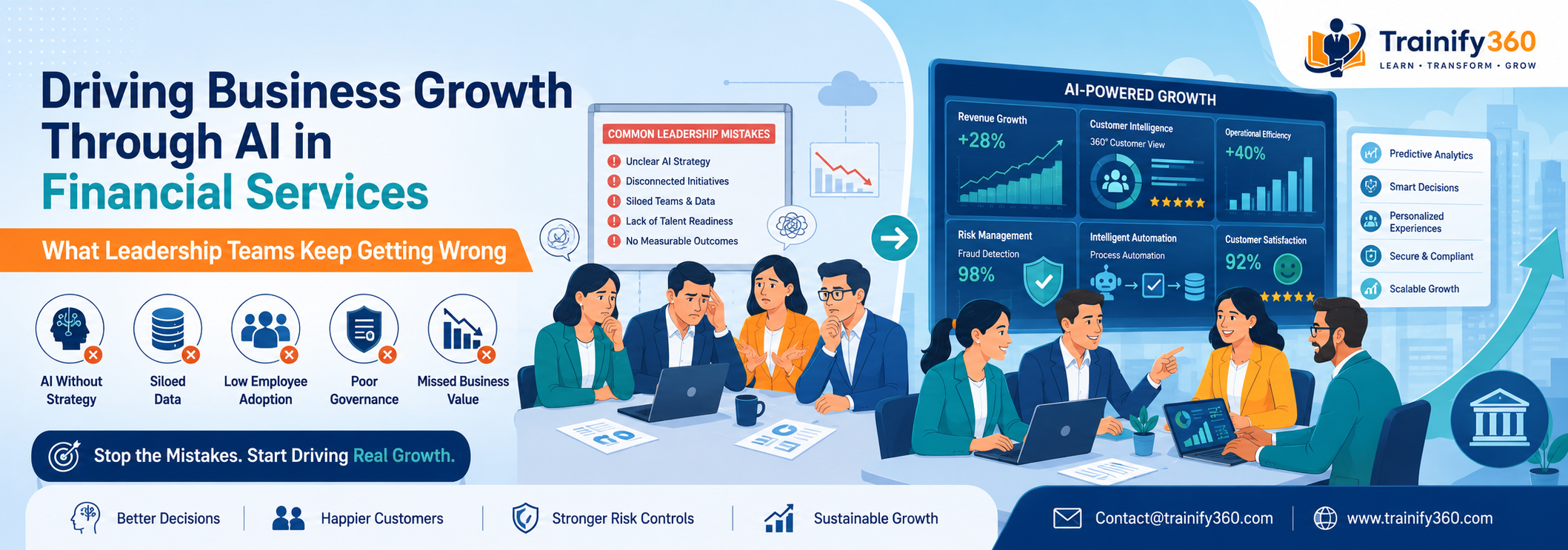
Driving Business Growth Through AI in Financial Services: What Leadership Teams Keep Getting Wrong
I was on a call a while back with the CHRO of a mid-sized lending firm. Her risk team had just gone live with an AI-based credit scoring model. Genuinely impressive technology: faster decisions, fewer manual errors, a real jump in underwriting speed that her CEO had been asking about for two years.
Then she said something I still think about. "Half my analysts don't trust the model," she told me, "and the other half trust it too much."
That one sentence sums up the problem better than any deck I could put together. Financial services firms are moving quickly on AI adoption. They're moving a lot more slowly on preparing the people who sit next to that AI every day, making the calls the model itself can't make.
The Growth Story Everyone Tells, and the Part They Skip
Sit through almost any board conversation about AI in banking, insurance, or wealth management, and you'll hear roughly the same pitch. Faster loan approvals. Better fraud detection. Product recommendations tailored to each customer. Lower cost to serve.
All of that is real. All of it is achievable.
What doesn't get talked about nearly enough is that none of it shows up automatically the day the system goes live. It shows up when a relationship manager can use an AI-generated insight in a client conversation without sounding like they're reading a script. It shows up when someone in compliance is willing to push back on a model's output instead of waving it through because the system said so. It shows up when a branch manager can sit across from a nervous customer and explain, in plain terms, why a decision went the way it did instead of shrugging and blaming "the system."
Growth from AI in this industry isn't really a technology outcome. It's a behaviour outcome. And behaviour change has always belonged to L&D before it ever belongs to IT.
Why Trust Is Harder to Earn Here Than in Most Industries
Financial services carries a weight that retail or media simply doesn't. Get a recommendation wrong on a shopping app, and someone's mildly annoyed. Get a decision wrong at a bank or an insurer, and it can touch a mortgage, someone's savings, the retirement they've spent thirty years building toward.
That weight shows up in a few specific ways once you're inside these organisations. There's the regulatory piece: every AI-assisted decision still needs a human who can explain and stand behind it, not just rubber-stamp it and move on. There's client trust, since most customers still want a person involved when the stakes are high, whether that's a loan, a claim, or investment advice. And then there's something less official but just as real: plenty of staff who've spent fifteen or twenty years building their own judgment are naturally wary of a tool that seems to be second-guessing it.
None of that is a reason to slow AI adoption down. If anything, it's the opposite; it's exactly why firms need to be more deliberate about how their people are trained to work with it, not less.
The Same Three Gaps, Almost Every Time
I've worked with banking, insurance, and asset management clients over the past couple of years, and no matter which AI tool is involved, the same three gaps keep showing up.
The first is interpretation. Staff get trained on how to use a system where to click, which screen leads where but rarely on how to question what it's telling them. A relationship manager needs to know when a recommendation looks off and why, not just how to move to the next step in the workflow.
The second is communication, and it tends to hide in plain sight during most rollouts. When a customer asks "why was I declined," whoever's answering needs language that's honest, compliant, and reassuring, all at the same time. Very few training programs actually teach this. Most firms seem to assume it'll sort itself out on the job, which is a fairly costly assumption to be making.
The third is escalation judgment: knowing when a case needs to move from "AI-assisted" to "this genuinely needs a human to look at it properly." Right now, in most places I've seen, that call is left almost entirely to instinct rather than any real training, which is exactly why one branch will handle a borderline case completely differently from another, even under the same policy.
What Actually Closes These Gaps
Most firms already handle the technical side of an AI rollout reasonably well. Vendors help, internal IT teams help, and staff generally figure out where the buttons are within a week or two.
The part that's missing sits closer to judgment and conversation, and it's usually the part nobody's actually budgeted for. Case-based learning built from real, anonymised decisions tends to work far better than generic training examples, simply because people are practising on situations they'll genuinely face rather than something invented for a workshop.
Pairing senior staff with junior staff for the first few months after a rollout matters more than most firms realise; it's often the only thing standing between institutional judgment and it quietly disappearing during the transition. Escalation thresholds need to be taught explicitly instead of assumed, so a branch in one city handles a case the same way a branch in another would.
Role-play sessions built around AI-influenced customer conversations help too, and they need refreshing as often as the regulation and the tools themselves change. And training needs to happen more often, in shorter bursts, tied to actual model updates, rather than sitting on an annual calendar built for a much slower-moving world.
None of this is about putting the brakes on adoption. It's about making sure the money already spent on AI actually turns into the growth leadership is expecting, rather than getting quietly chipped away at by staff who don't trust the tool, or customers who don't trust the answer they've just been handed.
Making the Case to Your CEO or Board
If you're the one bringing this upward, how you frame it matters as much as what you say. This isn't a request for a bigger training budget. It's a straight line between workforce readiness and the return on an AI investment the board has already approved.
A handful of numbers will do more work here than "adoption rates" ever could. Staff confidence, measured before and after a rollout rather than assumed. Override and escalation rates, and whether they look consistent across teams.
Customer complaint themes tied specifically to AI-influenced decisions. And how long it actually takes a new hire to become competent working alongside these tools, compared with how long it used to take. These tie training directly to business risk and business growth, the two things that reliably get a board's attention.
Where the Real Opportunity Sits
The financial services firms that get real growth out of AI won't be the ones running the most advanced model. They'll be the ones whose people can work alongside that model with confidence, explain its decisions in a way customers actually believe, and know exactly when to step in and take over. That's not a technology capability. It's a workforce capability, and workforce capability gets built on purpose. It doesn't just show up because the software did.
Key Takeaways
AI-driven growth in financial services depends far more on how staff behave than on how sophisticated the system is. Trust problems show up at both extremes staff who dismiss the tool entirely and staff who lean on it too heavily- and cause roughly the same amount of damage.
The real skill gaps sit in interpretation, communication, and escalation judgment, not in basic navigation of the software. Case-based learning and clear escalation frameworks close these gaps far more reliably than generic technical onboarding ever will. And the numbers worth watching are confidence, consistency in override decisions, and complaint themes, not simply how many people clicked through a module.
If your teams already have the AI tools but not yet the confidence to use them well, that's a conversation worth having early, rather than after the first serious complaint lands on someone's desk. Trainify360 works with financial services organisations on exactly this kind of workforce readiness, and we're happy to talk through what that could look like for your teams.
Frequently Asked Questions
Why is AI adoption slower to translate into growth in financial services compared with other industries?
Because the stakes are higher for both customers and regulators, growth depends heavily on whether staff can interpret, explain, and defend AI-assisted decisions, not just operate the software.
What's the most overlooked skill gap when banks or insurers roll out AI?
Talking to customers about AI-influenced decisions in a way that's honest and reassuring at the same time. Most training covers the technical interface and stops right there.
Should experienced staff be trained differently than new hires on AI tools?
Generally, yes. Experienced staff usually need training that respects the judgment they've already built and shows them specifically where the AI adds value, rather than a beginner-level onboarding course.
How often should AI-related training be refreshed in this industry?
More often than the usual annual cycle. Models and regulatory guidance shift often enough that short, recurring refreshers tend to work better than one long session a year.
What actually shows whether AI training is working?
Staff confidence, consistency in escalation and override decisions across teams, and complaint themes tied to AI-influenced decisions tell you far more than simple completion or adoption numbers.