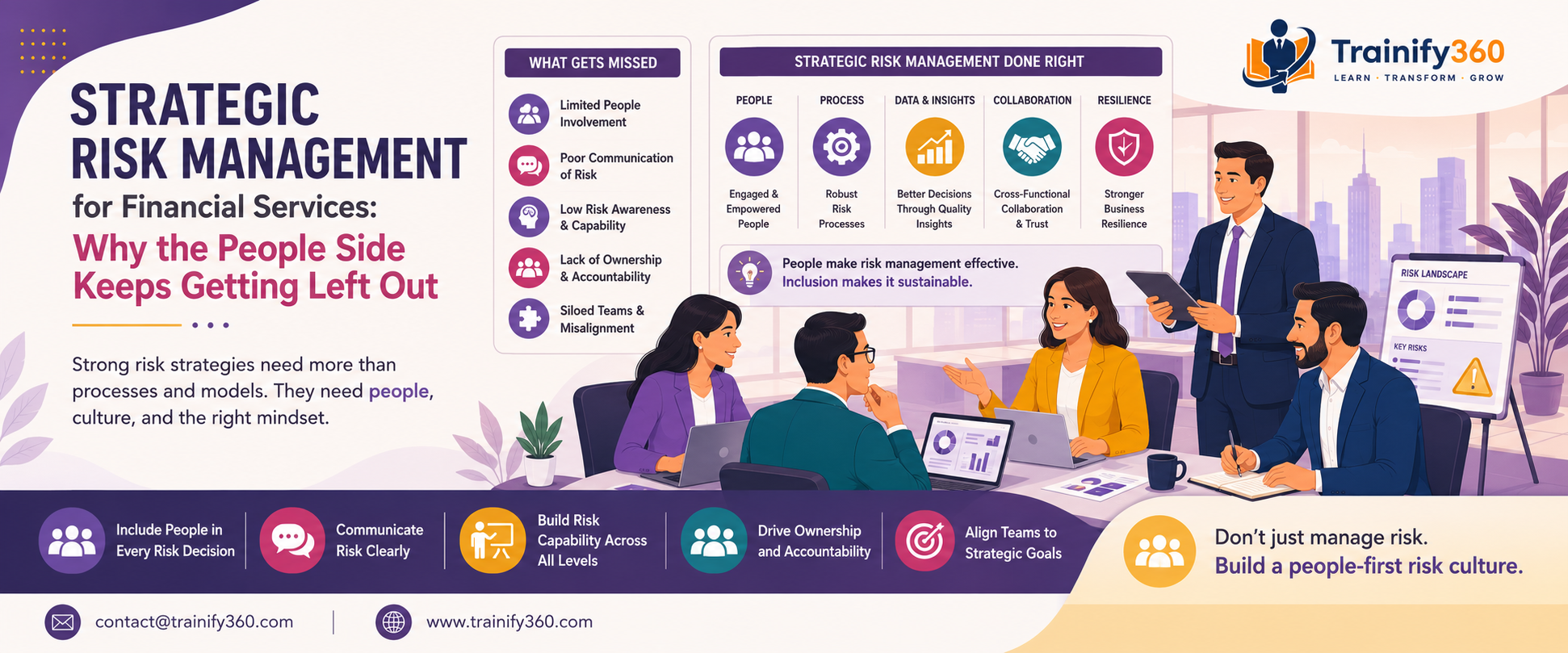
Strategic Risk Management for Financial Services: Why the People Side Keeps Getting Left Out
A Chief Risk Officer at a regional bank once told me their risk framework was "audit-proof but not people-proof." I asked what she meant, and she explained it in about ten seconds. Every control was documented. Every escalation path was mapped. Every policy had been signed off by the board. And staff still found ways around all of it, not out of malice, but because the framework had been built by people who understood risk modelling far better than they understood how staff actually behave under pressure.
That distinction matters more than most risk committees give it credit for. A framework can be technically flawless and still fail, because risk management isn't just a document sitting in a compliance folder. It's a set of decisions made by ordinary people, at speed, often under pressure, often with incomplete information. If those people haven't been trained to make good judgment calls in exactly those conditions, the framework is only as strong as its weakest untrained moment.
Risk Management Has Gotten More Sophisticated. Risk Culture Hasn't Kept Pace
Over the last decade, financial services firms have poured enormous resources into risk infrastructure. Better models, better data, better reporting lines, more granular controls across credit, market, operational, and conduct risk. Regulators have pushed for this, and firms have largely delivered.
What's happened alongside that, though, is a widening gap between how sophisticated the frameworks are and how well-equipped staff are to operate within them. A control is only effective if the person responsible for it understands why it exists, not just that it exists. A junior trader who's told "don't exceed this limit" behaves very differently from one who actually understands what happens downstream if that limit gets breached. The first follows a rule. The second exercises judgment, and judgment holds up far better under pressure than rule-following alone.
This is where L&D functions have a genuine role to play, and it's one that's often handed entirely to compliance teams instead. Compliance can teach people what the rules are. It's far less equipped to teach people how to think under the kind of ambiguity that actually produces risk events in the first place.
Where Risk Actually Breaks Down
Having sat in on a fair number of post-incident reviews across banking and insurance clients, the pattern is remarkably consistent. It's rarely a case of someone not knowing the rule. It's almost always a case of someone facing a situation the rule didn't clearly cover, and making a judgment call without the training or confidence to make a good one.
A relationship manager under pressure to hit a quarter-end target quietly stretches an exception that technically exists for a different purpose. A junior analyst notices something slightly off in a transaction but doesn't escalate it, partly because they're not confident enough in their own read of the situation, and partly because the escalation path feels heavier than the concern seems to warrant. A manager approves something slightly outside policy because a client relationship feels too important to risk friction over, telling themselves it's a one-off.
None of these people set out to create a risk event. Every one of them made a judgment call in a grey area, and the training they'd received hadn't prepared them for grey areas. It had prepared them for the black-and-white version of their job, which is precisely the version that rarely gets tested in practice.
What Strategic Risk Training Actually Needs to Cover
A lot of risk training in financial services is still built around what to do when a rule is clear. Far less of it addresses what to do when it isn't, and that's exactly the gap worth closing.
Training built around real, anonymised near-misses tends to be far more effective than generic case studies, simply because staff recognise the shape of the situation even if the details have been changed. It's the difference between "here's the policy" and "here's exactly the kind of moment where good people get this wrong, and here's how to think it through." The second version sticks.
Escalation confidence deserves far more attention than it typically gets. Most staff aren't held back from escalating because they don't know the process. They're held back because they're not sure their concern is significant enough to justify raising it, and nobody's ever explicitly told them that a false alarm costs almost nothing compared to a missed one. That reassurance needs to be built into training deliberately, not assumed as common sense.
Manager behaviour matters just as much as frontline behaviour, and this part gets skipped constantly. If a manager visibly rewards speed over caution, or reacts badly to a junior staff member raising a concern that turns out to be nothing, that manager has just taught their entire team to stop raising concerns. Risk training that only targets frontline staff while ignoring how managers respond to escalation is treating half the problem.
And judgment itself can be trained, more than most risk committees assume. Scenario-based exercises, decision simulations, and structured debriefs after real incidents all build the kind of pattern recognition that lets staff spot a grey area faster and respond to it with more confidence, rather than freezing or guessing.
Making This a Board-Level Conversation, Not Just a Training Line Item
If you're the one advocating for this internally, it helps to frame workforce risk readiness as a component of the broader risk appetite conversation, rather than a separate HR initiative competing for budget. Boards already think in terms of risk appetite and risk tolerance. Extending that thinking to ask whether the workforce is actually equipped to operate within stated tolerances is a natural next question, and one that's currently being skipped in most risk committee discussions.
A few things worth tracking to support that case: near-miss reporting rates, since a healthy increase often signals growing confidence to escalate rather than a worsening risk environment. Time between an issue arising and it being escalated, which tends to shrink noticeably once training addresses escalation confidence directly. And manager-level behaviour in response to escalations, which can be assessed through structured feedback rather than left as an assumption.
These give a risk committee something more useful than "training completion rates," because they connect workforce readiness directly to the metrics the board already cares about.
The Actual Opportunity Here
Firms that get strategic risk management right going forward won't necessarily be the ones with the most detailed policy documents. They'll be the ones whose people can recognise a grey area, feel confident enough to raise it, and trust that raising it won't be held against them. That's a cultural and training outcome as much as a governance one, and it deserves a seat in the risk conversation rather than being treated as something HR handles separately.
Key Takeaways
Risk frameworks have grown more sophisticated far faster than the training given to the people operating within them. Most risk failures happen in grey areas the policy didn't clearly address, not through ignorance of the rules. Escalation confidence and manager response to escalation matter as much as frontline knowledge. Judgment can be trained deliberately through scenario-based learning, rather than left to develop on its own. And workforce risk readiness belongs in board-level risk appetite conversations, not just training calendars.
If your risk framework looks solid on paper but you're not entirely confident it holds up under real pressure, that's usually a training and culture question worth examining early. Trainify360 works with financial services organisations on exactly this kind of risk-ready workforce development. Happy to talk through what that could look like for your teams.
Frequently Asked Questions
Why do risk failures still happen even when controls and policies are well documented? Most failures occur in situations the policy didn't clearly anticipate, where staff have to make a judgment call without enough confidence or training to make a good one.
Is risk training the same as compliance training? Not quite. Compliance training teaches staff what the rules are. Risk training needs to go further and teach staff how to think through situations the rules don't clearly cover.
Why do employees often hesitate to escalate concerns, even when they notice something is off? Usually because they're unsure whether the concern is significant enough to raise, and organisations rarely make clear that a false alarm costs far less than a missed one.
How much does manager behaviour affect risk culture? Significantly. If managers react poorly to escalations or visibly reward speed over caution, staff quickly learn to stop raising concerns, regardless of what official policy says.
How should risk-readiness training be measured? Near-miss reporting rates, time to escalation, and manager response patterns tend to be far more useful indicators than simple training completion rates.