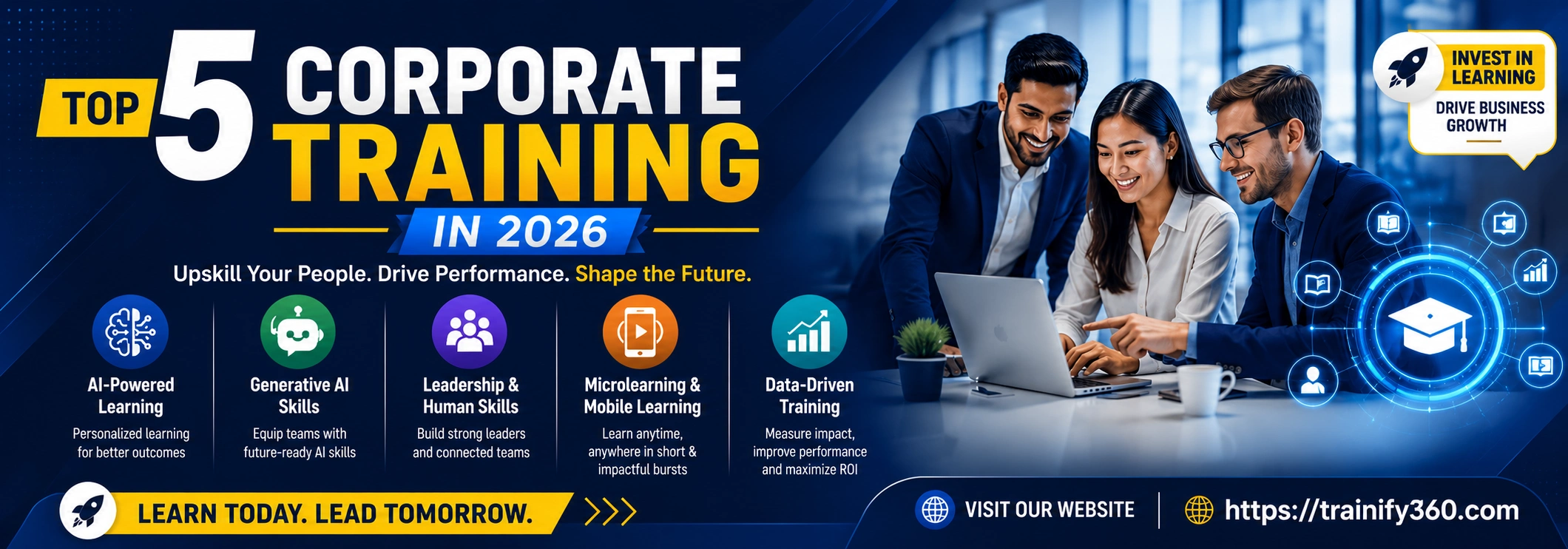
Corporate training in 2026 is evolving faster than ever. Companies are no longer investing in training just to complete compliance requirements — they are using it as a strategic tool to improve productivity, employee retention, leadership capabilities, and digital transformation.
With AI, hybrid work models, and rapid technological changes reshaping industries, organizations are focusing on training programs that deliver measurable business outcomes. Here are the top 5 corporate training trends dominating 2026.
1. AI-Powered Learning and Personalized Training
Artificial Intelligence is transforming corporate learning. Traditional “one-size-fits-all” training programs are being replaced with personalized learning journeys powered by AI.
AI-based Learning Management Systems (LMS) can now:
- Analyze employee performance
- Identify skill gaps
- Recommend customized learning paths
- Track progress in real time
Employees receive training based on their role, experience level, and career goals. This improves engagement and significantly increases learning effectiveness.
Organizations are also using AI tools for:
- Smart assessments
- AI chatbots for instant learning support
- Automated content creation
- Adaptive learning modules
In 2026, AI-driven training is becoming a core strategy for companies aiming to build future-ready workforces.
2. Generative AI and Prompt Engineering Training
As Generative AI tools become part of everyday business operations, companies are investing heavily in AI literacy programs.
Employees across departments — marketing, HR, sales, customer service, finance, and operations — are learning:
- Prompt engineering
- AI content generation
- AI-powered automation
- Workflow optimization
- Responsible AI usage
Businesses now expect employees to use AI tools productively rather than fear them.
Corporate training providers are designing specialized programs on:
- ChatGPT for business
- AI-assisted productivity
- AI for digital marketing
- AI-powered data analysis
- Automation using AI agents
In 2026, AI skills are becoming as essential as computer literacy once was.
3. Leadership and Human-Centric Skills Training
Even with automation and AI growth, human skills remain critical. Organizations are increasing investments in leadership and behavioral training to build emotionally intelligent teams.
The most in-demand human-centric training areas include:
- Emotional Intelligence
- Communication Skills
- Conflict Resolution
- Strategic Thinking
- Team Collaboration
- Change Management
- Decision Making
Companies recognize that technology alone cannot drive business success. Effective leaders who can motivate teams, manage change, and communicate clearly are more valuable than ever.
Leadership development programs in 2026 are also becoming more experiential through:
- Role-play simulations
- Gamified learning
- Coaching sessions
- Peer collaboration activities
Organizations are focusing on creating resilient leaders capable of managing hybrid and remote teams effectively.
4. Microlearning and Mobile Learning
Long classroom-style training sessions are losing popularity. Employees today prefer learning in short, focused, and easily accessible formats.
Microlearning delivers training in small modules such as:
- 5-minute videos
- Interactive quizzes
- Infographics
- Quick simulations
- Mobile-based lessons
This approach improves:
- Knowledge retention
- Employee engagement
- Learning flexibility
- Training completion rates
Mobile learning is also expanding rapidly because employees want to learn anytime and anywhere.
In 2026, organizations are increasingly using:
- Mobile LMS platforms
- Learning apps
- WhatsApp-based learning
- Short-form video learning
Microlearning works especially well for sales training, compliance, product knowledge, and soft skills development.
5. Data-Driven Training and ROI Measurement
Companies are no longer satisfied with training attendance reports. They want measurable business impact.
Modern corporate training programs now focus heavily on analytics and performance tracking.
Organizations are measuring:
- Employee skill improvement
- Productivity growth
- Sales performance
- Customer satisfaction
- Employee retention
- Training ROI
Advanced analytics tools help companies understand:
- Which training programs are effective
- Which employees need additional support
- How learning impacts business performance
Training providers are also adopting frameworks like:
- Kirkpatrick Model
- Bloom’s Taxonomy
- Learning Analytics Dashboards
In 2026, data-driven training decisions are becoming standard practice for high-performing organizations.
Final Thoughts
Corporate training in 2026 is becoming smarter, faster, and more business-focused. Companies are shifting from traditional training models to highly personalized, AI-powered, and measurable learning experiences.
The biggest trends shaping the future include:
- AI-powered personalized learning
- Generative AI and prompt engineering
- Leadership and behavioral skills development
- Microlearning and mobile learning
- Data-driven training measurement
Organizations that invest in continuous learning will have a significant competitive advantage in the rapidly changing business environment.
For businesses, corporate training is no longer just an HR activity — it is now a critical growth strategy.