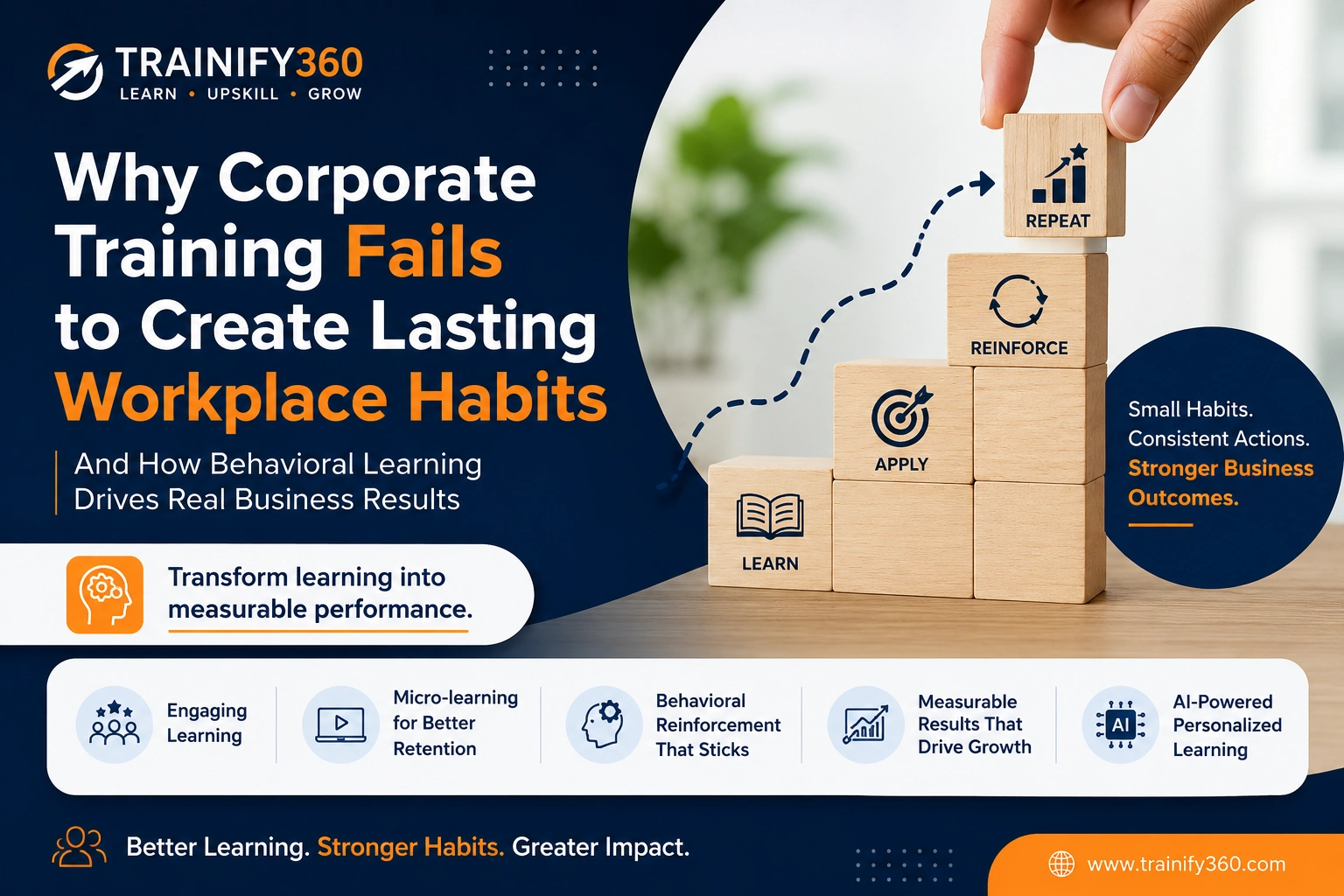
Why Corporate Training Fails to Create Lasting Workplace Habits — And How Behavioral Learning Drives Real Business Results
Most organizations invest heavily in corporate training programs.
Employees attend workshops.
Managers participate in leadership sessions.
Teams complete learning modules.
For a few days, motivation feels high.
Then reality returns.
Employees go back to old habits.
Learning adoption drops.
Training impact becomes difficult to measure.
This is one of the biggest challenges in modern workplace learning.
The problem is not that employees do not want to improve.
The real problem is that most corporate training programs focus on information instead of behavior.
And information alone does not create transformation.
At Trainify360, we believe sustainable employee development happens when learning becomes practical, repeatable, and easy to apply in daily work environments.
Because long-term business growth is not built through one-time motivation.
It is built through consistent workplace habits.
The Hidden Problem With Traditional
Corporate Training
Many organizations still approach employee training using outdated learning models.
The typical process looks like this:
- Conduct a training session
- Share presentations and theories
- Deliver large amounts of information
- Expect immediate implementation
But workplace behavior does not change that easily.
Employees already manage:
- Tight deadlines
- High workloads
- Constant communication
- Performance pressure
- Rapid technology changes
When learning feels overwhelming, employees struggle to apply new skills consistently.
As a result:
- Learning retention decreases
- Employee engagement drops
- Skill adoption slows down
- Training ROI becomes unclear
This is why many corporate training initiatives fail to create measurable business impact.
Why Workplace Habits Matter More Than Motivation
Many organizations believe motivation drives performance improvement.
But motivation is temporary.
Employees may feel inspired after a workshop, but without reinforcement, old behaviors quickly return.
Real workplace transformation happens through habits.
Small daily actions repeated consistently create long-term professional growth.
For example:
A leader does not become an effective manager after attending one leadership workshop.
Leadership improves through repeated behaviors such as:
- Giving constructive feedback regularly
- Listening actively during meetings
- Coaching employees consistently
- Communicating with clarity
Similarly, sales performance improves through continuous practice:
- Handling objections daily
- Following up consistently
- Reviewing customer conversations
- Improving communication techniques
This is the foundation of behavioral learning.
Small actions create sustainable change.
The Science Behind Behavioral Learning
Behavioral learning focuses on making workplace development easier to apply and sustain.
Successful behavior change requires three important elements:
1. Motivation
Employees must understand why the skill matters.
When learning connects directly with:
- performance improvement
- career growth
- productivity
- leadership success
engagement naturally increases.
But motivation alone is not enough.
2. Ability
The behavior must feel simple enough to repeat consistently.
This is where many training programs fail.
Organizations often expect employees to implement large-scale changes immediately.
Instead of overwhelming employees, companies should focus on micro-learning and small practical actions.
For example:
Instead of:
“Become a better communicator.”
Start with:
- Ask one thoughtful question in meetings
- Improve one email response daily
- Practice active listening during conversations
Simple actions reduce resistance and improve adoption.
3. Reinforcement
Employees need continuous reminders and support.
Without reinforcement, learning fades quickly.
This is why modern workplace learning requires:
- follow-up coaching
- micro-learning modules
- practical exercises
- feedback systems
- performance tracking
Continuous reinforcement turns learning into workplace habits.
Why Tiny Workplace Habits Create Massive Business Results
Many organizations underestimate the business impact of small behavioral improvements.
But high-performing companies understand an important truth:
Small improvements repeated consistently create significant long-term results.
Tiny workplace habits improve:
- employee productivity
- leadership effectiveness
- communication quality
- customer experience
- team collaboration
- learning retention
Most importantly, small habits reduce resistance to change.
Employees are more likely to adopt behaviors that feel manageable and realistic.
For example:
I
nstead of asking employees to complete long learning programs immediately:
- Deliver short learning modules
- Encourage one practical action daily
- Reinforce learning through real workplace situations
This creates sustainable performance improvement.
The Trainify360 Workplace Learning Framework
At Trainify360, we use a practical behavioral learning approach designed to improve learning adoption and workplace performance.
Our framework focuses on four stages:
Learn
Employees gain practical and industry-relevant knowledge through interactive corporate training programs.
Apply
Learning is immediately connected to real workplace scenarios through:
- roleplays
- simulations
- case studies
- practical exercises
This improves learning retention.
Reinforce
Continuous reinforcement strengthens behavioral consistency through:
- micro-learning
- coaching
- feedback
- gamification
- performance tracking
Reinforcement is critical for habit formation.
Repeat
Consistent repetition transforms learning into sustainable workplace behavior.
This is where long-term organizational transformation happens.
How Modern Organizations Use Behavioral Learning
Forward-thinking organizations are moving beyond traditional training methods.
Instead of focusing only on content delivery, they focus on:
- employee engagement
- workplace application
- measurable outcomes
- continuous learning
- behavioral reinforcement
This shift improves both employee performance and business productivity.
Real Workplace Examples of Behavioral Learning
Leadership Development
A manager who practices structured feedback for 5 minutes daily improves team communication far more effectively than attending one annual leadership seminar.
Small actions create leadership confidence over time.
Sales Training
Sales professionals who review one objection-handling strategy daily improve customer conversations more consistently than teams overloaded with theory-heavy sales training.
Daily reinforcement improves performance.
Communication Skills
Employees who improve one communication habit every day develop stronger professional relationships and collaboration skills.
Behavioral consistency creates workplace confidence.
The Role of AI in Modern Corporate Learning
AI is transforming workplace learning and employee development.
Modern organizations now use AI-powered learning systems to:
- personalize training experiences
- deliver adaptive learning paths
- automate reinforcement reminders
- track employee engagement
- analyze learning performance
- improve skill development
AI makes learning more scalable, personalized, and measurable.
But technology alone is not enough.
The real value comes when AI combines with behavioral learning principles.
This helps organizations create learning experiences that employees can actually apply in their daily work.
How Organizations Can Build a High-Performance Learning Culture
Creating a strong workplace learning culture requires intentional strategy.
Here are practical ways organizations can improve employee learning adoption:
1. Make Learning Simple
Avoid overwhelming employees with excessive information.
Focus on:
- short learning sessions
- practical skills
- actionable outcomes
Simple learning improves consistency.
2. Connect Learning to Daily Work
Employees retain skills better when learning directly relates to workplace challenges.
Use:
- real business scenarios
- simulations
- practical exercises
- interactive discussions
Application improves retention.
3. Reinforce Learning Continuously
One-time training rarely creates long-term change.
Organizations should use:
- coaching
- micro-learning
- feedback systems
- learning reminders
- progress tracking
Reinforcement strengthens workplace habits.
4. Measure Behavioral Outcomes
Track measurable improvements such as:
- employee engagement
- productivity growth
- communication quality
- leadership effectiveness
- customer satisfaction
Data-driven learning improves training ROI.
5. Celebrate Small Wins
Recognition improves motivation and participation.
Employees repeat behaviors that feel rewarding and appreciated.
Small wins build long-term momentum.
Why Consistency Beats Intensity in Employee Development
Many organizations expect immediate transformation after training sessions.
But sustainable growth does not happen overnight.
High-performance teams are built through:
- continuous learning
- small improvements
- daily application
- consistent reinforcement
A small habit repeated daily creates stronger results than occasional bursts of motivation.
This applies to:
- leadership development
- sales training
- communication skills
- AI adoption
- employee productivity
- workplace collaboration
Consistency creates culture.
And culture drives business performance.
The Future of Corporate Training and Workplace Learning
The future of corporate learning is shifting from information delivery to behavior transformation.
Organizations that succeed in the future will focus on:
- practical learning experiences
- AI-powered learning systems
- micro-learning strategies
- behavioral reinforcement
- continuous employee development
- measurable business outcomes
Companies that make learning easier, faster, and more practical will build more adaptable and future-ready workforces.
Final Thoughts
Most corporate training programs fail because they focus too heavily on information and not enough on sustainable behavior change.
Real workplace transformation happens when learning becomes:
- practical
- repeatable
- measurable
- easy to apply
Small workplace habits may seem insignificant initially.
But over time, they create:
- stronger leaders
- more productive employees
- better communication
- higher engagement
- long-term business growth
At Trainify360, we help organizations build practical, AI-powered, and behavior-focused corporate learning experiences that create measurable workplace transformation.
Because lasting business success is not created through temporary motivation.
It is created through consistent actions repeated every day.