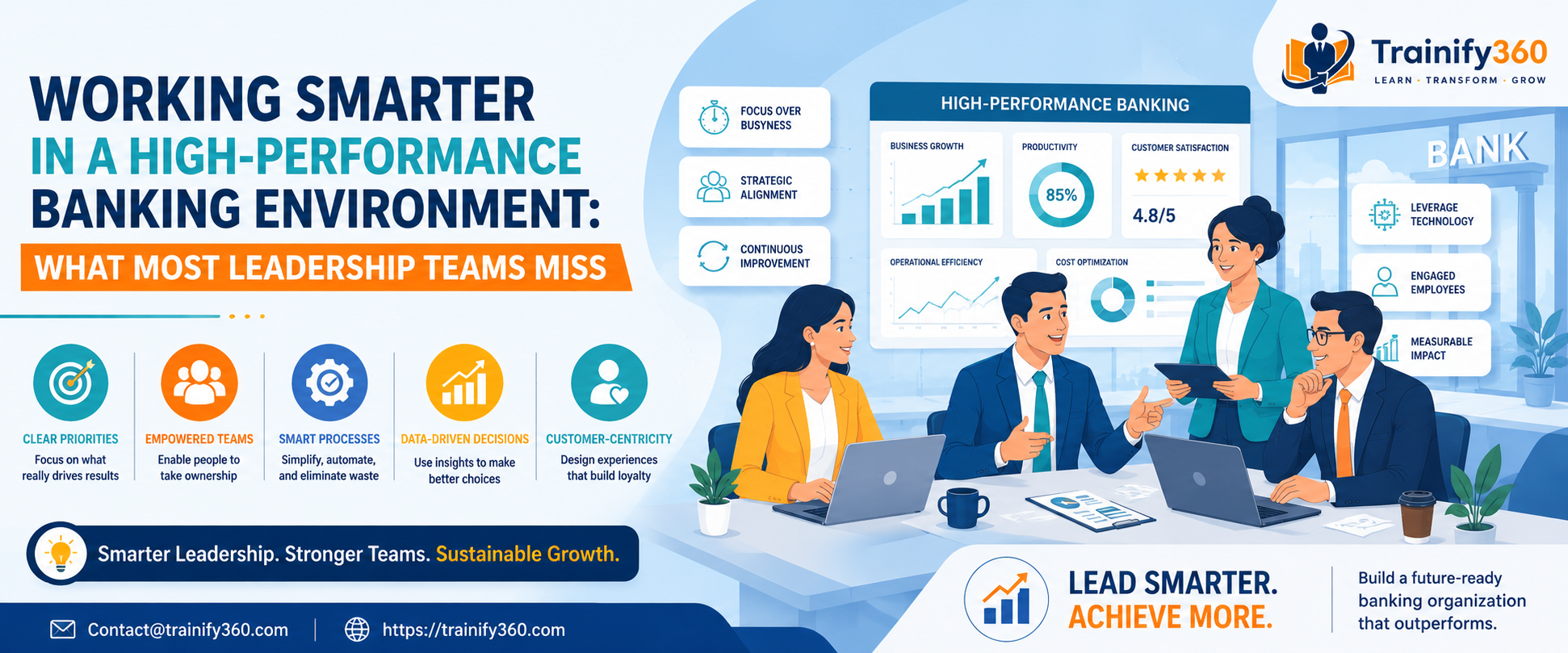
Working Smarter in a High-Performance Banking Environment: What Most Leadership Teams Miss
A CLO at a large private bank told me something last year that I've repeated in almost every workshop since. "Our people work harder than anyone I know," she said, "and I still can't tell you if we're actually more productive than we were five years ago."
That gap is worth sitting with. Banking, more than most industries, prides itself on effort. Long hours, weekend calls, an always-on culture that gets treated almost as a badge of honour. And yet, when you ask leadership teams whether all that effort is translating into better decisions, faster turnaround, or stronger client outcomes, the answer is usually a pause, followed by something vague.
That pause is the real story. High performance in banking has quietly become confused with high effort. They're not the same thing, and the difference matters a great deal to anyone running L&D or talent development in this sector right now.
Effort Is Not the Same as Output
Walk into most banking operations, whether it's retail, corporate, or investment banking, and you'll find genuinely exhausted teams. Not lazy. Not disengaged. Exhausted, because the pace has been treated as the strategy for so long that nobody's stopped to ask whether the pace is actually producing anything better.
A relationship manager who spends four extra hours a week manually reconciling data that a system could handle isn't working smarter. They're just working longer at the same task. An analyst who stays late redoing a report because the original brief wasn't clear isn't demonstrating commitment. They're absorbing a process failure with their own time.
This is where a lot of banking cultures get the diagnosis wrong. Leadership sees long hours and reads it as dedication. What's actually happening, more often than not, is a workforce compensating for gaps in process, tools, or training by simply putting in more hours. That's not sustainable, and it's not something a wellness webinar is going to fix.
Why This Shows Up More in Banking Than Almost Anywhere Else
A few things make this particularly acute in financial services. The regulatory load is heavy, and every process carries documentation and compliance steps that other industries don't have to think about. Client expectations sit at a premium, since a private banking client or a corporate treasury team expects near-instant responsiveness. And there's a generational layer worth naming honestly: a lot of senior leaders came up through a culture where visible hours equalled commitment, and that mindset gets passed down whether anyone intends it to or not.
None of that is a criticism of the industry. It's simply the environment L&D and HR leaders are working within, and it explains why "working smarter" conversations land differently here than they would in, say, a retail or consumer goods business. You can't just tell a banking team to work fewer hours. You have to actually change what the hours are spent on.
Where the Real Time Is Going
When we run time-and-motion style assessments with banking clients, the same patterns come up again and again. A huge amount of senior staff time goes into low-value activity that feels urgent but isn't actually strategic. Reformatting reports because a template wasn't standardised. Chasing approvals across departments that should have a clear escalation path but don't. Re-explaining context to a colleague or a client because information wasn't captured properly the first time.
None of this shows up on a job description. It's the invisible tax on every day, and it's rarely addressed through a training program, because most training programs are built to teach skills, not to fix workflow. That's a gap worth closing, and it's one L&D functions are unusually well positioned to close, provided the mandate is broadened slightly beyond "deliver the compliance modules."
What Working Smarter Actually Looks Like in This Sector
I'd be cautious about any consultant who tells you the answer is a single tool or a single training module. It isn't. What tends to move the needle is a combination of a few specific shifts, applied consistently rather than as a one-off initiative.
Training built around decision-making rather than task completion makes a real difference. A credit analyst doesn't need another module on how to use the system. They need practice making judgment calls faster, with less second-guessing, because that's where the actual time gets lost. Similarly, teaching managers to delegate properly, rather than simply assigning tasks and hovering, frees up more senior time than almost any efficiency tool on the market. Most managers were never taught how to delegate; they were taught how to check.
There's also real value in training people to recognise when a task doesn't need the level of polish they're giving it. Banking cultures often reward perfectionism on things that don't require it, and nobody's ever explicitly taught staff which tasks warrant that level of care and which don't. That distinction alone saves meaningful hours across a team once it's made explicit.
And then there's something a little less obvious: training people to protect focus time. Constant interruption is treated as normal in most banking environments, largely because responsiveness has become the unofficial measure of commitment. Helping staff and, just as importantly, helping managers set boundaries around when a response can reasonably wait an hour instead of five minutes changes the actual shape of a working day.
Making the Business Case Without Sounding Like an HR Slide
If you're bringing this to your executive committee, the conversation lands better when it's framed around cost and risk rather than wellbeing alone, even though wellbeing is a real and valid reason on its own. Burnout-driven attrition in banking is expensive to replace, especially at the mid-to-senior level where institutional knowledge walks out the door with the person. Errors made by exhausted staff, particularly in compliance-heavy roles, carry regulatory exposure that's far costlier than the training investment required to prevent them. And client relationships suffer in ways that don't show up immediately but do show up eventually, when a relationship manager who's stretched too thin starts missing the smaller signals that used to keep an account healthy.
None of this requires a leadership team to suddenly value work-life balance for its own sake, though most do. It simply requires recognising that unmanaged effort has a cost, and that cost is currently being absorbed quietly by the people doing the work.
The Real Shift Worth Making
Working smarter in banking isn't about asking people to do less. It's about being honest about where effort is currently going and redirecting a meaningful chunk of it toward the things that actually move outcomes. That's a training and culture question as much as it's an operations question, which is exactly why it belongs on the L&D agenda and not just the process improvement one.
Key Takeaways
Long hours in banking are often a symptom of process and training gaps, not a sign of genuine high performance. The real time drain usually sits in low-value, invisible tasks rather than the core work itself. Training focused on decision-making, delegation, and judgment about where effort belongs tends to shift outcomes far more than another efficiency tool. And framing this conversation around risk and cost, not just wellbeing, tends to get it further with a leadership team.
If your teams are working hard but leadership can't clearly point to where that effort is translating into results, that's usually a design problem worth examining closely. Trainify360 works with banking and financial services organisations on exactly this kind of workforce effectiveness. Happy to talk through what that could look like for your teams.
Frequently Asked Questions
Why do banking teams often work long hours without a clear increase in output? Long hours are frequently a way of compensating for process gaps, unclear escalation paths, or unstandardised workflows, rather than a genuine driver of better results.
Is "working smarter" the same as reducing working hours in banking? Not directly. It's about redirecting effort toward higher-value activity, which sometimes reduces hours as a byproduct, but the goal is better use of time, not simply less of it.
What training actually helps reduce burnout in high-performance banking teams? Training focused on delegation, decision-making speed, and recognising which tasks need less polish tends to have more impact than generic wellness or time-management sessions.
How should HR leaders make the business case for this kind of training? Frame it around attrition cost, regulatory risk from errors made by exhausted staff, and client relationship quality, rather than wellbeing alone, since this tends to resonate more with executive committees.
Why is this issue more pronounced in banking than in other sectors? Heavy regulatory load, premium client expectations, and a long-standing culture that equates visible hours with commitment all combine to make this pattern harder to shift without deliberate intervention.