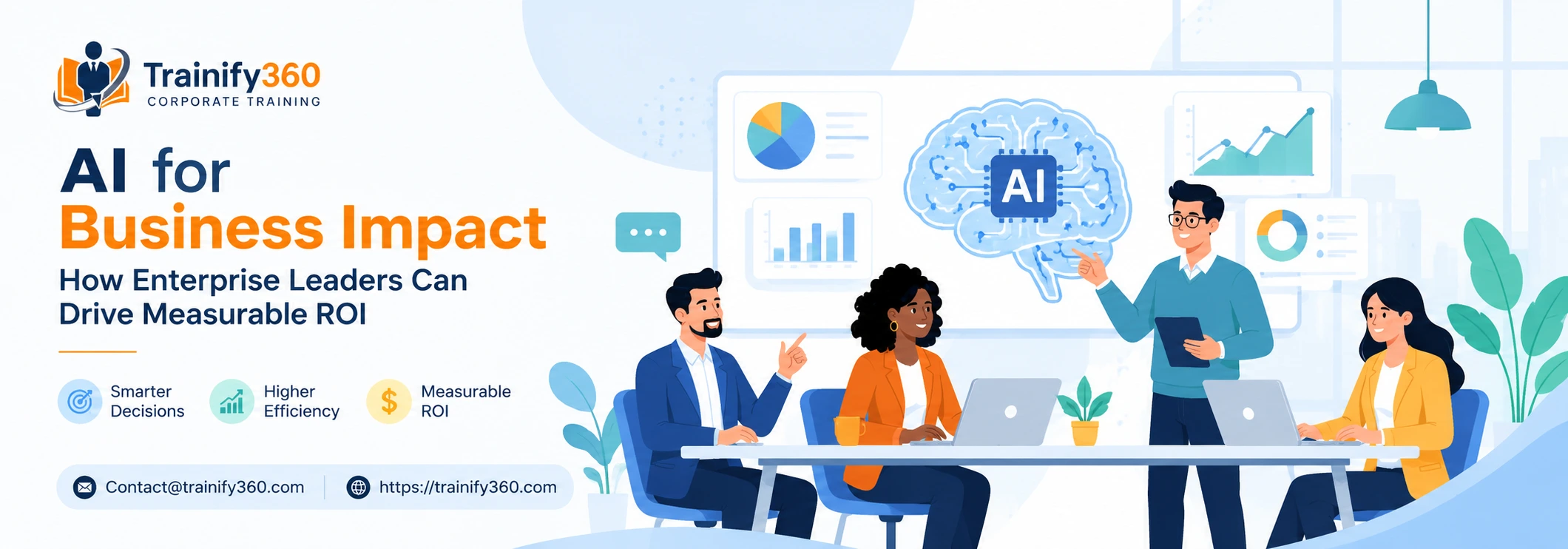
AI for Business Impact: How Enterprise Leaders Can Drive Measurable ROI
Artificial Intelligence has moved beyond experimentation. Across industries, executive teams are asking a different question. Rather than debating whether AI has a place in the organisation, they want to know how it can create measurable business value.
This shift changes the role of HR, Learning & Development, and business leaders. AI is no longer viewed as an IT initiative. It has become a business capability that influences productivity, customer experience, operational efficiency, workforce planning, decision-making, and innovation.
For enterprise organisations, the conversation should not begin with technology. It should begin with business outcomes.
Organisations that treat AI as another software implementation often struggle to achieve sustainable returns. Those that invest equally in people, processes, governance, and capability development are more likely to realise measurable ROI.
This article explores how enterprise leaders can create business impact from AI while building the workforce capabilities required for long-term success.
AI Is a Business Strategy, Not Just a Technology Initiative
Many organisations still approach AI as a collection of tools.
They purchase AI-powered software, automate selected workflows, or introduce generative AI applications to employees. While these initiatives may deliver short-term efficiencies, they rarely transform business performance on their own.
Successful AI adoption begins with a clear business strategy.
Enterprise leaders first identify business problems worth solving.
Examples include:
- Reducing customer response times
- Improving forecasting accuracy
- Increasing employee productivity
- Automating repetitive administrative work
- Enhancing sales effectiveness
- Supporting better operational decisions
- Improving compliance monitoring
- Strengthening knowledge management
Once these priorities are defined, AI becomes an enabler rather than the objective.
This distinction is critical because technology alone does not improve business performance. People using technology effectively do.
Why Enterprise Leaders Must Think Beyond Automation
One of the most common misconceptions surrounding AI is that automation represents its greatest value.
Automation certainly creates efficiencies by reducing manual effort and repetitive tasks. However, enterprise organisations gain significantly greater value when AI enhances human decision-making rather than simply replacing manual work.
Consider a sales organisation.
Instead of merely automating CRM updates, AI can analyse customer interactions, recommend the next best action, identify buying signals, and provide sales teams with better insights before client meetings.
Similarly, HR teams can move beyond automating administrative processes.
AI can support workforce planning, identify future skill gaps, improve learning recommendations, and provide data that strengthens talent decisions.
In finance, AI assists with anomaly detection, predictive forecasting, and risk identification.
Operations teams benefit from predictive maintenance, demand forecasting, and supply chain optimisation.
Across every business function, the greatest return comes when AI augments professional judgement.
The Current Challenges Organisations Face
Although AI adoption continues to accelerate, many organisations encounter similar barriers.
Lack of Workforce Readiness
Employees frequently gain access to AI tools before understanding how to use them responsibly or effectively.
Without structured learning, adoption becomes inconsistent.
Some employees become enthusiastic users.
Others avoid AI completely.
Many remain uncertain about governance, ethics, privacy, and acceptable business use.
The result is fragmented adoption with inconsistent outcomes.
Unclear Business Objectives
Many AI projects begin with enthusiasm but lack measurable success criteria.
Questions such as these often remain unanswered:
- Which business metric will improve?
- How will ROI be measured?
- Which teams will benefit first?
- How will productivity gains be quantified?
Without defined objectives, organisations struggle to demonstrate business value.
Leadership Capability Gaps
Senior leaders are expected to make strategic decisions regarding AI investments.
However, many executives have limited practical understanding of AI opportunities and limitations.
Effective leadership does not require coding expertise.
It requires the ability to evaluate business use cases, assess organisational readiness, manage change, and develop responsible governance frameworks.
These capabilities become increasingly important as AI adoption expands.
Change Resistance
Employees naturally question how AI will affect their roles.
Some fear redundancy.
Others question the reliability of AI-generated outputs.
Leadership teams that communicate openly, involve employees early, and invest in capability development generally achieve stronger adoption and greater engagement.
Measuring AI ROI Beyond Cost Reduction
One of the biggest mistakes organisations make is measuring AI success only through labour savings.
Enterprise leaders should evaluate AI using a broader business framework.
Productivity Improvements
Employees spend less time on repetitive administrative work.
Knowledge workers produce reports, presentations, analyses, and documentation more efficiently.
Managers make faster decisions because information becomes easier to access.
Better Customer Experience
AI supports faster responses, personalised communication, intelligent recommendations, and improved service quality.
Customer satisfaction often improves because employees can focus on higher-value interactions.
Improved Decision Quality
AI provides leaders with stronger data analysis, predictive insights, and scenario planning.
Better decisions reduce operational risk while improving planning accuracy.
Revenue Growth
Sales teams identify better opportunities.
Marketing campaigns become more targeted.
Customer retention improves.
Cross-selling opportunities increase.
AI contributes to revenue generation rather than acting solely as a cost-saving tool.
Innovation Capacity
When employees spend less time on repetitive work, they devote more attention to innovation, collaboration, and strategic thinking.
This creates long-term organisational value that extends beyond immediate financial returns.
Why Learning and Development Plays a Strategic Role
AI adoption cannot succeed through technology deployment alone.
The real differentiator lies in workforce capability.
This is where Learning & Development becomes a strategic business function rather than a support activity.
L&D leaders help organisations answer critical questions:
- Which skills will employees need over the next three years?
- Which roles require AI literacy?
- How should managers lead AI-enabled teams?
- What governance training is necessary?
- How can responsible AI practices become part of organisational culture?
Rather than offering generic AI awareness sessions, enterprise organisations need structured capability-building programmes aligned with business priorities.
The most effective learning strategies combine technical understanding with practical workplace application.
Employees should not simply learn what AI is.
They should understand how to use it to improve productivity, make better decisions, collaborate more effectively, and deliver stronger business outcomes while maintaining ethical and responsible practices.
Common Mistakes Organisations Make When Adopting AI
Despite growing investment in artificial intelligence, many organisations struggle to translate experimentation into measurable business outcomes. The challenge rarely lies with the technology itself. More often, it stems from decisions made during implementation.
Treating AI as an IT Project
When AI is owned solely by the technology function, business adoption remains limited. Successful organisations establish cross-functional ownership involving HR, operations, finance, sales, legal, and business leaders. AI should support enterprise objectives rather than departmental initiatives.
Investing in Tools Before Building Skills
Providing employees with AI platforms without structured learning often leads to inconsistent usage, security concerns, and missed opportunities. Employees require practical guidance on selecting the right use cases, evaluating AI-generated outputs, and applying responsible AI practices.
Ignoring Change Management
AI introduces new ways of working. Employees need clarity on how their roles will evolve and how AI supports rather than replaces human expertise. Transparent communication and leadership involvement encourage confidence and reduce resistance.
Measuring Activity Instead of Outcomes
Tracking the number of AI licences purchased or prompts created offers limited business insight. Organisations should measure operational improvements such as productivity gains, reduced cycle times, higher customer satisfaction, stronger compliance, and improved decision quality.
Best Practices for Driving Measurable AI ROI
Enterprise organisations achieving sustainable results tend to follow similar principles.
Start with Business Priorities
Rather than asking where AI can be used, begin by identifying business challenges that influence profitability, efficiency, customer experience, or operational resilience.
Develop AI Literacy Across Leadership
Executives and managers do not need to become AI specialists, but they should understand its capabilities, limitations, governance requirements, and strategic implications. Leadership confidence significantly influences organisational adoption.
Build Role-Based Capability
Different functions require different levels of AI proficiency.
- HR teams need skills in AI-supported talent analytics and workforce planning.
- Sales professionals benefit from AI-assisted customer insights and proposal development.
- Finance teams require knowledge of predictive analytics and risk monitoring.
- Managers need guidance on leading AI-enabled teams and making informed decisions.
Role-specific learning creates greater business relevance than generic awareness sessions.
Establish Responsible AI Governance
Policies addressing data privacy, intellectual property, ethical decision-making, bias, and human oversight should accompany every AI initiative. Governance frameworks protect organisational reputation while building employee confidence.
Measure, Refine, and Scale
Pilot programmes provide valuable learning opportunities. Organisations that evaluate outcomes, gather employee feedback, refine processes, and scale successful initiatives generally achieve stronger long-term returns.
How Corporate Training Creates Business Impact
Technology adoption becomes sustainable only when people develop the confidence and capability to apply it effectively.
Corporate AI training should move beyond software demonstrations. It should help employees solve real business challenges using AI responsibly.
An effective enterprise AI learning programme enables employees to:
- Improve productivity without compromising quality.
- Produce better reports, presentations, and business communications.
- Analyse information more efficiently.
- Support informed decision-making using AI-assisted insights.
- Collaborate more effectively across teams.
- Apply responsible AI practices that protect organisational data and reputation.
For leaders, AI training provides a stronger understanding of governance, change management, workforce planning, and strategic decision-making.
For HR and L&D teams, it supports future skills planning, capability development, and organisational readiness.
The result is a workforce that views AI as a business capability rather than simply another digital tool.
Why Organisations Choose Trainify360
Developing AI capability requires more than a one-time workshop. Organisations need learning solutions aligned with business priorities, workforce maturity, and organisational goals.
Trainify360 partners with enterprises to design practical AI learning journeys that focus on business outcomes rather than technical complexity.
Our programmes include:
- AI awareness for business professionals
- AI productivity workshops for functional teams
- AI literacy for managers and leaders
- Responsible AI and governance training
- Prompt engineering for workplace productivity
- Customised enterprise AI learning pathways
- Instructor-led workshops
- Virtual and blended learning solutions
- Scenario-based learning with practical application
- Outcome-focused capability development
Every programme is designed to help organisations build confident, responsible, and business-ready teams capable of applying AI effectively in their daily work.
Conclusion
Artificial intelligence is becoming part of everyday business operations. The organisations that achieve meaningful returns are those that align technology investments with workforce capability, leadership commitment, and measurable business objectives.
Enterprise leaders should view AI as a strategic capability that strengthens decision-making, improves productivity, enhances customer experiences, and supports sustainable growth.
Technology creates opportunities. People create business value.
By investing in structured learning, responsible governance, and practical application, organisations can move beyond isolated AI experiments and establish lasting competitive advantage.
For HR leaders, CHROs, L&D professionals, and business executives, the question is no longer whether AI belongs in the workplace. The real opportunity lies in preparing people to use it confidently, responsibly, and in ways that deliver measurable organisational outcomes.
Trainify360 supports organisations on that journey through enterprise-focused AI learning solutions that combine business relevance with practical workplace application.
Frequently Asked Questions (FAQs)
1. What is AI for Business Impact?
AI for Business Impact focuses on applying artificial intelligence to improve productivity, decision-making, customer experience, operational efficiency, and overall business performance rather than simply adopting technology.
2. How can organisations measure AI ROI?
Measure outcomes such as reduced process time, increased productivity, improved customer satisfaction, revenue growth, better forecasting accuracy, lower operational costs, and enhanced employee performance instead of relying only on technology usage metrics.
3. Why do many AI projects fail?
Projects often fail because organisations focus on technology without investing in workforce capability, leadership alignment, governance, change management, and clearly defined business objectives.
4. Why is AI training important for employees?
AI training enables employees to use AI responsibly, improve productivity, make informed decisions, protect sensitive information, and confidently integrate AI into everyday work.
5. Which business functions benefit most from AI?
Sales, HR, finance, customer service, operations, marketing, procurement, compliance, and executive leadership all benefit from AI when solutions are aligned with business priorities.
6. What skills should leaders develop for AI adoption?
Leaders should understand AI strategy, governance, ethical considerations, workforce planning, change management, decision-making, and risk management.
7. How does AI support Learning and Development?
AI assists L&D teams with personalised learning, skills analysis, learning recommendations, workforce capability planning, and training effectiveness measurement.
8. How can Trainify360 support enterprise AI adoption?
Trainify360 delivers customised AI learning programmes that combine strategic leadership education, practical workplace application, instructor-led workshops, virtual learning, and measurable capability development for enterprise teams.