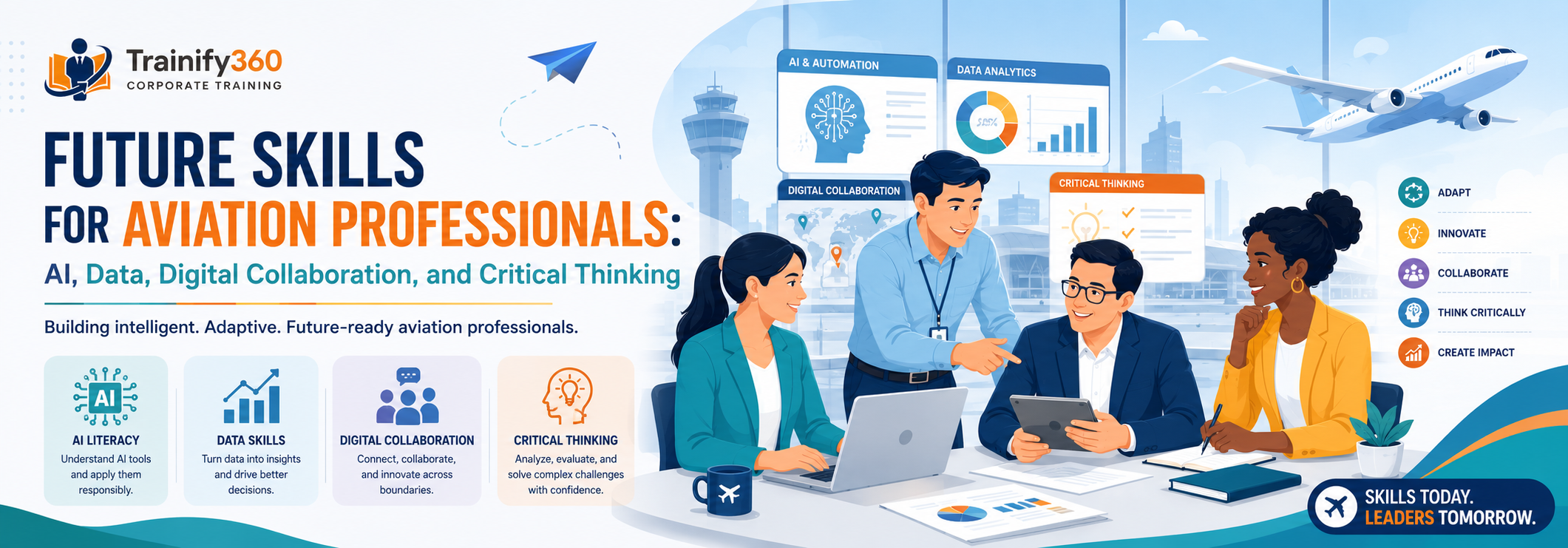
Future Skills for Aviation Professionals: AI, Data, Digital Collaboration, and Critical Thinking
For decades, aviation and aerospace have been built on technical excellence. Engineers, maintenance technicians, pilots, manufacturing specialists, quality professionals, and operations teams have relied on deep technical expertise to keep aircraft safe, reliable, and efficient. That foundation isn't going anywhere.
What's changing is the environment those professionals now work in.
Aircraft generate more operational data than they ever have. Manufacturing facilities keep getting more automated. Maintenance teams lean on predictive analytics to catch a failure before it happens, rather than after. Engineering teams collaborate across continents through digital platforms as a matter of routine, and AI is starting to show up everywhere from maintenance planning to quality inspection to operational forecasting.
Technology is reshaping the work. It isn't replacing the people doing it. What it's actually doing is changing which skills those people need to succeed.
For CHROs, HR Directors, Chief Learning Officers, and L&D leaders, that's the real strategic challenge here. Workforce capability can no longer be defined by technical knowledge alone. Organisations need people who can interpret data, collaborate across digital environments, work through complex problems, and make sound calls alongside increasingly intelligent technology. This isn't really about preparing employees for some future date. Most of it is already happening now.
Technology Is Changing Jobs, Not Eliminating Them
Bring up AI in almost any workforce conversation, and the same question comes up fast: will this replace aviation jobs? In most organisations I work with, that's not actually the useful question. The better one is: how will the job itself change?
Across aviation and aerospace, AI is already supporting routine inspections, predicting maintenance needs, optimising flight schedules, analysing production data, and giving supply chains better visibility. It reduces repetitive work and sharpens decision-making. What it doesn't do is replace human judgement.
An AI system can flag an unusual vibration pattern in an engine easily enough. It still takes an experienced engineer to work out what that actually means operationally, and to decide what to do about it. Predictive analytics can suggest a maintenance window, but someone still has to weigh that against operational priorities, regulatory requirements, available resources, and customer commitments — all things a model isn't positioned to judge on its own. Technology provides the insight. People still have to provide the judgement. That's precisely why future skills matter as much as they do.
Data Literacy Is Becoming a Core Workplace Skill
Data has quietly become one of aviation's most valuable assets. Every flight generates operational information. Every production line throws off performance metrics. Every maintenance activity creates data that could, in principle, improve the next decision made.
The hard part was never collecting it. It's helping people actually understand what it's telling them.
Data literacy doesn't mean turning every aviation professional into a data scientist nobody's asking for that. It means giving people enough confidence to read a dashboard properly, spot a trend, question something that looks off, and make a decision grounded in reliable information rather than a hunch. That matters more for leaders than almost anyone, because the best decisions now blend operational experience with real evidence pulled from real-time data. Organisations that build this kind of confidence across the workforce end up making faster decisions, planning operations more effectively, and avoiding the costly errors that come from acting on assumption instead of evidence.
AI Literacy Matters for Every Function, Not Just the Technical Ones
Artificial intelligence stopped being a research-lab curiosity a while ago. It's part of everyday work across aviation now engineers using AI-assisted design tools, maintenance teams running predictive maintenance platforms, HR analysing workforce trends, learning teams personalising development paths, operations managers relying on intelligent scheduling systems.
None of this requires employees to understand the mathematics underneath machine learning. What they do need is a working sense of what the technology can actually do, where its limitations sit, and when a human needs to step in rather than defer to it.
Strong AI literacy, in practice, looks like understanding how AI supports a decision without making it, recognising bias and limitation in what a model produces, protecting sensitive operational data properly, knowing when it's appropriate to challenge an automated recommendation, and applying human judgement before acting on whatever the AI has suggested. The organisations getting the most value out of AI right now aren't necessarily the ones spending the most on the technology itself. They're the ones investing just as heavily in the people who have to use it well.
Digital Collaboration Has Become an Operational Capability
Modern aviation programmes rarely sit in one location anymore. An aircraft might be designed in Europe, manufactured in Asia, assembled in North America, and maintained across several continents at once. That reality has fundamentally changed how teams have to work together.
Digital platforms let specialists from different countries and disciplines solve problems in real time, which is genuinely useful but the technology alone doesn't create good collaboration. People do. The teams that pull this off communicate clearly, document their decisions properly, share knowledge without being asked twice, and understand how their piece of the work affects everyone downstream of it.
Poor collaboration rarely announces itself as a dramatic failure. More often it just shows up as delay, duplicated effort, small misunderstandings that compound, and decisions that take twice as long as they should. For L&D leaders, it's worth treating digital collaboration as a genuine business capability rather than filing it under "technology skills" and moving on.
Critical Thinking Will Separate the High Performers
As automation takes over more of the routine work, the complex judgement calls become correspondingly more valuable. Critical thinking the ability to weigh information, evaluate options, question assumptions, and land on a balanced decision when the answer isn't obvious has always mattered in aviation. What's changed is the speed and complexity of the decisions people now have to make.
Professionals are expected to pull together multiple sources of information, interpret whatever an AI system has recommended, understand the operational risk involved, and land on a decision that balances safety, efficiency, compliance, and customer expectation all at once. Employees who follow procedure well remain valuable, and always will be. Employees who can think past the procedure when the situation calls for it are becoming the ones organisations can't afford to lose.
Learning Strategies Need to Catch Up
Most organisations still build their learning strategy around technical certification, and technical capability will always be the foundation that's not up for debate. But the future-ready ones are widening the lens considerably.
The strongest programmes I've seen bring together AI awareness and responsible use, data literacy for operational teams, digital collaboration skills, critical thinking and structured problem-solving, communication across hybrid and global teams, adaptability to change, and leadership fit for a technology-enabled environment. Rather than bolting these on as standalone courses that everyone forgets by Friday, the organisations doing this well weave them into leadership programmes, onboarding, project work, and ongoing learning journeys. Learning stops being an annual event and starts being part of how work actually gets done.
The Leadership Challenge Underneath All of This
Whether a new technology gets adopted well or badly usually comes down to leadership behaviour, not the technology itself. Employees look to their managers the moment a new system, process, or digital tool shows up. If a leader shows genuine curiosity, encourages people to learn as they go, and creates room to experiment without penalty, adoption tends to move quickly. If a leader treats the whole thing as an IT initiative rather than a business shift worth their attention, resistance builds fast.
Future-ready leaders don't need to become AI specialists themselves. They need to get better at asking the right questions: How will this actually improve the work? What new skills will our people need to use it well? How do we build trust in these systems without letting people switch off their own judgement? Increasingly, those questions belong in leadership meetings, not just in a technology briefing somewhere down the hall.
Preparing the Workforce for What Comes Next
Aviation has adapted to major shifts before. Jet engines transformed commercial aviation. Digital flight systems reshaped the cockpit. Composite materials changed how aircraft get built. AI and advanced analytics are simply the next chapter in that same story.
The organisations that benefit most from this next chapter probably won't be the ones spending the most on the technology. They'll be the ones investing just as much in their people. Technical expertise remains the foundation it's always been but how much value that technology actually delivers depends entirely on the humans working alongside it. That means developing people who are comfortable working with AI, confident with data, skilled at collaborating across digital environments, and capable of making a sound call when the situation gets complicated.
Final Thoughts
Future skills aren't a conversation about preparing for a decade from now. They're already an operational requirement today. Aviation and aerospace organisations are adopting AI, automation, advanced analytics, and connected technology faster than most workforces can naturally keep pace with and every one of those investments ultimately depends on the people expected to use it well.
For CHROs, HR Directors, Chief Learning Officers, and L&D leaders, the opportunity here is fairly clear. Workforce development needs to extend past technical certification and start building AI literacy, data confidence, digital collaboration, critical thinking, and adaptable leadership alongside it.
At Trainify360, we partner with aviation and aerospace organisations to build exactly these capabilities, through practical, business-focused learning rather than generic technology modules. Our programmes are designed to help people not just operate new technology, but make better decisions, collaborate more effectively, and lead with confidence in a workplace that keeps getting more digital.
Because the future of aviation won't be shaped by technology on its own. It'll be shaped by the people who know how to use it wisely.