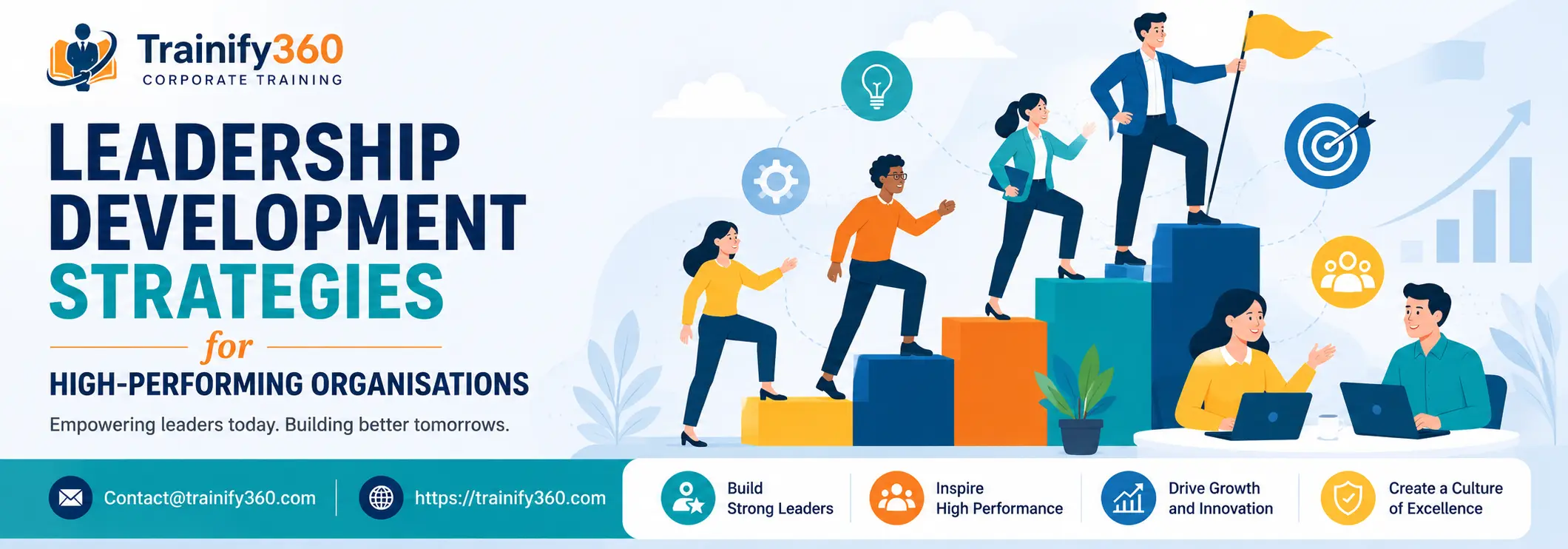
Leadership Development Strategies for High-Performing Organisations
Some organisations consistently outperform their competitors. They adapt quickly, retain talented people, navigate change with confidence, and continue to grow even during uncertain times. While several factors contribute to this success, one stands out above the rest: strong leadership.
The reality is that high-performing organisations don't simply hire great leaders; they develop them.
Many businesses invest heavily in technology, operational excellence, and business transformation. These investments certainly matter. However, without leaders who can inspire teams, make sound decisions, communicate with clarity, and build trust, even the best strategies struggle to deliver lasting results.
Leadership isn't a title that comes with a promotion. It's a capability that develops over time through learning, experience, feedback, and practice. Yet many organisations still assume that successful individual contributors will naturally become effective managers. Unfortunately, that transition isn't always seamless.
Managing people requires an entirely different set of skills. Leaders are expected to coach, influence, resolve conflicts, guide change, build engagement, and make decisions that affect both people and business outcomes. These capabilities rarely develop by chance.
That's why leadership development deserves a place at the centre of every organisation's growth strategy, not as an occasional training programme, but as a long-term business priority.
Leadership Development Should Support Business Growth
One of the biggest mistakes organisations make is treating leadership development as an HR initiative rather than a business initiative.
Training programmes often sit on the annual learning calendar, delivered to managers once or twice a year, with little connection to the organisation's strategic priorities. While these sessions may receive positive feedback, they don't always lead to measurable improvements in performance.
The organisations seeing the strongest results take a different approach.
Instead of asking, "What leadership programme should we run this year?", they ask a more valuable question:
"What kind of leaders will our organisation need to achieve its business goals over the next few years?"
The answer to that question shapes everything from programme design to learning objectives.
For example, an organisation preparing for rapid expansion may need leaders who can delegate effectively, make faster decisions, and build high-performing teams. A company undergoing digital transformation might focus on leading through uncertainty, encouraging innovation, and managing change. Businesses looking to improve customer experience may prioritise coaching, accountability, and stronger communication.
Leadership development creates the greatest value when it directly supports business priorities.
Develop Leadership Across Every Level
Leadership isn't confined to the executive boardroom.
First-line managers influence employee engagement more than almost anyone else in the organisation. Middle managers connect strategy with execution. Senior leaders shape culture, direction, and organisational confidence.
Each leadership level faces different challenges, which means each requires different development opportunities.
New managers often need support in building confidence, giving constructive feedback, managing difficult conversations, and leading former peers.
Experienced managers benefit from strengthening coaching skills, stakeholder management, cross-functional collaboration, and strategic thinking.
Senior leaders, meanwhile, need to focus on organisational change, executive communication, succession planning, and long-term business strategy.
Organisations that recognise these differences create leadership pathways instead of one-size-fits-all programmes. As a result, they build a stronger internal talent pipeline and reduce their dependence on external hiring.
Leadership Is About Behaviour, Not Just Knowledge
One of the most common reasons leadership programmes fail is that they focus too heavily on theory.
Participants attend workshops, learn leadership models, receive certificates, and then return to work without changing how they actually lead.
Real leadership development happens when behaviour changes.
A leadership programme should leave managers feeling more confident about the situations they deal with every day. They should know how to support an underperforming employee, navigate difficult conversations with empathy, guide their teams through uncertainty, influence key stakeholders, and earn the trust of the people they lead.
That's why the most effective leadership programmes go beyond theory. They create opportunities for leaders to practise what they've learned in realistic workplace scenarios.
Activities such as role plays, business simulations, case discussions, peer coaching, manager feedback, and workplace action plans allow participants to put new skills into practice straight away. Instead of leaving with ideas they'll probably forget, they return to work with the confidence and experience to apply those skills in real conversations and real business situations.
Understanding leadership principles is a good starting point. But it's the habits leaders develop and the behaviours they demonstrate consistently that make the biggest difference to their teams and the organisation.
Leadership Growth Doesn't End After the Workshop
Leadership isn't developed over two days in a training room.
It grows through continuous learning, reflection, coaching, and real workplace experience.
High-performing organisations understand this well. They don't treat learning as an event—they make it part of everyday work.
Managers are encouraged to seek feedback, mentor colleagues, participate in cross-functional projects, and learn from business challenges. Regular coaching conversations reinforce new behaviours, while stretch assignments give emerging leaders opportunities to grow outside their comfort zones.
This ongoing approach helps organisations build leadership capability that lasts long after formal training has ended.
Developing Future Leaders Before the Need Arises
One of the clearest indicators of a mature organisation is its ability to prepare leaders well before leadership positions become vacant. Unfortunately, many organisations still take a reactive approach. They begin searching for potential leaders only after a senior manager resigns, retires, or moves into a new role. This often creates unnecessary disruption and places pressure on teams during periods of transition.
A more sustainable approach is to identify leadership potential early and nurture it over time.
Not every high-performing employee aspires to lead people, and not every technical expert will become an effective manager. Identifying individuals with the right mindset, learning agility, emotional maturity, and willingness to take ownership allows organisations to invest in talent that has the greatest potential for long-term success.
Future leaders benefit from opportunities that extend beyond formal training programmes. Assigning them to cross-functional projects, involving them in strategic business discussions, encouraging them to mentor junior colleagues, or giving them ownership of critical initiatives helps broaden their perspective and strengthen their decision-making ability.
These experiences expose emerging leaders to real business challenges while allowing them to develop confidence in a supported environment. Over time, they build the judgement and resilience required to handle larger responsibilities.
Developing leaders before they are needed also strengthens succession planning. Instead of relying heavily on external recruitment, organisations create a strong internal leadership pipeline where capable employees are ready to step into key roles with minimal disruption. This not only reduces hiring costs but also preserves organisational knowledge and reinforces employee confidence in internal career growth.
Measuring the Impact of Leadership Development
Leadership development should deliver more than positive participant feedback. While satisfaction surveys provide useful insights into the learning experience, they don't necessarily reflect whether the programme has created meaningful business value.
The real measure of success is what happens after the programme ends.
Are managers communicating more effectively with their teams? Are employees receiving better coaching and more constructive feedback? Has collaboration improved across departments? Are teams becoming more engaged and productive? Are more leadership positions being filled internally rather than through external hiring?
These are the outcomes that demonstrate whether leadership development is contributing to organisational performance.
When HR and L&D teams connect leadership initiatives with measurable business outcomes, conversations with senior leadership become far more meaningful. Leadership development is no longer viewed as a training expense but as an investment that supports productivity, employee retention, organisational culture, and long-term business growth.
Organisations that consistently measure these outcomes are also better positioned to refine their leadership programmes, ensuring they remain aligned with changing business priorities and workforce expectations.
Ultimately, leadership development is not about creating better managers alone. It is about building an organisation that is resilient, adaptable, and prepared for future challenges. When leaders continue to learn, inspire, and develop others, the benefits extend far beyond individual performance; they shape the culture, strengthen business results, and create a foundation for sustainable success.
At Trainify360, we partner with organisations to build leadership capability that delivers measurable business impact. Our customised leadership development programmes combine practical learning, behavioural skill development, coaching, and real-world application to help organisations create confident leaders who can inspire teams, drive performance, and prepare the business for future growth.