The toughest performance issues in a business rarely start in a boardroom. They show up on the front lines.
You’ve probably seen it: a disengaged employee sliding through the day, a major project falling behind schedule, a talented group struggling to get along, or a top performer quietly updating their resume on lunch break.
When these friction points happen, companies usually try to fix them by buying new software or changing company processes. But the real issue sits much closer to the daily work. It’s a team issue and a leadership issue.
Here is an uncomfortable truth: most managers get promoted because they were great at their previous job, not because they actually know how to lead people. Technical skills might earn you the promotion, but leadership skills determine whether your team succeeds.
For CHROs, HR leaders, and L&D professionals, this is a massive opportunity. A team rarely outperforms its leader. If you want high productivity, real engagement, and steady growth, you have to invest in managers who know how to build and guide teams.
The True Cost of "Trial and Error" Leadership
When managers are forced to figure out leadership on their own, the company pays a hidden price. In the talent world, this is called the "accidental manager tax."
The warning signs are easy to spot:
- Employee engagement starts to drop.
- Good people start quitting.
- Departments stop talking to each other.
- Decisions take forever to get made.
- Teams burn out trying to hit targets.
This isn’t just a localised headache. It works like a slow leak across the entire business, and over time, it gets incredibly expensive.
The Mindset Shift: From "Me" to "We"
To build a great team, a new manager has to completely change how they think. Many struggle because they try to keep playing as star solo athletes instead of acting like a coach.
Here is how their perspective needs to change:
- Old Way: Focuses on personal results à New Way: Drives collective team results.
- Old Way: Solves problems entirely alone à New Way: Helps the team find solutions together.
- Old Way: Focuses on a single task à New Way: Aligns team goals with the bigger business picture.
- Old Way: Executes daily to-do lists à New Way: Spends time developing people.
- Old Way: Tries to control every detail à New Way: Gives people real ownership.
This shift doesn’t happen automatically. It takes deliberate, practical training to help a professional make the jump.
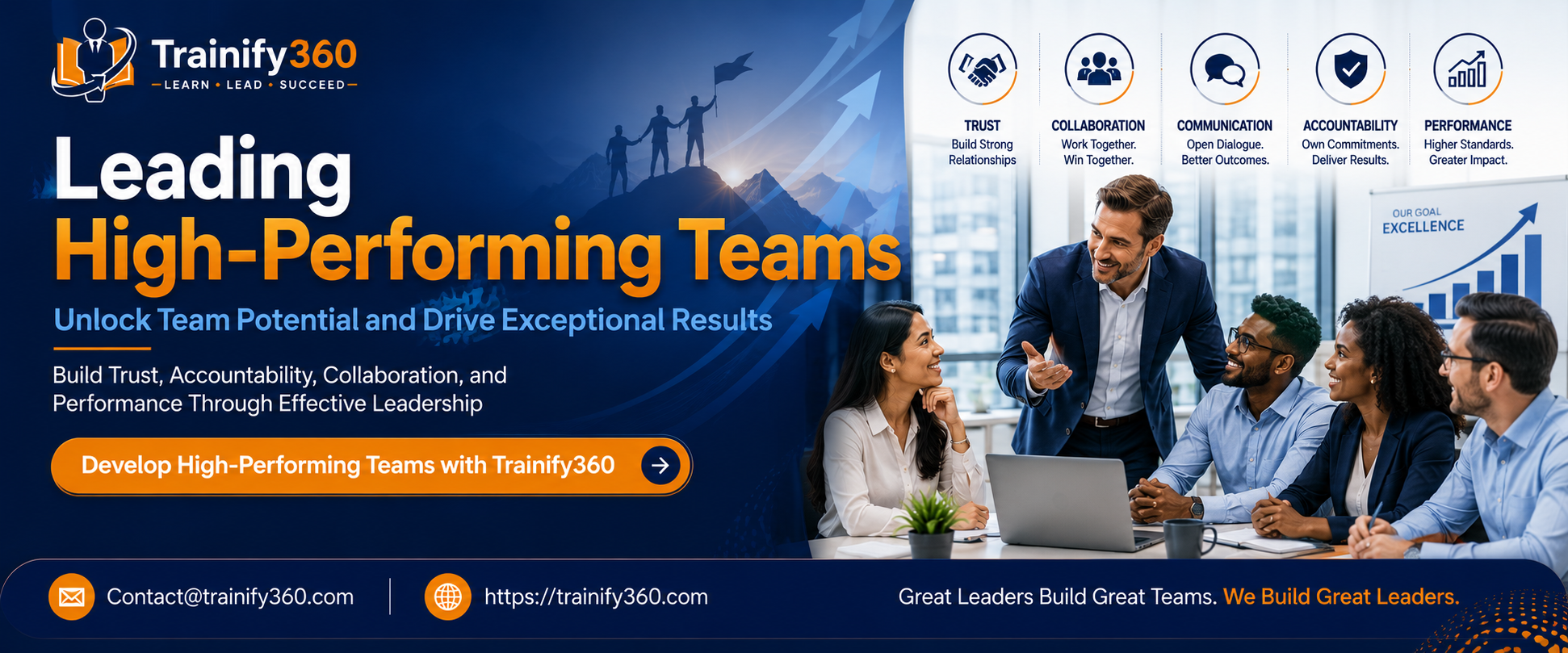
The 5 Pillars of High-Performing Teams
Great teams don't happen by accident. They are built through five everyday leadership behaviours.
1. Crystal-Clear Communication
Real communication isn't about flooding Slack channels or sending longer emails. It’s about removing confusion. High-performing teams need to know exactly what success looks like, why their work matters, and who owns what.
Good leaders stop doing generic check-ins and start setting clear expectations. Teams rarely suffer from over-communication; they suffer from muddy communication.
2. Emotional Intelligence (EQ)
Most leadership failures aren't due to a lack of technical skill; they are relationship failures. Emotional intelligence is simply the ability to read a room, manage your own reactions, and build trust.
In a fast-paced workplace, teams deal with constant pressure and change. Managers with high EQ handle this well because they resolve conflicts early and make it safe for people to speak up. Empathy isn't a soft perk anymore; it’s a basic survival skill.
3. Radical Accountability
Every team inherits the habits of its leader. If your team lacks accountability, you have to look in the mirror before looking at the roster.
Great teams thrive because their leaders encourage ownership instead of blame. They set clear rules, track results openly, and address performance dips right away. When a leader owns their mistakes, the team handles their own work the same way.
4. Strategic Delegation
Many managers hate handing off work because they don't trust the process. Their internal monologue is usually: "It’s just faster if I do it myself."
That might save you an hour today, but it ruins your schedule tomorrow. True delegation isn't about dumping boring tasks on others; it’s about building your team's skills. Every project you hand over is a chance for an employee to learn something new and build confidence.
5. A Coaching Mindset
Traditional managers love giving orders. Great leaders prefer asking questions. Instead of saying, "Here is how you fix this," try asking:
- "What options have you looked at so far?"
- "Where do you think we might run into trouble?"
- "What do you need from me to get this done?"
This simple shift turns dependent employees into independent thinkers. The best leaders aren't trying to create followers; they are trying to build more leaders.
5 Traps That Kill Team Performance
Even experienced managers fall into these common traps. Spotting them early keeps performance from hitting a wall:
- Micromanagement: Control disguised as "quality checks." It kills initiative and slows everything down.
- Avoiding Tough Conversations: Performance issues never fix themselves. Ignoring them just signals to the rest of the team that low standards are fine.
- Waiting for the Annual Review: Giving feedback only once a year leaves employees working in the dark for months.
- Skipping Recognition: People need to know their hard work is noticed. A lack of praise is the fastest way to turn a high performer into an ex-employee.
- Measuring Busyness Over Results: A busy team isn't always a productive team. Focus on actual business impact, not just hours logged.
Why Leadership Training is a Business Strategy
Leadership training shouldn't be treated as a boring, check-the-box HR exercise. The most successful businesses view it as a direct investment in company performance. The quality of your managers directly impacts employee retention, customer satisfaction, and your bottom line.
Building great leaders takes more than a single, one-day workshop. It requires a mixed learning journey:
- Core Frameworks: Teaching the actual tools and models leaders need.
- 1-on-1 Coaching: Providing personalised advice for real, everyday workplace challenges.
- Peer Groups: Giving managers a private space to solve problems together.
- Live Projects: Applying new skills directly to real business goals.
The Road Ahead
The companies that win in the future won't just be the ones with the best products or the biggest budgets. They will be the ones with the strongest leaders.
They need leaders who communicate clearly, expect accountability, hand off work strategically, and coach instead of control. For HR and L&D heads, investing in these skills is the smartest move you can make for your business.
At Trainify360, we help companies build excellent leaders who drive real engagement, better cultures, and measurable business growth. Through practical, real-world development programs, we turn potential into performance.
Because world-class teams don't happen by luck. They are built on purpose.