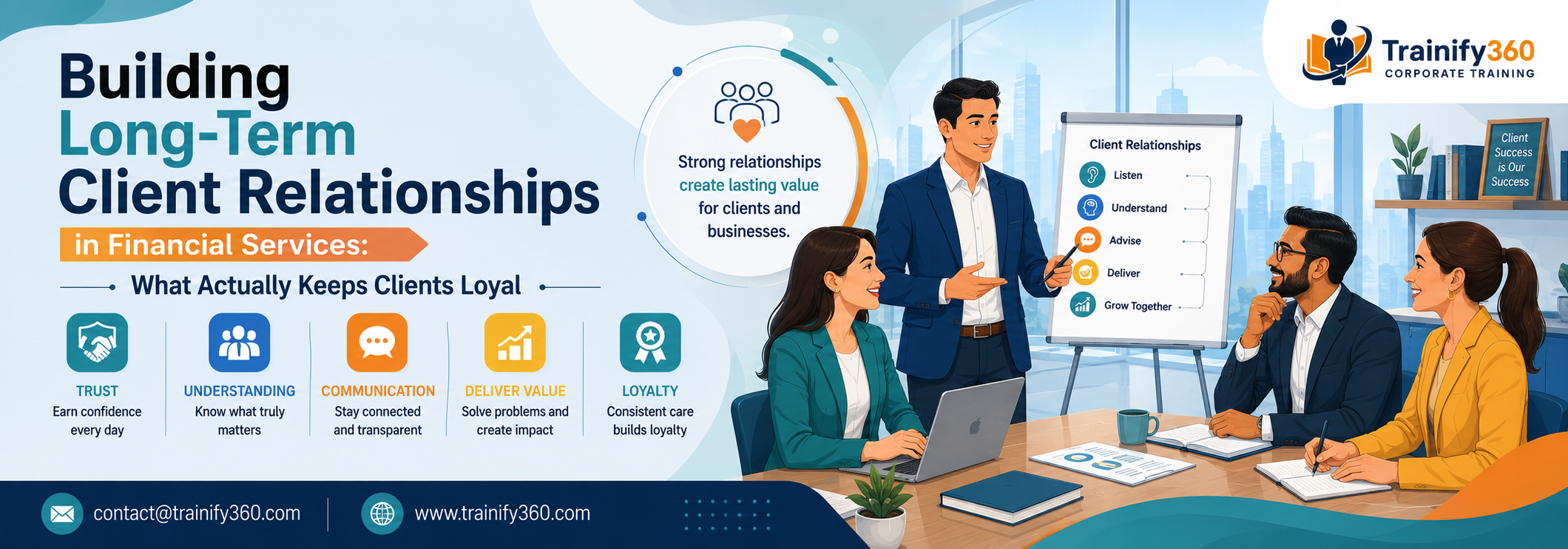
Building Long-Term Client Relationships in Financial Services: What Actually Keeps Clients Loyal
A Managing Director at a private bank once told me she could predict, almost to the month, which clients were about to leave. Not from performance numbers. From something far smaller. "They stop mentioning their kids," she said. "They stop asking how our team's doing. The conversation gets shorter and more transactional, and six months later, they're gone."
She wasn't being sentimental about it. She'd simply noticed, over twenty years, that the erosion of a client relationship seldom starts with a specific complaint. It starts with a slow flattening of the relationship itself, long before anyone files a formal grievance or moves their assets elsewhere.
That observation is worth sitting with, because most retention strategies in financial services are built around the wrong signal. Firms track satisfaction scores, portfolio performance, response times. All useful, none of them catching the thing that actually predicts whether a client stays for another decade or quietly starts looking elsewhere.
Clients Don't Leave Over One Bad Moment. They Leave Over a Thousand Small Ones
Ask most relationship managers what makes a client leave, and you'll hear about a specific incident. A missed call, a poor return, a mishandled complaint. These things happen, and they matter. But in most cases I've reviewed, the client had already been drifting for months before that incident. The incident was the excuse to finally act on a decision that had been building quietly for a while.
What actually erodes a long-term relationship is usually smaller and harder to spot. A relationship manager who's technically excellent but treats every conversation as a status update rather than an actual conversation. A firm that only reaches out when there's a product to discuss or a review due, never simply to check in. A team that changes so often the client stops bothering to build rapport with whoever's covering them this quarter, because the last three people didn't stay long enough to matter.
None of this shows up cleanly in a CRM. It shows up in a client who used to call first when something changed in their life and now waits to be asked. That shift is the real early warning signal, and very few firms have trained their people to notice it, let alone respond to it.
Why This Matters More in Financial Services Than in Most Sectors
Client relationships in this industry carry a particular kind of intimacy that other sectors don't have to manage. A wealth management client is often sharing details about inheritance, family conflict, business succession, and health concerns tied to financial planning. A corporate treasury relationship involves trust built over years of confidential conversations about a company's actual financial position, not just its public numbers.
This depth of relationship means the cost of losing a client is rarely just the lost revenue. It's the lost referrals that would have come from that relationship, the institutional knowledge about that client's preferences and history that walks out with them, and often, the quiet reputational ripple among their peers who hear about why they left.
It also means the skills required to sustain these relationships go well beyond product knowledge or technical competence. Most relationship managers are hired and promoted on exactly that: technical skill, market knowledge, deal execution. Very few are trained specifically on how to sustain a relationship over a ten or fifteen-year horizon, through market downturns, personal life changes, and long stretches where nothing dramatic happens at all.
The Skills Gap Nobody's Training For
Working with wealth management, private banking, and corporate banking clients, the same gaps keep surfacing regardless of the specific business line.
Relationship managers are rarely trained to have conversations that aren't tied to a transaction or a review cycle. Reaching out simply because it's been a while, without a product angle attached, feels unnatural to a lot of people who've spent their careers being measured on activity tied to revenue. That instinct needs to be actively unlearned, because clients notice the difference between contact that serves them and contact that serves a quota.
There's also a real gap in handling life transitions. A client going through a divorce, a business sale, a death in the family, or a health scare needs something entirely different from their relationship manager than someone reviewing quarterly performance. Very few training programmes prepare staff for these conversations, despite the fact that almost every long-term client relationship will pass through at least one of them.
Continuity training matters more than most firms realise. When a relationship manager moves on, the handover to a new contact is often treated as an administrative task rather than a relationship-critical moment. Clients who've built trust over a decade don't want to start from zero with someone new, and a poorly managed handover is one of the most common, and most avoidable, triggers for a client quietly beginning to look elsewhere.
And there's a broader gap in simply noticing the signals a client is drifting. Shorter calls, fewer questions, less warmth in routine correspondence. These are learnable things to watch for, but almost nobody trains relationship-facing staff to actually watch for them.
What Actually Builds Long-Term Loyalty
A few specific interventions tend to make a real difference with financial services clients working on this.
Training relationship managers to schedule genuinely non-transactional check-ins, and giving them explicit permission from leadership to do so without needing to justify it against a sales target, changes the tone of a relationship more than almost anything else. Clients can tell the difference immediately.
Structured training on difficult personal conversations, built around real scenarios like bereavement, divorce, or a business sale, gives relationship managers language and confidence they don't currently have. Most are winging it in these moments, which clients can sense even when the intention is good.
Formal handover protocols, treated with the same seriousness as a client onboarding process, protect relationships during staff transitions rather than leaving them to chance. This includes overlap time, a proper introduction, and documentation that goes well beyond account numbers and into actual relationship context.
And training staff to recognise and act on early drift signals, rather than waiting for a formal complaint or a redemption request, allows firms to intervene while the relationship is still salvageable, rather than after the decision to leave has already been made.
Making the Case Internally
If you're advocating for this kind of training investment, the framing that resonates with leadership is usually built around lifetime value and referral loss, not just retention percentages. A client relationship of fifteen years rarely represents just one account. It represents referrals, family relationships that may follow into the next generation, and reputational capital that's expensive to rebuild once lost. Losing that kind of client rarely shows up as a single line item, which is exactly why it's so easy for leadership to underinvest in the training that prevents it.
The Real Shift
Firms that keep clients for decades rather than years usually aren't doing anything dramatically different on the investment or product side. They've simply trained their people to notice the small things, the shortened calls, the missed life events, the awkward handover, and to act on them before a client has quietly made up their mind to leave.
Key Takeaways
Client attrition in financial services rarely starts with a single bad incident. It starts with a slow erosion that goes unnoticed because nobody's been trained to watch for it. Relationship managers are usually hired for technical skill, not relationship endurance, and the gap between the two needs deliberate training to close. Non-transactional contact, handling personal life transitions, and managing handovers well are the specific skills most consistently missing. And the business case for this training rests on lifetime value and referral loss, not simple retention metrics.
If your firm has strong client relationships on paper but you're not entirely confident your teams would notice a client quietly drifting, that's worth addressing before it shows up as a redemption request. Trainify360 works with financial services organisations on exactly this kind of relationship-focused training. Happy to talk through what that could look like for your teams.
Frequently Asked Questions
Why do long-term clients in financial services leave even when their portfolio performance is strong? Because client loyalty depends heavily on the quality of the relationship itself, not just financial outcomes. Clients often leave due to a relationship that's gone flat or transactional, even when the numbers look fine.
What's the biggest training gap among relationship managers in financial services? Handling non-transactional conversations and personal life transitions well. Most relationship managers are trained on products and markets, rarely on sustaining a relationship through decades of ordinary and difficult moments alike.
How much does staff turnover affect client retention? Significantly. A poorly managed handover when a relationship manager leaves is one of the most common and avoidable reasons a long-term client begins looking elsewhere.
What are the early warning signs that a client relationship is weakening? Shorter calls, fewer personal updates, less warmth in routine correspondence, and a shift toward purely transactional contact are all signals worth training staff to notice.
How should firms measure the value of relationship-focused training? By tracking lifetime client value, referral rates, and client tenure, rather than relying solely on satisfaction scores or short-term retention percentages.