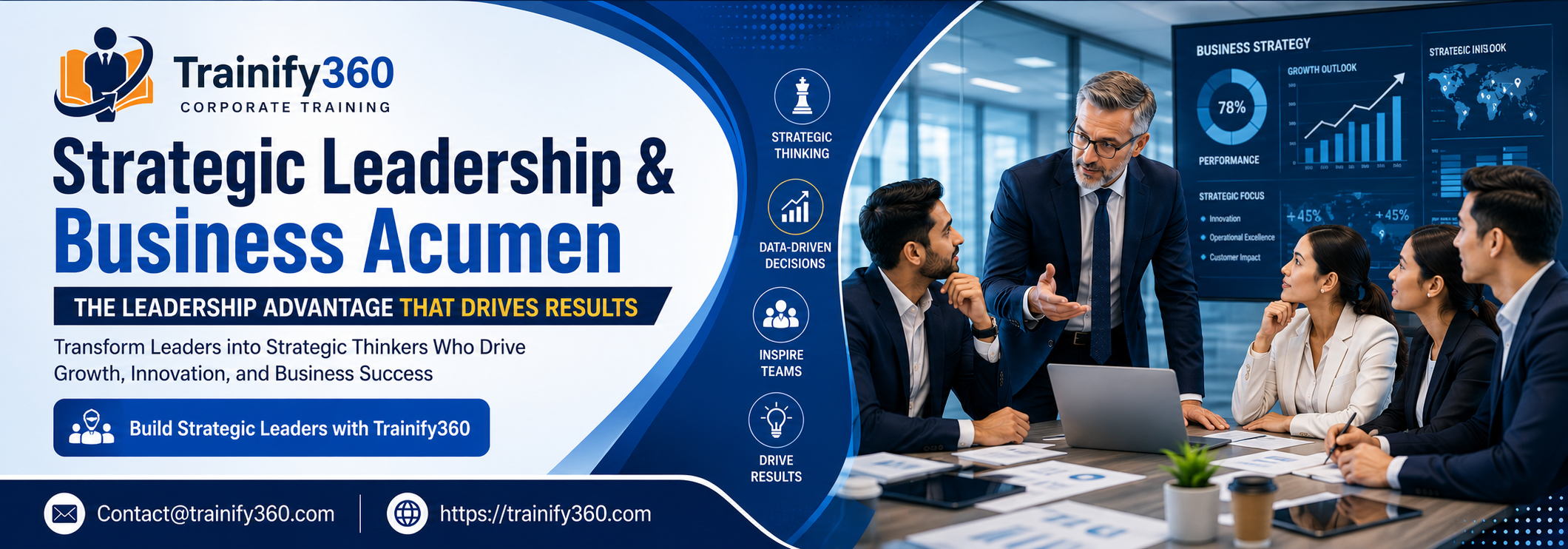
Strategic Leadership & Business Acumen: The Leadership Advantage That Drives Results
The biggest performance bottlenecks in organisations rarely start in the boardroom. They start on the front lines.
A delayed customer response. A missed project deadline. A team working hard but moving in the wrong direction. Most organisational friction can be traced back to one fundamental challenge: managers who understand their function but struggle to connect daily decisions to broader business outcomes.
That's where strategic leadership and business acumen become non-negotiable. Organisations promote their top performers into leadership roles because they're technically brilliant. They know the product, the process, the technology, or the customer better than anyone else. Yet leadership requires a different lens entirely.
For CHROs, HR leaders, and L&D professionals, this distinction matters. A strong leadership pipeline is no longer built solely on management skills. It requires leaders who understand how the business operates, where value is created, how decisions impact profitability, and how teams contribute to long-term organisational goals.
The Cost of Neglecting Strategic Leadership Development
When managers are left to figure leadership out through trial and error, the consequences are rarely immediate. They're gradual and expensive.
The warning signs typically include:
- Teams focused on activity rather than outcomes
- Poor cross-functional collaboration
- Short-term decision-making that creates long-term problems
- Low employee engagement
- Increased turnover among high performers
- Weak succession pipelines
- Resource waste and duplicated efforts
- Missed growth opportunities
- Reduced innovation and agility
The impact extends far beyond individual teams. Managers influence culture, productivity, customer experience, talent retention, and ultimately business performance.
Strategic Leadership vs Traditional Management
Many managers spend their days managing tasks. Strategic leaders manage direction. The difference may seem subtle, but it fundamentally changes how decisions are made and how teams perform.
Business acumen complements this capability by helping leaders understand financial drivers, operational realities, market dynamics, customer expectations, and competitive pressures. Together, they create leaders who don't just execute plans but also influence business outcomes.
The Identity Shift: From Contributor to Business Leader
One of the most significant transformations new managers face is shifting from individual achievement to organisational impact.
|
Individual Contributor (Me-Focused) |
Strategic Leader (We-Focused) |
|
Completes assigned work |
Drives business outcomes |
|
Focuses on personal performance |
Focuses on team success |
|
Solves immediate problems |
Anticipates future challenges |
|
Works within a function |
Things across the business |
|
Measures activity |
Measures impact |
|
Executes strategy |
Shapes and supports strategy |
|
Seeks answers |
Asks better questions |
|
Owns individual goals |
Aligns team goals with business goals |
|
|
|
This shift is where many promising managers struggle. Not because they lack talent. Because they have never been taught how to think like business leaders.
The Five Core Pillars of Strategic Leadership & Business Acumen
1. Clear Communication: Beyond Casual Check-Ins
Communication isn't simply about keeping everyone informed. It's about creating alignment.
Strategic leaders ensure their teams understand:
- What needs to be accomplished
- Why it matters
- How success will be measured
- How their work connects to business priorities
Without context, employees focus on tasks. With context, they focus on outcomes.
Managers who communicate business objectives clearly create stronger engagement because employees understand the purpose behind their work. That connection often becomes a powerful performance multiplier.
2. Emotional Intelligence: A Business Skill in Disguise
For years, emotional intelligence was categorised as a soft skill. Today's business environment tells a different story. It is a survival skill.
Leaders constantly navigate uncertainty, competing priorities, workplace conflict, and organisational change. Technical expertise doesn't solve those challenges. Emotional intelligence does.
Leaders with strong emotional intelligence can:
- Build trust faster
- Navigate difficult conversations
- Improve collaboration
- Strengthen employee engagement
- Reduce workplace friction
In high-pressure environments, people don't leave spreadsheets. They leave managers. This is why emotional intelligence remains one of the strongest predictors of leadership effectiveness.
3. Radical Accountability: Leadership Starts at the Top
Every team reflects its leader. Accountability cannot be delegated. Strategic leaders create ownership by modelling it themselves first.
Organisations that embed accountability into leadership practices often experience:
- Faster execution
- Higher trust levels
- Stronger collaboration
- Improved performance consistency
Accountability is not about pressure. It's about ownership.
4. Strategic Delegation: Developing People While Delivering Results
Many managers misunderstand delegation. They view it as task distribution. Strategic leaders see it as talent development.
Delegation creates opportunities for employees to develop new capabilities, build confidence, and expand their contribution.
Effective delegation answers three critical questions:
- What outcome is expected?
- What authority is required?
- What support will be available?
5. Coaching Mindset: Leading Through Questions
Traditional managers often rely on instructions. Strategic leaders rely on curiosity. Instead of providing immediate answers, they ask thoughtful questions that encourage critical thinking and ownership.
Questions such as:
- What options have you considered?
- What obstacles do you anticipate?
- What support do you need?
- What would success look like?
These conversations develop problem-solving capability and create independent thinkers rather than dependent employees. The best leaders don't create followers. They create more leaders.
Common Leadership Pitfalls That Undermine Business Performance
Even experienced managers can fall into predictable traps. Recognising them early can prevent significant performance issues.
Micromanagement
Control often masquerades as quality assurance. In reality, it slows decision-making and weakens employee confidence.
Avoiding Difficult Conversations
Unaddressed issues rarely improve on their own. They usually grow.
Focusing Only on Operational Tasks
Managers who become consumed by day-to-day activity often lose sight of strategic priorities.
Lack of Business Awareness
Leaders who don't understand organisational goals struggle to align team efforts effectively.
Leading Through Authority Instead of Influence
Compliance may achieve short-term results.
Influence creates sustainable commitment.
Strategic Leadership Is No Longer Optional
The organisations that thrive over the next decade will not necessarily have the best products or the largest budgets.
They will have the strongest leaders. Leaders who understand both people and business. Leaders who can connect daily decisions to long-term strategy. Leaders who create accountability, engagement, innovation, and growth.
For CHROs, HR leaders, and L&D professionals, developing strategic leadership and business acumen is one of the most valuable investments an organisation can make.
At Trainify360, we partner with organisations to design leadership development journeys that build commercially aware, strategically focused, and future-ready leaders. Our programs combine practical business insight with leadership excellence to help organisations strengthen capability, improve performance, and accelerate growth.
Because great leadership isn't an accident, it's built intentionally.