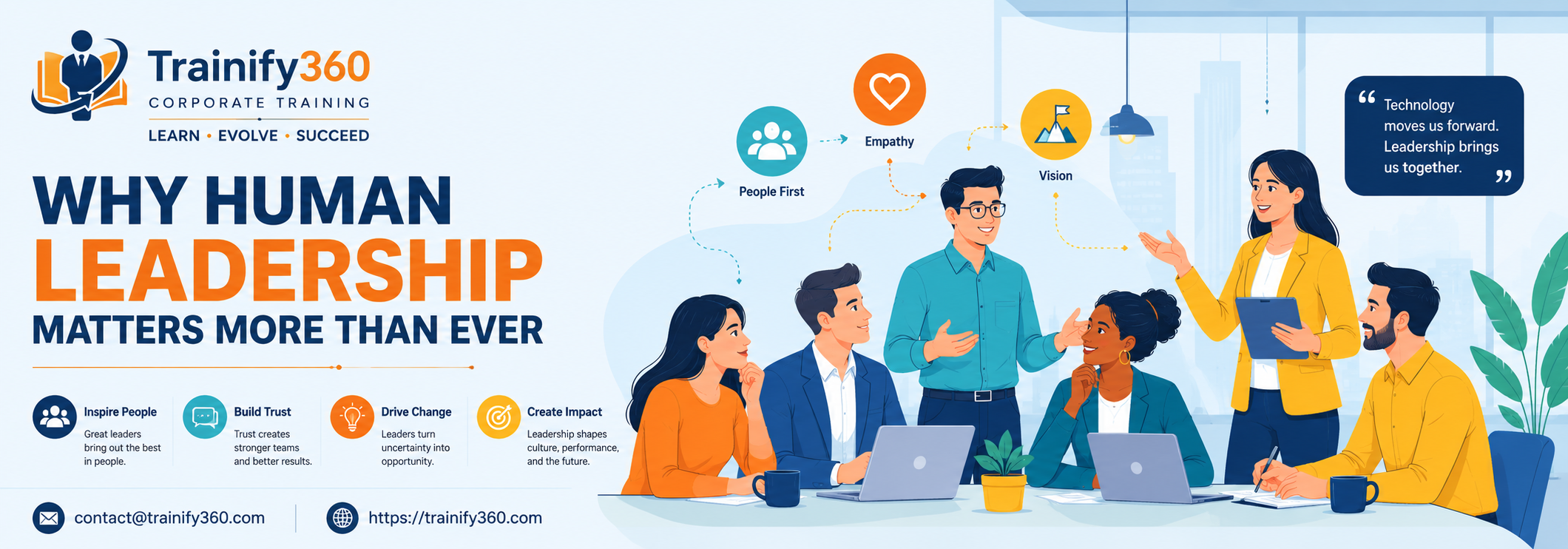
Why Human Leadership Matters More Than Ever
Artificial intelligence and data analytics have transformed the way organisations operate. Businesses today can predict customer behaviour, automate routine processes, analyse millions of data points within seconds, and make faster strategic decisions than ever before. AI has become an essential part of modern business, helping organisations improve efficiency, reduce costs, and unlock new opportunities for innovation.
Yet despite these technological advances, one reality remains unchanged: people lead businesses, not algorithms.
The companies achieving the greatest success with AI are not necessarily those with the most advanced technology. They are the ones with leaders who can combine data-driven insights with human judgment, empathy, communication, and strategic thinking. As AI becomes more capable, leadership becomes even more important, not less.
AI Doesn't Replace Leadership, It Changes It
There was a time when leadership decisions relied heavily on experience and instinct. Today, leaders have access to dashboards, predictive analytics, machine learning models, and real-time business intelligence. These tools provide valuable insights that help leaders make informed decisions.
However, AI can tell you what is happening.
Great leaders decide what should happen next.
A dashboard may identify declining employee engagement, but it cannot build trust with a concerned team. Predictive analytics may forecast customer churn, but it cannot negotiate, inspire confidence, or strengthen relationships. AI provides information, while leadership provides direction.
The most effective leaders understand that technology supports decision-making; it does not replace responsibility.
The Rise of Data-Driven Leadership
Modern organisations increasingly rely on data to guide strategic planning, marketing, operations, customer experience, and workforce management. Leaders are expected to understand data, ask the right questions, and make decisions backed by evidence rather than assumptions.
Data-driven leadership means:
- Making informed business decisions using reliable insights
- Measuring performance objectively
- Identifying risks before they become problems
- Understanding customer needs through analytics
- Improving operational efficiency
- Encouraging continuous improvement
However, becoming data-driven doesn't mean becoming data-dependent.
Successful leaders know that numbers reveal patterns, but they don't always explain human behaviour. Every chart has a story behind it, and understanding that story requires curiosity, conversation, and emotional intelligence.
Leadership Skills AI Can Never Replace
As organisations embrace automation, uniquely human leadership qualities become even more valuable.
Emotional Intelligence
AI can analyse sentiment in customer reviews or employee surveys, but it cannot genuinely understand emotions.
Leaders with emotional intelligence recognise concerns before they escalate. They listen actively, manage conflict constructively, and create environments where employees feel respected and valued.
Teams don't remain loyal because of software.
They stay because of leaders who make them feel supported.
Communication
Data only creates value when people understand it.
Leaders must communicate complex information in ways that inspire confidence and encourage action. Whether presenting strategy to executives or explaining organisational changes to employees, communication remains one of the most important leadership skills.
In AI-driven organisations, clear communication reduces uncertainty and helps employees embrace change rather than fear it.
Critical Thinking
AI generates recommendations based on available data, but leaders must evaluate those recommendations within the broader business context.
Questions such as:
- Is the recommendation ethical?
- Does it align with our company values?
- How will employees react?
- What long-term impact could this decision create?
These require critical thinking not automation.
Adaptability
Technology evolves rapidly. New AI tools appear almost every month, changing how organizations work.
Leaders who embrace continuous learning adapt more quickly, encourage innovation, and help teams stay competitive without becoming overwhelmed by constant change.
Adaptability has become one of today's most valuable leadership qualities.
Building Trust in an AI-Powered Workplace
Whenever organisations introduce new technology, employees often have concerns.
Will AI replace jobs?
Will automation reduce opportunities?
Will decisions become less personal?
These concerns cannot be addressed by technology alone.
Leaders play a crucial role in building trust by communicating openly about how AI will be used, explaining its benefits, and involving employees in the transformation process.
Organisations that focus only on technology often struggle with adoption.
Organisations that focus on people succeed because employees understand the purpose behind change.
Transparency creates confidence.
Confidence creates engagement.
Engagement drives successful transformation.
Leading Teams Through Intelligent Transformation
Digital transformation isn't just about implementing new software.
It is about helping people adopt new ways of working.
Successful leaders recognize that every technological change affects people differently. Some employees embrace innovation immediately, while others need guidance, reassurance, and additional support.
Leaders who invest time in coaching, training, and continuous learning create workplaces where employees view AI as an opportunity rather than a threat.
Instead of asking, "How can AI replace people?"
Forward-thinking leaders ask:
"How can AI help our people perform at their best?"
That mindset changes everything.
Creating a Culture Where Data Supports Innovation
Innovation thrives when employees feel comfortable experimenting with ideas, learning from mistakes, and using data to improve outcomes.
Leadership shapes this culture.
Rather than using analytics only to measure performance, successful leaders encourage teams to explore insights, ask better questions, and test new approaches.
When employees understand that data is a learning tool instead of a reporting tool, creativity increases.
Curiosity becomes part of everyday work.
Innovation becomes continuous.
Ethical Leadership in the Age of AI
As AI becomes more influential, ethical leadership becomes increasingly important.
Organizations must consider issues such as:
- Data privacy
- Responsible AI use
- Algorithmic bias
- Transparency
- Accountability
- Customer trust
Technology itself cannot decide what is ethically acceptable.
Leadership determines how AI should be implemented responsibly.
Ethical leaders establish governance, encourage transparency, and ensure technology aligns with both legal requirements and organisational values.
Companies that prioritise responsible AI are more likely to earn long-term trust from employees, customers, and stakeholders.
Investing in Leadership Development
Many organisations invest heavily in AI platforms, automation tools, and analytics software while overlooking leadership development.
Technology investments produce the greatest return when leaders know how to guide teams through change.
Modern leadership development should include:
- Strategic decision-making
- Emotional intelligence
- Communication skills
- Data literacy
- Change management
- Coaching and mentoring
- Collaboration across departments
- Ethical decision-making
These capabilities prepare leaders to manage both technological and human challenges.
Leadership development is no longer optional.
It is essential for sustainable growth.
The Future Belongs to Human-Centered Leaders
The future workplace will undoubtedly be shaped by artificial intelligence, automation, and advanced analytics. Yet technology alone cannot build strong cultures, inspire innovation, or create meaningful relationships.
People continue to look to leaders for vision, empathy, clarity, and confidence during times of change.
Organizations that combine intelligent technology with strong human leadership will be better equipped to navigate uncertainty, foster innovation, and achieve long-term success.
The most successful AI-driven companies will not simply be the ones with the smartest algorithms.
They will be the ones with leaders who know how to bring out the best in people while making the most of technology.
Final Thoughts
AI is transforming the way businesses operate, but leadership remains the driving force behind meaningful progress. Data can reveal opportunities, automate processes, and improve efficiency, but it cannot replace the human qualities that inspire teams, strengthen relationships, and shape organisational culture.
Leaders who embrace AI while prioritising empathy, communication, adaptability, and ethical decision-making create workplaces where both technology and people thrive.
Trainify360 – Developing Future-Ready Leaders
At Trainify360, we help organisations prepare leaders for an AI-driven future through practical leadership development, communication excellence, emotional intelligence, change management, and data-informed decision-making programs. Our learning solutions empower leaders to confidently navigate digital transformation while building engaged, resilient, and high-performing teams.
Because the future of work isn't powered by technology alone, it's powered by leaders who know how to lead people through intelligent transformation.