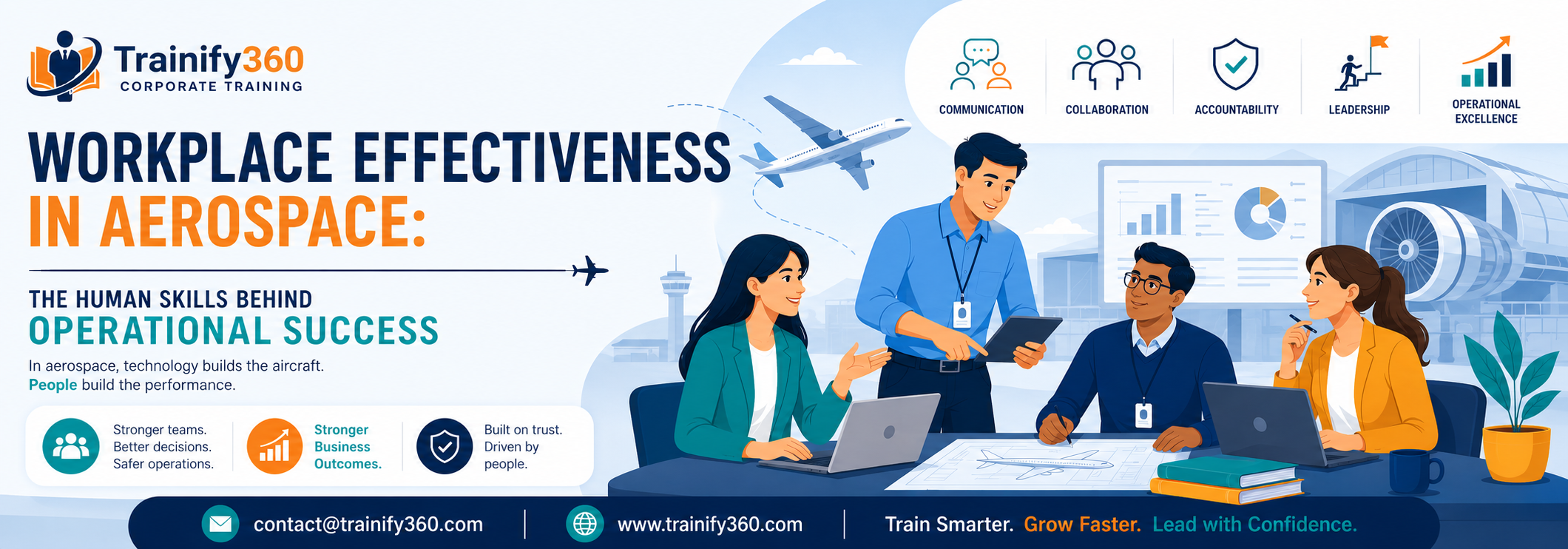
Workplace Effectiveness in Aerospace: The Human Skills Behind Operational Success
I was sitting in on a post-incident review at a manufacturing site a few years ago not an aerospace client, but the pattern was so familiar that an aerospace colleague in the room said, "This could have been one of ours." A part had been installed correctly. The torque was right. The documentation was in order. And yet something had gone wrong downstream, because two teams that needed to talk to each other simply hadn't. Nobody had been negligent. They had just assumed someone else had the information.
That's the story I keep coming back to when clients in aerospace ask me why their operational metrics aren't improving despite years of investment in systems, tooling, and technical training. The answer is rarely a skills gap in engineering. It's a gap in the human layer that sits underneath every technical process communication, judgment, coordination, and the willingness to speak up when something feels slightly off.
Precision Alone Doesn't Prevent Failure
Aerospace is arguably the most process-disciplined industry in the world. Checklists, certifications, redundant systems, and audit trails exist precisely because the cost of error is unacceptable. And yet, when you look at root-cause analyses across manufacturing, MRO, and flight operations, a consistent theme emerges: the technical failure is often the last domino, not the first. The first domino is usually a communication breakdown, a hierarchy that discouraged someone from raising a concern, or a handoff between shifts or departments that assumed too much.
This isn't a controversial idea inside the industry aviation has known it for decades, which is why Crew Resource Management became a standard part of pilot training after a string of accidents in the 1970s made it clear that technical competence without teamwork and communication discipline wasn't enough. What's changed is that this thinking now needs to extend well beyond the cockpit. Ground operations, supply chain teams, quality assurance, engineering design reviews, and program management all carry the same risk profile: capable people, working under pressure, who don't always coordinate as well as their individual skill levels would suggest.
Where the Gaps Actually Show Up
When I run diagnostics with aerospace clients, three patterns show up more than any others.
The first is silence under authority gradient. Junior engineers or technicians notice something questionable but don't escalate it, because the person who would need to hear it is several levels senior, and the culture even an unintentional one makes speaking up feel like a risk to career or relationships. This is not a training problem in the traditional sense. It's a leadership behaviour problem that training can address, but only if leaders themselves are willing to model it.
The second is handoff fragility. Shift changes, department transfers, and contractor-to-employee transitions are where information quietly degrades. Everyone believes they've communicated the full picture. Almost nobody has, because we tend to share what we think is important and skip what we assume the other person already knows.
The third is decision-making under time pressure. Aerospace timelines are unforgiving, a delivery schedule, a maintenance window, a certification deadline. Under that pressure, teams default to whoever speaks first or loudest, rather than running a structured decision process. This is exactly the scenario where good people make preventable mistakes, not because they lack judgment, but because the pressure crowds out the space to use it.
Why This Belongs on the CHRO's Desk, Not Just the Safety Officer's
I've noticed that workplace effectiveness in aerospace often gets treated as a safety and compliance topic, owned by quality and safety functions, with HR and L&D playing a supporting role at best. That framing undersells the issue. Communication discipline, psychological safety, and structured decision-making are organisational capabilities, and building organisational capability is squarely an HR and talent development mandate.
When a CHRO or CLO reframes workplace effectiveness as a leadership and culture issue rather than a compliance checkbox, the conversation changes. It stops being about "which course do we assign" and becomes "what behaviours do we need our leaders and teams to practise every day, and how do we build the muscle for that." That's a fundamentally different design brief, and it changes what the intervention looks like.
What Actually Moves the Needle
A few things consistently produce results with aerospace and other high-reliability clients:
Structured communication protocols, adapted from aviation's own playbook closed-loop communication, standardised handoff templates, and explicit escalation language that removes the ambiguity of "should I say something." These aren't complicated tools, but they only work if practised until they become habit, not policy.
Debrief discipline. The best-performing teams I've worked with debrief constructively after both failures and successes, asking what worked, what didn't, and what they'd do differently without turning it into blame. This is a skill, and it has to be taught and modelled, particularly by mid-level leaders who set the tone for their teams.
Decision-making under constraint. Teams benefit enormously from simple, repeatable frameworks for high-pressure decisions even something as basic as a pause-and-check step before a critical call. The goal isn't to slow people down; it's to interrupt the reflex to default to hierarchy or speed alone.
Leadership behaviour, not just leadership content. Senior leaders need to visibly invite dissent and correction, not just say they welcome it. Teams read behaviour far more than they read values statements, and one dismissive reaction to a raised concern can undo months of culture-building work.
The Business Case Is Straightforward
None of this is soft in the way the phrase "soft skills" implies. Miscommunication and unclear escalation paths show up directly in rework costs, schedule slippage, audit findings, and in the worst cases safety events. Organisations that invest deliberately in these human capabilities tend to see fewer repeat errors, faster and more accurate handoffs, and teams that catch problems earlier, when they're cheaper and easier to fix.
For talent leaders sitting across the table from operations and engineering executives, that's the argument worth making: this isn't a training initiative competing for budget against technical priorities. It's the layer that determines whether technical investment actually pays off in practice.
Where to Start
If you're responsible for workplace effectiveness in an aerospace organisation, the starting point isn't a broad rollout. It's a focused diagnostic a handful of structured conversations with frontline teams, supervisors, and shift leads to understand where communication actually breaks down, and where people hesitate to speak up. That diagnostic tells you far more than an engagement survey ever will, and it gives you a defensible, specific case for where to invest first.
The organisations that get this right don't treat human skills as an add-on to technical excellence. They treat them as the operating system technical excellence runs on. That's the shift worth making and it's one most aerospace leadership teams are more ready for than they might assume.
One word of caution, because I've seen well-intentioned programmes stall on this point: don't outsource the diagnostic entirely to a generic off-the-shelf module. Aerospace operations differ enormously between a design office, a production floor, and an MRO hangar, and the specific points of friction differ with them. Content built around the actual handoffs, escalation moments, and pressure points your teams face gets used, because people recognise their own reality in it.
This work also takes longer than a single workshop cycle. Habits around speaking up, structured handoffs, and disciplined debriefs are built through repetition and reinforcement from direct supervisors. Treat it as a twelve-to-eighteen-month capability build, not a one-off event. That's usually the difference between a programme that changes behaviour on the floor and one that changes only the training completion dashboard.