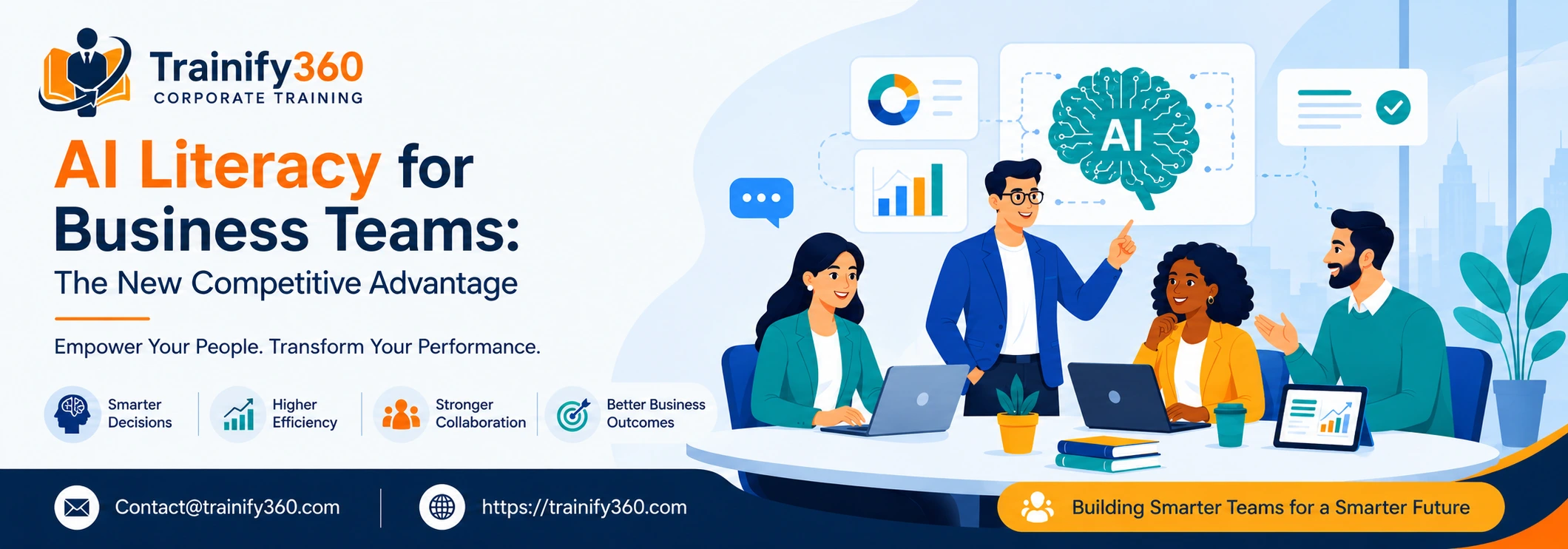
AI Literacy for Business Teams: The New Competitive Advantage
Artificial intelligence is completely changing how companies run, make decisions, and drive value. Interestingly, the businesses getting the best results aren't necessarily the ones dumping millions into tech. Instead, they are the ones investing heavily in their people.
For most executives, the conversation has officially moved past "Should we use AI?" to a much more practical question: "How do we make sure our team actually knows what to do with it?" The answer comes down to AI literacy.
This isn't just tech jargon for data scientists or IT departments anymore. Today, understanding AI is a core business skill. It empowers employees at every level to work faster, think sharper, collaborate smoothly, and adapt to shifting market demands. For CHROs, L&D directors, and C-suite executives, this represents a massive opportunity. Companies that build widespread AI skills wind up with more agile teams and a major boost in productivity. On the flip side, lagging means risking a widening gap between tech spending and actual performance. At the end of the day, the future of enterprise AI isn't about how advanced the software is, it’s about how confidently your people can use it.
Why AI Literacy Has Become a Business Priority
AI is already baked into the software your team opens every single day. Look at your daily workflows: productivity tools, CRM databases, HR systems, customer service portals, and communication apps all feature built-in AI tools.
Most companies have already paid for these features. But buying the software is only half the battle.
In reality, employees often touch only a tiny fraction of what these tools can do. Some feel intimidated by the tech, while others worry about accidentally breaking data privacy laws. Managers might see the potential but feel stumped on how to apply it to their team's specific daily tasks.
Because of this, companies face a frustrating loop:
- Paid AI licenses sit entirely unused.
- Productivity gains don't match the software's promises.
- Teams stick to slow, manual habits out of comfort.
- Fear of security or compliance issues completely stalls adoption.
- Leadership starts wondering if they wasted money on tech investments.
These roadblocks rarely stem from bad software. It’s almost always a skills gap. Widespread AI literacy bridges that gap. It’s not about teaching your staff to code or build machine learning models; it’s about showing them what AI can achieve, where it fits best, when human oversight is non-negotiable, and how to use it safely.
What Real AI Literacy Looks Like on the Ground
AI literacy is frequently mistaken for formal technical training. In practice, enterprise AI training is purely about workplace application.
Your employees need to walk away knowing:
- How AI directly assists their specific job role
- The art of writing clear, actionable prompts
- How to fact-check and validate AI outputs
- When to lean on AI and when to avoid it entirely
- Data privacy guardrails and ethical boundaries
- Company-specific rules and security policies
To see this in action, think about an HR specialist using AI to draft job openings or parse through employee feedback trends. A sales lead might use it to build deep-dive client briefs in minutes, while finance teams use it to spot trends across massive spreadsheets. Customer service reps can pull up exact troubleshooting steps instantly using AI search engines. The use cases look entirely different, but they all build off the same fundamental baseline of AI knowledge.
The Business Case: Why It Matters
Executives regularly ask if dedicated AI training justifies the line item in the budget. A better question is whether your business can afford to stay in the dark.
1. Slashing Unnecessary Overhead
Employees waste hours on mind-numbing administrative work, routine emails, and basic data gathering. AI can handle a massive chunk of this heavy lifting. But those efficiency gains only happen if your team knows how to prompt the tool correctly. A smart training program embeds AI right into daily workflows without dropping the ball on quality.
2. Sharper Corporate Decision-Making
AI helps teams parse data, spot invisible patterns, and summarise thick reports in seconds. When you pair that speed with human experience, decision-making skyrockets. AI shouldn't replace a professional's perspective; it should sharpen it. Teams that pair critical thinking with AI tools always outperform those that blindly copy-paste automated suggestions.
3. Overcoming Employee Anxiety
New tech naturally breeds anxiety. People worry about messing up or, worse, losing their jobs to automation. These fears stall adoption and kill ROI. AI literacy replaces fear with confidence by clearly outlining where human talent remains essential. When employees understand the tool, they stop fearing it and start experimenting with it.
4. Better Cross-Department Collaboration
AI impacts every corner of an organisation. Marketing uses it for copy ideas, sales for fast proposals, HR for tailored training, and finance for forecasting. When everyone speaks the same AI language and follows the same rules, cross-functional collaboration becomes much smoother.
5. Managing Risk and Compliance
As your company scales its AI usage, governance becomes critical. Without proper education, an employee might accidentally drop proprietary data into a public model or trust a flawed output. Training serves a dual purpose: it drives output up while driving corporate risk down.
Common Pitfalls to Avoid
Many companies realize they need AI skills but totally misjudge what it takes to build them. Giving people access to a tool or hosting a single lunch-and-learn rarely changes daily habits. Here is where most strategies fall short:
- Treating it like an IT course: A marketing manager doesn't need a lecture on neural networks. They need to know how to plan a campaign or analyze customer feedback using the tool. Keep the focus entirely on practical application.
- Using a cookie-cutter approach: A finance analyst and a customer service rep need entirely different skills. Building distinct, role-based learning paths ensures the training actually feels relevant to their daily lives.
- Forgetting about safety guidelines: Assuming employees instinctively know how to handle sensitive data is a massive gamble. Governance, bias awareness, and human verification must be core pillars of your training.
- Obsessing over tools instead of results: Tracking success by the number of software licenses handed out is a vanity metric. Focus instead on real business outcomes: faster project turnaround, improved customer satisfaction, and hours saved.
Strategic Best Practices for Leadership
Building a capable workforce requires a commitment to continuous learning rather than a single check-the-box event.
Align the Leadership First
Change always starts at the top. Before rolling out training to the wider team, executives need to be on the same page regarding goals, security boundaries, and priorities. When managers actively use the technology themselves, employees naturally follow suit.
Point Out High-Impact Wins
Don’t just tell your team to "use AI more." Give them concrete examples tailored to their departments:
- HR: Automate initial policy drafts and summarise employee engagement surveys.
- Sales: Run prospect research and build proposal templates quickly.
- Finance: Build instant executive summaries from quarterly reports.
- Operations: Identify bottlenecks and streamline logistics tracking.
Create a Safe Sandbox
People learn best by doing. Give your staff the freedom to experiment with real-world tasks, but keep clear guardrails around data security. Finding this balance lets your team innovate without exposing the company to liability.
Commit to the Long Game
The AI landscape changes every single week, which means a single training session will be outdated in six months. The most successful organisations treat AI learning as an ongoing journey, utilising brief workshops, peer knowledge-sharing, and regular updates on new tools.
Why Choose Trainify360?
Transforming your workforce requires more than buying a new software subscription. You need a structured, practical approach that ties technology directly to your business goals.
At Trainify360, we partner with organisations to build custom learning paths designed around your company’s goals and maturity level.
Our targeted programs cover:
- Foundational AI concepts for business professionals
- Strategic AI frameworks for managers and executives
- Hands-on prompt engineering to maximise daily output
- Compliance, risk management, and governance principles
- Department-specific workshops (HR, Sales, Finance, Operations, Customer Service)
- Blended learning formats, including live instructor sessions and virtual labs
We look past the technical hype to focus entirely on building confident, capable teams that use AI responsibly to drive actual business value.
Conclusion
Artificial intelligence is quickly becoming a permanent fixture of modern business infrastructure. Moving forward, the competitive edge won't belong to companies with the biggest tech budgets, it will belong to the ones with the most AI-literate workforces.
Investing in your people gives them the confidence to innovate, sharpens corporate decision-making, and protects your business from compliance risks. For modern business leaders, building this capability is no longer an optional training exercise; it is a core strategic move. The companies that take the time to prepare their teams today are the ones that will lead, scale, and dominate tomorrow.