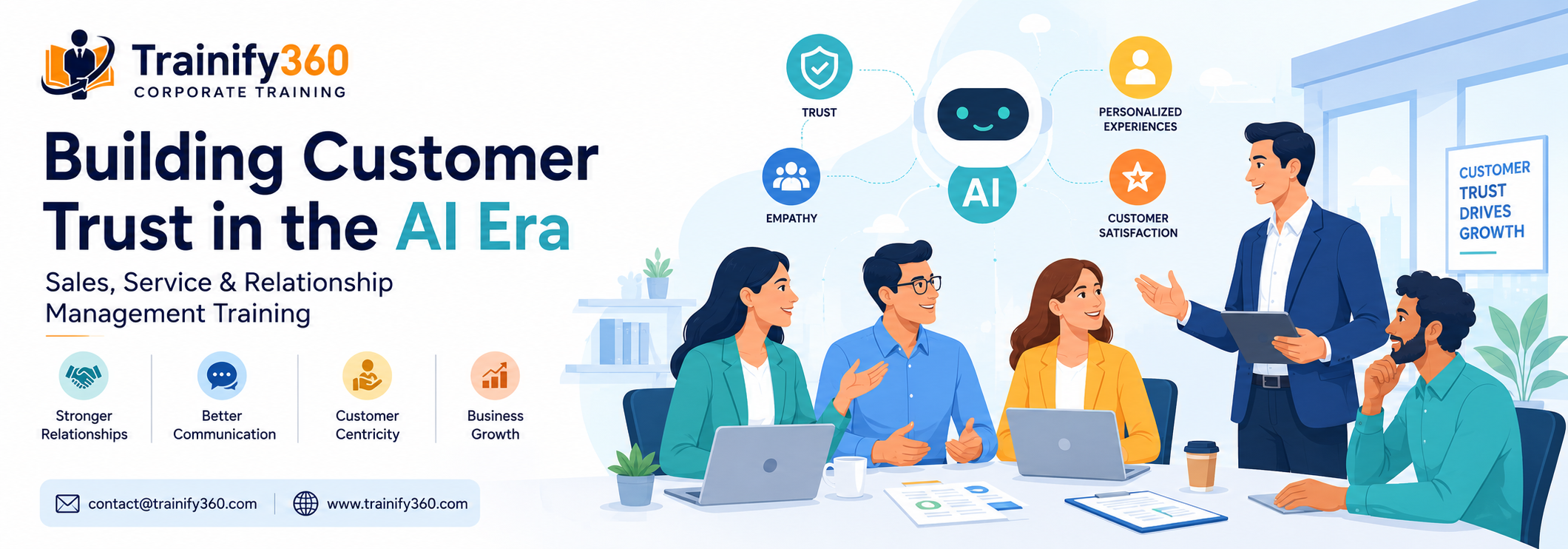
Building Customer Trust in the AI Era: Sales, Service & Relationship Management Training
Artificial Intelligence isn't just changing the way organisations work behind the scenes. it is also changing what customers expect from every interaction.
Customers have become accustomed to quick responses, personalised recommendations, and seamless digital experiences. They expect businesses to understand their preferences, remember previous conversations, and provide relevant solutions without unnecessary delays. AI has made many of these expectations achievable.
However, meeting customer expectations involves far more than speed and automation.
Most people have experienced the frustration of interacting with a chatbot that responds instantly but fails to understand the real issue. Others have received highly personalised marketing emails only to encounter poor communication after becoming a customer. While the technology performs exactly as intended, the overall experience often feels disconnected.
Customers notice these inconsistencies.
They don't judge an organisation solely by the sophistication of its technology. They judge it by how easy it is to do business with, how well employees understand their concerns, and how confidently problems are resolved.
This is where the human element becomes indispensable.
Artificial Intelligence can analyse customer behaviour, identify patterns, and recommend possible actions. What it cannot do is recognise the emotion behind a difficult conversation, reassure a concerned client, or build confidence during a high-stakes business discussion.
Those moments depend on people who know how to listen, ask thoughtful questions, and respond with empathy.
The organisations creating the strongest customer relationships are not trying to replace people with AI. Instead, they are using AI to handle routine tasks, giving employees more time to focus on conversations that require judgement, creativity, and relationship-building.
Technology provides the information.
People create the experience.
And that experience is what customers remember long after the transaction is complete.
The Role of Learning in Building Customer Confidence
Many organisations approach AI implementation as a technology initiative.
The platform is selected, systems are integrated, employees receive software training, and the rollout begins. While these steps are essential, they represent only one part of the transformation.
The real challenge starts once employees begin using AI in their day-to-day work.
Knowing how to operate a new platform is important, but knowing when to rely on AI, when to apply professional judgement, and how to use technology to improve customer interactions requires a different level of capability.
That capability is built through learning.
Learning and Development teams now have an opportunity to move beyond technical training and focus on preparing employees for a new way of working. Future-ready customer-facing professionals need to understand not only how AI functions, but also how it fits into the broader customer experience.
This means strengthening skills that remain essential regardless of how technology evolves.
Consultative selling.
Business communication.
Relationship management.
Emotional intelligence.
Critical thinking.
Commercial judgement.
Problem-solving.
These capabilities enable employees to interpret AI-generated insights, adapt to different customer situations, and make decisions that technology alone cannot.
Forward-thinking organisations are already taking this approach. Rather than treating AI capability and customer experience as separate learning initiatives, they combine them into a single development strategy. Employees learn how technology can support better decisions while continuing to place the customer at the centre of every interaction.
The outcome is far more than improved technical competence.
Teams become more confident in using AI, managers make better-informed decisions, and customers experience conversations that feel personal, thoughtful, and relevant.
Ultimately, AI may enhance the way organisations serve their customers, but it is learning that enables people to turn technology into meaningful customer experiences.
Developing Customer-Focused Teams for an AI-Enabled Workplace
Artificial Intelligence is changing the way customer-facing teams work, but it isn't changing what customers value most.
Customers still want to feel heard. They expect honest conversations, thoughtful advice, and confidence that the person sitting across the table understands their business. AI can support these interactions by providing better information, but it cannot replace the trust that develops through genuine human engagement.
This is why the role of sales and service professionals is evolving rather than disappearing.
As AI takes over routine tasks such as updating CRM records, analysing customer data, generating reports, or responding to basic enquiries, employees have more time to focus on activities that create real business value. They can spend more time understanding customer challenges, building stronger relationships, and working collaboratively to find solutions.
However, making the most of this opportunity requires more than learning how to use new technology.
Employees need to know how to interpret AI-generated insights, ask meaningful questions, communicate with confidence, and adapt their approach to different customer situations. They also need the judgement to recognise when technology provides the answer and when human experience should guide the conversation.
These capabilities don't develop through software training alone.
They require continuous learning, practical experience, and coaching.
For Learning and Development teams, this presents an opportunity to rethink how customer-facing capability is developed. AI training should not sit separately from programmes focused on sales, service, communication, or leadership. Instead, organisations should bring these areas together to create learning experiences that reflect how people actually work.
Future-ready programmes should help employees strengthen consultative selling, customer relationship management, communication skills, emotional intelligence, negotiation, stakeholder management, and commercial thinking while building confidence in using AI responsibly.
When organisations develop both digital capability and human capability together, employees become better equipped to create experiences that customers genuinely value.
Leadership Sets the Standard
Customer experience is often viewed as the responsibility of sales and service teams, but in reality, it starts with leadership.
The behaviours leaders encourage quickly become part of an organisation's culture.
If employees are recognised only for meeting sales targets or improving response times, they are naturally likely to focus on short-term results. While these measures are important, they don't always encourage the behaviours that build long-term customer relationships.
The organisations that consistently earn customer loyalty take a broader view.
Their leaders recognise that trust is built through collaboration, accountability, ethical decision-making, and a genuine commitment to customer success. They encourage employees to solve problems rather than simply complete transactions. They create an environment where listening to customers is valued just as much as closing deals.
Leadership also plays an important role in how employees respond to AI.
Introducing a new technology is often the easiest part of transformation. Helping people feel confident enough to use it effectively requires ongoing support.
Managers who encourage experimentation, provide regular coaching, and create opportunities for employees to apply new skills in real business situations help build confidence across their teams. They position AI as a tool that strengthens professional judgement rather than replacing it.
When leaders invest in both technology and people, they create teams that are adaptable, customer-focused, and prepared for future change.
Measuring Success Beyond Training Metrics
One of the biggest shifts taking place in Learning and Development is how organisations define success.
For many years, learning was measured by attendance, course completion, or assessment scores. While these metrics remain useful for tracking participation, they say very little about whether learning has improved business performance.
The more important question is simple:
Has learning changed the way people work?
Organisations should look beyond traditional training metrics and evaluate outcomes that reflect meaningful business impact.
Are sales conversations becoming more consultative?
Are customer service teams resolving issues with greater confidence?
Are customers staying with the organisation for longer?
Has customer satisfaction improved?
Are employees making better use of AI to support decision-making without losing the personal connection customers value?
These are the indicators that demonstrate whether capability development is delivering value.
Another important consideration is recognising that learning doesn't end when a programme concludes.
The most successful organisations create a culture where learning continues through coaching, mentoring, peer discussions, practical application, and regular feedback. Employees are encouraged to reflect on customer interactions, share experiences, and continuously improve their approach.
When learning becomes part of everyday work, employees continue to grow, customer experiences become more consistent, and organisations build stronger, more trusted relationships over time.
How Trainify360 Helps Businesses Build Customer-Centric Teams
At Trainify360, we believe that customer trust is not built through technology alone. It is built through people who know how to use technology wisely while creating meaningful customer experiences.
As AI becomes an integral part of sales, customer service, and relationship management, organisations are recognising that successful transformation goes beyond implementing new tools. The real challenge is helping employees use those tools to build stronger relationships, make better decisions, and deliver consistent value to customers.
That's where our Building Customer Trust in the AI Era: Sales, Service & Relationship Management Training programme makes a difference.
Our approach is designed to help customer-facing teams develop the skills they need to succeed in an AI-enabled workplace without losing the human qualities that customers continue to value. Alongside AI awareness, we focus on strengthening consultative selling, customer relationship management, business communication, negotiation, emotional intelligence, stakeholder management, and customer-centric decision-making.
We understand that every organisation has different goals, customer expectations, and business challenges. That's why our learning programmes are never one-size-fits-all. Each programme is tailored to reflect the organisation's industry, business priorities, and workforce capability.
Learning is designed to be practical from the very beginning. Participants work through real business scenarios, customer conversations, case studies, simulations, and facilitated discussions that closely reflect the situations they encounter in their day-to-day roles. The objective is simple to ensure employees can immediately apply what they learn and create better outcomes for both customers and the business.
For us, learning is more than delivering a workshop. It is about helping organisations build confident professionals who can combine technology with empathy, commercial judgement, and strong relationship-building skills.
Because while AI will continue to reshape the workplace, organisations that consistently earn customer trust will always be those that invest in developing their people.
Final Thoughts
Artificial Intelligence is changing the way organisations sell, serve, and support their customers. It is helping businesses improve efficiency, make more informed decisions, and deliver increasingly personalised experiences.
However, technology has not changed what customers value most.
Customers still choose organisations that understand their business, communicate openly, respond with integrity, and consistently deliver on their commitments. These qualities are not created by algorithms. They are demonstrated by professionals who know how to combine technology with empathy, sound judgement, and genuine customer focus.
For CHROs, HR leaders, Learning & Development professionals, and business executives, this presents an opportunity to rethink how customer-facing capability is developed. Preparing employees for an AI-enabled future is no longer only about digital skills. It is about equipping people with the confidence to use technology while strengthening the relationships that drive long-term business success.
Organisations that invest in both AI capability and human capability will be better positioned to build customer loyalty, improve business performance, and adapt confidently to changing market expectations.
At Trainify360, we partner with organisations to develop future-ready teams through practical, business-focused learning programmes that combine AI readiness with the communication, leadership, and relationship management skills customers continue to value.
Because technology can improve efficiency.
People create trust. And trust remains the strongest foundation for every successful customer relationship.