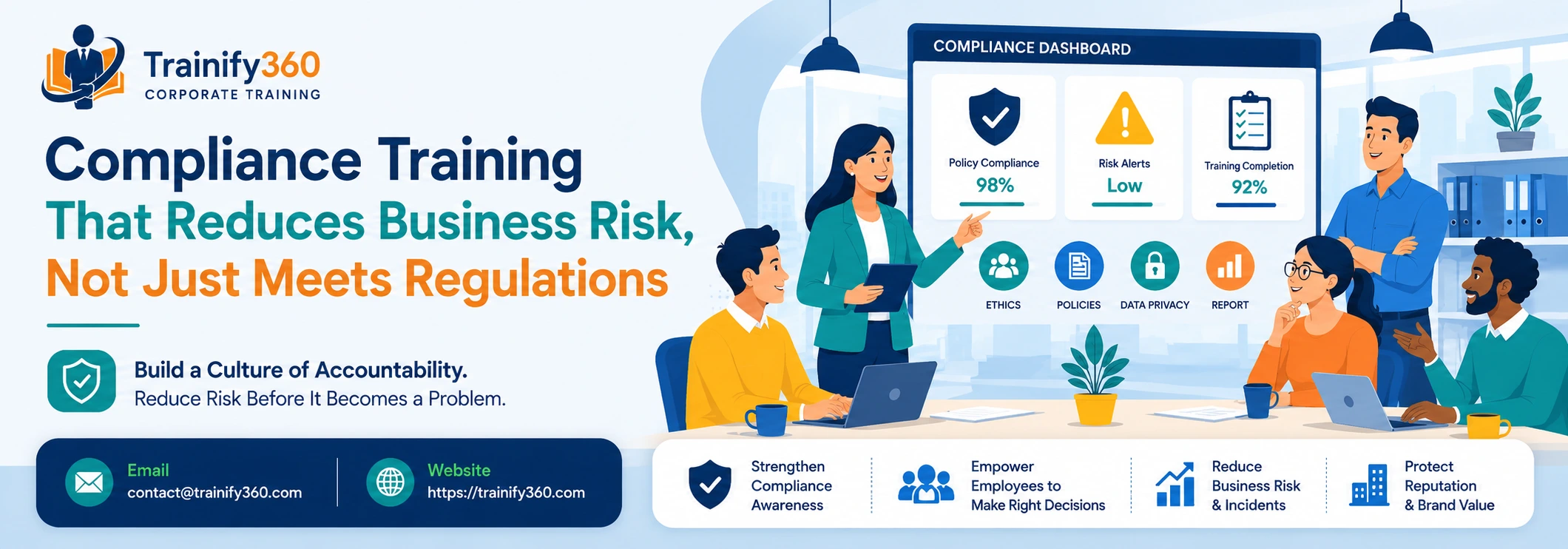
Compliance Training That Reduces Business Risk, Not Just Meets Regulations
For many organisations, compliance training has become a predictable annual exercise. Employees complete mandatory courses, answer a short assessment, receive a certificate, and move on. From an audit perspective, the organisation has met its obligation. From a business perspective, however, very little has changed.
The real purpose of compliance training is not to satisfy regulators. It is to reduce business risk by influencing employee decisions, strengthening ethical behaviour, and creating a culture where people understand their responsibilities before problems occur.
The organisations that consistently outperform their peers understand this distinction. They don't measure success by course completion rates alone. They evaluate whether their compliance programmes reduce incidents, improve decision-making, and protect the organisation's reputation.
For HR leaders, Chief Learning Officers, compliance teams, and business executives, this shift represents an opportunity to move compliance training from a regulatory requirement to a strategic business capability.
Compliance Is a Business Issue, Not Just an HR Responsibility
Every business faces risk. Some risks are financial. Others are operational, legal, reputational, or cyber-related. In almost every case, employees play a significant role in either reducing or increasing that risk.
A data privacy breach rarely occurs because employees intentionally ignore company policies. More often, it happens because someone misunderstood a procedure, clicked a malicious email, shared confidential information incorrectly, or simply wasn't aware of the consequences.
The same applies to workplace harassment, anti-bribery requirements, information security, health and safety, diversity and inclusion, and code of conduct violations. Policies alone do not prevent incidents. People do.
This is why compliance training deserves the same strategic attention as leadership development or digital transformation initiatives. When employees consistently make informed decisions, the organisation becomes more resilient.
Why Traditional Compliance Training Falls Short
Many compliance programmes focus heavily on information rather than behaviour.
Employees are expected to read lengthy policies, complete generic e-learning modules, and answer knowledge-based questions. While this approach may satisfy documentation requirements, it rarely changes how employees respond to real workplace situations.
Several common issues limit the effectiveness of traditional compliance learning:
- Content is too generic and disconnected from employees' daily responsibilities.
- Training is delivered once a year with little reinforcement.
- Success is measured by completion rates instead of behavioural outcomes.
- Employees see compliance as an administrative requirement rather than part of their professional responsibilities.
- Managers are rarely involved in reinforcing expectations after training ends.
When learning feels like a checkbox exercise, employees retain very little. More importantly, they struggle to apply what they have learned when faced with real business decisions.
Make Compliance Relevant to Every Role
One of the most effective ways to improve compliance outcomes is to personalise learning for different functions across the organisation.
An HR professional encounters different compliance challenges than someone in procurement, finance, sales, manufacturing, or customer service.
Rather than delivering identical content to every employee, organisations should tailor examples and scenarios to reflect real workplace situations.
For example:
- Sales teams should explore realistic situations involving gifts, entertainment, anti-bribery regulations, and customer confidentiality.
- Finance teams should understand fraud prevention, financial reporting standards, and internal controls.
- HR teams should practise responding to workplace investigations, discrimination concerns, and employee privacy requirements.
- Operations teams benefit from practical scenarios involving safety procedures, operational compliance, and incident reporting.
When employees recognise situations they encounter every day, learning becomes more meaningful and significantly easier to apply.
Move Beyond Policies and Focus on Decisions
Compliance failures rarely occur because employees cannot remember a policy document.
They happen because people make decisions under pressure, with incomplete information, or while balancing competing priorities.
Effective compliance training prepares employees for these moments.
Scenario-based learning allows participants to evaluate realistic situations, consider potential consequences, and choose appropriate actions before they encounter similar circumstances in the workplace.
For example, instead of asking employees to memorise sections of a code of conduct, present a scenario where confidential customer information is accidentally shared outside the organisation.
Ask participants:
- What are the immediate risks?
- Who should be informed?
- What actions should be taken first?
- How could the situation have been prevented?
This approach develops judgment rather than memorisation.
Build a Culture Where Speaking Up Is Encouraged
Even the strongest compliance framework cannot eliminate every risk.
What distinguishes resilient organisations is how quickly employees identify and report concerns.
Employees should feel confident raising questions, reporting potential violations, and seeking guidance without fear of retaliation.
This requires more than a reporting hotline. It requires visible leadership commitment.
Senior leaders and managers must consistently demonstrate ethical decision-making, discuss compliance openly during team meetings, and reinforce that reporting concerns is part of protecting the organisation, not creating problems.
When employees trust the process, issues are identified earlier, investigated more effectively, and resolved before they become significant business risks.
Reinforcement Matters More Than Annual Training
Knowledge fades quickly when it is not reinforced.
A single compliance course completed once every twelve months cannot prepare employees for the risks they encounter throughout the year.
Leading organisations now adopt continuous compliance learning through smaller, targeted learning experiences.
Examples include:
- Monthly compliance reminders.
- Five-minute microlearning modules.
- Interactive case studies.
- Team discussions based on recent industry events.
- Manager-led conversations during team meetings.
- Regular phishing simulations and cybersecurity exercises.
These smaller interventions require less employee time while significantly improving long-term knowledge retention.
More importantly, they keep compliance visible throughout the year rather than limiting it to an annual campaign.
Measure Business Outcomes, Not Training Activity
Many compliance dashboards focus on operational metrics such as enrolments, completion percentages, and assessment scores.
While these metrics remain useful, they tell only part of the story.
Business leaders should also monitor indicators that demonstrate organisational impact.
These may include:
- Reduction in policy violations.
- Fewer workplace incidents.
- Improved cybersecurity awareness.
- Faster reporting of compliance concerns.
- Higher employee confidence in handling ethical dilemmas.
- Positive audit findings.
- Reduced legal and financial exposure.
When learning metrics are connected to business outcomes, compliance training becomes easier to justify as a strategic investment rather than a mandatory expense.
Leadership Determines Whether Compliance Becomes Culture
Policies establish expectations, but leadership shapes culture.
Employees observe how leaders make decisions far more closely than they read policy documents.
If managers prioritise ethical behaviour, encourage open conversations, and demonstrate accountability, compliance becomes embedded in everyday business practices.
Conversely, when leaders focus exclusively on commercial results while ignoring ethical standards, employees receive conflicting messages.
Organisations that successfully reduce business risk ensure their leadership teams actively participate in compliance initiatives rather than delegating responsibility solely to HR or legal departments.
Compliance becomes part of how the organisation operates not simply another training programme.
How Trainify360 Helps Organisations Build Risk-Aware Workforces
At Trainify360, we believe compliance learning should create confident employees, informed managers, and stronger organisations not simply generate completion certificates.
Our corporate compliance programmes combine practical business scenarios, engaging learning experiences, and role-specific content that employees can immediately apply in their day-to-day work.
Whether organisations are strengthening cybersecurity awareness, reinforcing workplace ethics, improving information security, supporting anti-harassment initiatives, or meeting regulatory requirements, our programmes focus on one objective: helping employees make better decisions when it matters most.
We work closely with HR leaders, Learning & Development teams, and business stakeholders to design learning experiences that align with organisational priorities while supporting measurable business outcomes.
Final Thoughts
Compliance training should never be viewed as an annual obligation that ends once employees complete a course.
Its real value lies in reducing operational risk, strengthening ethical decision-making, protecting organisational reputation, and building a workplace where employees understand both the rules and the reasons behind them.
For organisations committed to sustainable growth, compliance learning is not simply about meeting regulations. It is about creating a culture where responsible decisions become part of everyday work.
Creating a resilient organisation starts with helping employees make the right decisions every day—not just ensuring they complete mandatory training.
If you're looking to move beyond tick-box compliance, Trainify360 can help. We work with organisations to design practical, engaging compliance training that builds employee confidence, encourages responsible decision-making, and helps reduce business risk. Get in touch with our team to explore how we can support your compliance and learning goals.