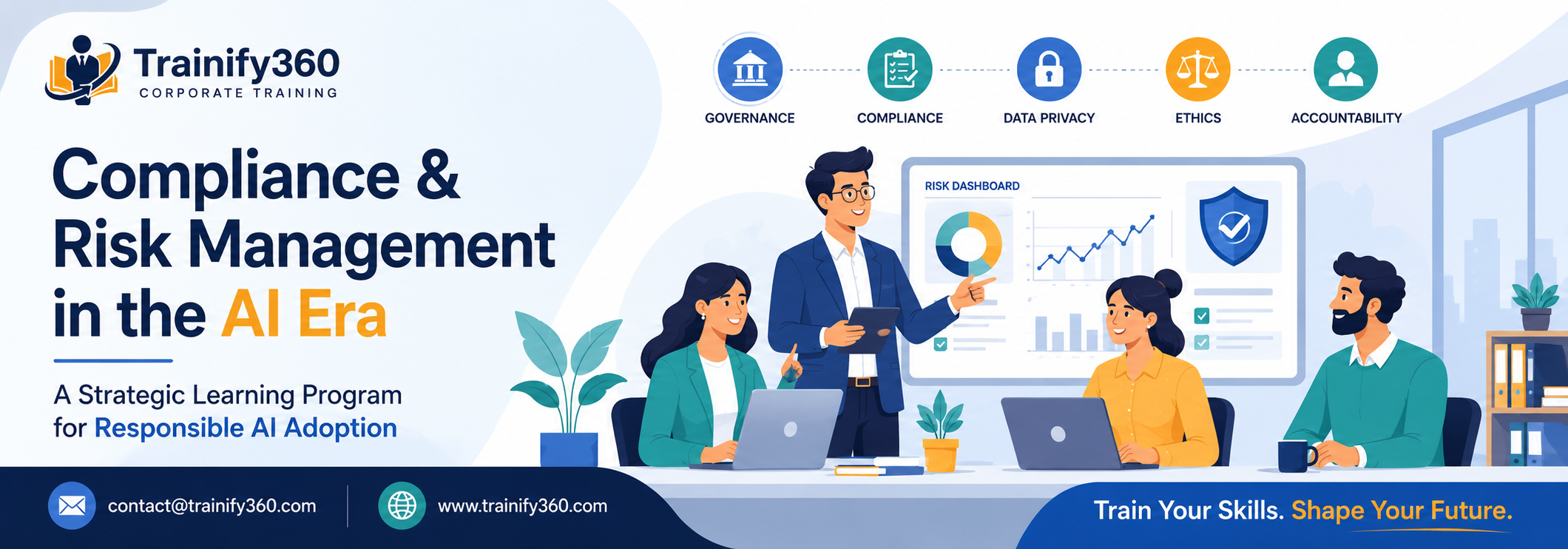
Compliance & Risk Management in the AI Era: A Strategic Learning Program
Artificial intelligence has quietly become part of everyday business. Whether it's helping recruiters screen applications, assisting customer service teams, forecasting demand, or supporting financial analysis, AI is now influencing decisions across almost every function.
Most organisations have focused their attention on selecting the right AI tools. Far fewer have invested the same energy in preparing their people to use those tools responsibly.
That difference matters.
Technology may accelerate decisions, but people remain accountable for the outcomes. Every AI-generated recommendation, every automated workflow, and every data-driven insight carries implications for compliance, ethics, privacy, and business risk. These are no longer issues that sit exclusively with legal teams or information security departments. They have become leadership responsibilities.
As organisations continue expanding their AI capabilities, the conversation is shifting. The question is no longer "Should we adopt AI?" Instead, business leaders are asking, "How do we ensure AI is used responsibly, consistently, and in line with our organisational values?"
The answer lies in developing people alongside technology. A strategic learning programme that combines compliance, governance, ethics, and risk management equips employees to make informed decisions, recognise potential issues early, and build confidence in responsible AI adoption.
AI Has Changed the Nature of Business Risk
For years, compliance programmes centred around financial regulations, workplace policies, data protection, and operational controls. Those areas remain important, but AI introduces an entirely new layer of complexity.
Unlike traditional software, AI systems often learn from data, generate recommendations, and support decisions that directly affect customers, employees, and business operations. That creates questions organisations may never have considered before.
Can a hiring manager explain why an AI system shortlisted one candidate over another?
Who is responsible if an automated recommendation leads to an incorrect business decision?
What safeguards exist to prevent confidential business information from being entered into public AI tools?
How frequently should AI models be reviewed to ensure they continue producing fair and reliable outcomes?
These questions don't have simple answers. They require collaboration between business leaders, HR, legal, IT, operations, and compliance teams.
The organisations that successfully manage AI are not necessarily those with the most advanced technology. They are the ones building governance into everyday decision-making.
Compliance Is No Longer Just a Legal Function
One of the biggest shifts brought about by AI is the way responsibility is shared across the organisation.
In the past, compliance was often viewed as something managed by legal teams, internal auditors, or regulatory specialists. Employees typically became involved only when mandatory training or policy updates were rolled out.
That approach no longer reflects how modern organisations operate.
AI influences decisions made by recruiters, marketers, finance professionals, procurement teams, customer service representatives, manufacturing managers, and senior executives alike. Each department faces different risks, but all contribute to responsible AI usage.
Consider a few common examples. A recruitment team using AI to screen applications must understand how bias can appear in automated decision-making.
A marketing department creating AI-generated content should recognise intellectual property considerations, copyright obligations, and brand governance.
Finance teams relying on predictive analytics need confidence that AI-generated insights can be validated before influencing business decisions.
Meanwhile, procurement teams evaluating AI vendors should know what questions to ask about data security, privacy standards, contractual responsibilities, and model transparency.
None of these challenges can be solved through policy documents alone.
They require practical knowledge and sound judgement.
Why Many AI Policies Never Deliver the Expected Results
Many organisations have already introduced AI policies. Some have established governance committees, published acceptable-use guidelines, or developed internal frameworks for responsible AI.
These are positive steps. However, documentation alone rarely changes behaviour.
Employees don't make decisions based on policy manuals during a busy working day. They rely on their understanding, experience, and confidence.
If they are unsure how a policy applies to a real business situation, uncertainty often leads to inconsistency.
For example, imagine an employee using a generative AI platform to prepare a customer proposal. They may not immediately recognise that confidential pricing information should never be entered into a public AI application.
Another employee may unknowingly rely on AI-generated financial data without verifying its accuracy because the system appears credible. Neither situation necessarily results from negligence. More often, it reflects a lack of practical learning.
Effective training closes this gap by helping employees understand not just what the policy says, but why it exists and how it applies to their day-to-day responsibilities.
When people understand the reasoning behind governance practices, they make better decisions—even in situations where no written policy provides a perfect answer.
What Effective Learning Looks Like
Many compliance programmes still rely on annual presentations followed by multiple-choice assessments.
While these sessions may satisfy mandatory training requirements, they rarely influence everyday decision-making.
Learning becomes meaningful when employees can connect governance principles to situations they genuinely face at work.
Instead of focusing only on regulations, organisations should encourage discussion around practical business scenarios.
For example:
- A customer requests that personal information be processed using an AI platform hosted outside the country.
- A manager wants to use AI-generated performance summaries during employee appraisals.
- A sales team plans to create client proposals with generative AI.
- An operations team introduces predictive AI for production planning without fully understanding how recommendations are generated.
These situations are far more effective learning opportunities than memorising regulatory terminology.
When participants discuss realistic scenarios, they develop judgement rather than simply acquiring information.
That distinction is significant because AI governance depends less on remembering rules and more on making thoughtful decisions when the answers are not always obvious.
Learning Should Reflect Different Roles Across the Business
One-size-fits-all compliance training rarely delivers meaningful outcomes.
The learning needs of a Chief Human Resources Officer are very different from those of a frontline manager. Similarly, an IT security specialist faces different governance challenges than someone working in procurement or customer service.
An effective learning strategy recognises these differences.
Senior executives need to understand strategic governance, regulatory exposure, organisational accountability, and the broader business implications of AI investments.
Department heads require practical guidance on implementing responsible AI practices within their teams while balancing operational objectives.
Functional teams benefit from role-specific examples that reflect their daily responsibilities. HR professionals may focus on ethical recruitment, employee privacy, and workforce analytics.
Marketing teams need greater awareness of copyright, brand protection, and responsible content creation.
Finance leaders require confidence in validating AI-assisted forecasting and reporting. Operations teams should understand model monitoring, quality assurance, and process reliability.
When employees see direct relevance to their own work, engagement improves significantly. More importantly, responsible behaviour becomes part of everyday business practice rather than something associated only with annual compliance training.
Building a Culture That Supports Responsible AI
Strong governance cannot be created through policies alone. It develops through organisational culture.
Employees should feel comfortable questioning AI-generated recommendations, raising concerns about potential risks, and discussing ethical dilemmas without worrying that doing so will slow progress or attract criticism.
That kind of environment begins with leadership. When executives openly discuss responsible AI, ask thoughtful questions before approving new technologies, and encourage transparency around decision-making, they send a clear message that governance is a business priority—not an administrative exercise.
The organisations that build lasting trust in AI are rarely those with the largest technology budgets.
More often, they are the ones who create a culture where curiosity, accountability, and ethical judgement are valued just as highly as innovation.
In the long run, that culture becomes one of the strongest safeguards against unnecessary risk—and one of the greatest enablers of responsible growth.
The Business Value of AI Governance Training
Many organisations still view compliance training as a mandatory exercise, something to complete because regulations require it. While compliance is certainly one outcome, limiting the conversation to regulatory obligations misses the broader business value.
A well-designed AI governance programme strengthens decision-making across the organisation.
When employees understand where AI should be used, where human judgement must take precedence, and how to identify potential risks before they become business issues, they make better decisions with greater confidence.
Consider a product team introducing an AI-powered customer service solution. Without proper guidance, the focus may remain on improving response times and reducing operational costs. With appropriate governance training, the discussion naturally expands to include customer privacy, transparency, data retention, escalation procedures, and accountability.
That shift changes the quality of decisions. Instead of reacting to compliance concerns after implementation, teams begin identifying them during planning. Projects move forward with fewer surprises, stronger governance, and greater stakeholder confidence.
Over time, organisations also benefit from improved collaboration. HR, Legal, IT, Operations, Risk, and Business leaders develop a shared understanding of responsible AI, making cross-functional discussions more productive and aligned.
Ultimately, responsible AI is not about slowing innovation; it is about enabling sustainable innovation.
Preparing for a Changing Regulatory Environment
The regulatory landscape surrounding artificial intelligence continues to evolve.
Across different regions, governments and industry regulators are introducing new expectations around transparency, accountability, data protection, explainability, and human oversight. While the pace and scope of these regulations vary, one trend is consistent: organisations are expected to demonstrate greater responsibility in how AI systems are developed, deployed, and monitored.
Waiting for regulations to become mandatory is rarely a successful strategy. Forward-thinking organisations prepare in advance by strengthening internal capabilities rather than relying solely on external compliance advice.
That preparation starts with people. Employees who understand governance principles can adapt more quickly as regulations evolve because they already appreciate the reasoning behind responsible AI practices. Instead of learning entirely new behaviours, they refine existing ones to meet updated requirements.
This approach reduces disruption and allows organisations to respond confidently as regulatory expectations continue to mature.
Measuring the Success of Learning Programmes
One of the biggest mistakes organisations make is measuring training solely through attendance records or course completion rates.
Completing an online module does not necessarily mean employees are equipped to make better decisions.
The real question is whether learning has changed behaviour.
Effective AI compliance programmes should be evaluated against business outcomes rather than learning activity alone.
For example:
- Are managers identifying AI-related risks earlier in projects?
- Has awareness of data privacy improved across departments?
- Are teams documenting AI usage more consistently?
- Have internal audits highlighted fewer governance concerns?
- Are employees more confident in escalating ethical issues before they become operational problems?
- Are business leaders asking better governance questions when approving AI initiatives?
These indicators provide a much clearer picture of organisational maturity than a completion certificate ever could.
Learning creates value only when it influences decisions made after the classroom session has ended.
Leadership Sets the Standard
Technology initiatives often begin with investment decisions, but responsible AI adoption begins with leadership behaviour.
Employees observe how leaders respond to difficult decisions.
If speed is consistently prioritised over governance, teams quickly understand which message carries more weight. On the other hand, when leaders encourage thoughtful discussions about ethics, compliance, and long-term business impact, responsible behaviour becomes embedded in everyday decision-making.
Leadership involvement should extend beyond approving policies.
Senior leaders should actively participate in AI governance discussions, encourage cross-functional collaboration, ask challenging questions about risk, and demonstrate that responsible decision-making is part of organisational success not an obstacle to it.
This commitment builds trust throughout the organisation.
Employees become more willing to raise concerns, seek clarification, and challenge assumptions because they know responsible behaviour is genuinely supported. Culture is shaped less by written policies and more by the decisions leaders make every day.
Building Learning That Evolves with Technology
Artificial intelligence is developing at an extraordinary pace.
New tools, capabilities, and business applications emerge almost every month. As a result, AI governance cannot be treated as a one-time training programme delivered during implementation.
Learning must evolve alongside technology.
Organisations benefit most from creating continuous learning ecosystems where employees regularly revisit emerging risks, regulatory developments, and practical business scenarios.
Short learning interventions, leadership discussions, case-study workshops, and role-based refresher programmes help maintain awareness without overwhelming employees.
Continuous learning also creates opportunities to share internal experiences.
As different teams begin using AI in new ways, their successes—and the challenges they encounter—become valuable learning resources for the wider organisation.
This practical exchange of knowledge strengthens governance far more effectively than static compliance documentation.
How Trainify360 Helps Organisations Build Responsible AI Capability
At Trainify360, we believe responsible AI adoption is ultimately about people.
Technology will continue to evolve, but sound judgement, ethical decision-making, and informed leadership remain the foundation of sustainable business success.
Our Compliance & Risk Management in the AI Era learning programme has been designed specifically for organisations seeking practical, business-focused capability development rather than purely theoretical compliance training.
We work closely with organisations to understand their business model, regulatory environment, operational challenges, and learning objectives before designing customised programmes.
Participants gain a clear understanding of AI governance, ethical decision-making, enterprise risk management, data privacy, regulatory expectations, and practical frameworks that can be applied immediately within their roles.
Rather than relying on lengthy lectures, our programmes encourage discussion, business simulations, real-world case studies, and collaborative problem-solving. This approach helps employees build confidence in handling situations they are likely to encounter in their own workplace.
Whether the audience includes senior executives, functional leaders, managers, or operational teams, every programme is tailored to ensure learning remains relevant, practical, and aligned with organisational priorities.
Because successful AI adoption is never achieved through technology alone—it is achieved when people know how to use technology responsibly.
Final Thoughts
Artificial intelligence offers organisations remarkable opportunities to improve efficiency, enhance customer experiences, and support better business decisions. Yet every opportunity is accompanied by new responsibilities.
Responsible AI cannot be achieved through software, policies, or governance frameworks in isolation.
It depends on the knowledge, judgement, and everyday decisions of the people using these technologies.
Organisations that invest in compliance and risk management learning today are doing more than preparing for regulatory change. They are building stronger leadership, improving operational resilience, protecting customer trust, and creating a culture where innovation and accountability work together rather than compete.
The most successful organisations over the coming years will not necessarily be those with access to the most sophisticated AI platforms. They will be those that combine technological capability with informed human judgement, clear governance, and a workforce that understands both the opportunities and the responsibilities AI brings.
At Trainify360, we partner with organisations to build exactly that capability. Through practical, industry-focused learning solutions, we help leaders and teams develop the confidence to adopt AI responsibly, manage emerging risks effectively, and create lasting business value.
Because responsible innovation begins with knowledgeable people.
About Trainify360
Trainify360 delivers corporate learning solutions that help organisations strengthen leadership capability, improve workforce performance, and prepare for the future of work. From AI governance and compliance to leadership development, digital transformation, and functional excellence, our programmes are designed to create measurable business outcomes—not just completed training sessions.