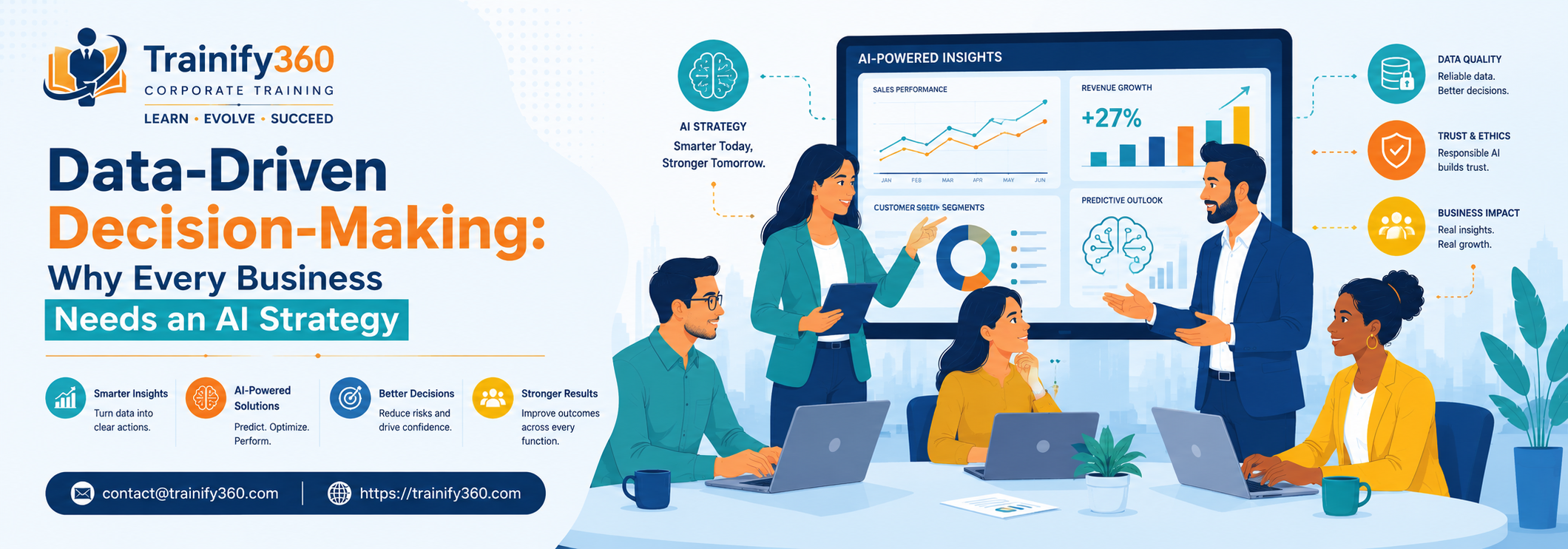
Data-Driven Decision-Making: Why Every Business Needs an AI Strategy
Walk into any executive meeting today, and you'll notice a common theme. Business leaders are surrounded by more information than ever before, yet many still struggle to make timely, confident decisions. Reports arrive from multiple systems, dashboards present conflicting numbers, and teams often rely on experience or intuition to fill the gaps.
Experience remains invaluable, but experience alone is no longer enough.
The organisations consistently outperforming their competitors share one defining characteristic: they make decisions based on reliable data supported by intelligent technologies. Artificial Intelligence has become a practical business capability that helps leaders interpret information faster, identify patterns earlier, and make more informed decisions with greater confidence.
For CHROs, Chief Learning Officers, HR Directors, and business leaders, this shift is about much more than technology. It represents a change in how organisations operate, develop talent, and create long-term value.
The question is no longer whether businesses should adopt AI.
The real question is whether organisations are prepared to build an AI strategy that supports smarter decision-making across every function.
Why Decision-Making Has Become More Complex
Business leaders rarely struggle because they lack information. They struggle because they have too much of it.
Customer behaviour changes quickly. Market conditions fluctuate. Regulatory requirements evolve. Employee expectations continue to shift. Every department generates large volumes of operational data, yet much of that information remains disconnected.
Without a structured approach, decision-making becomes slower rather than faster.
Consider a retail organisation planning seasonal inventory. Sales data may sit in one system, customer insights in another, and supply chain information somewhere else. Individually, each dataset provides value. Together, they tell a much richer story.
Artificial Intelligence helps organisations connect those pieces, transforming raw information into meaningful business intelligence.
Data Is No Longer Just an Operational Asset
Many organisations still view data as something collected for reporting purposes.
Leading organisations think differently.
They recognise data as a strategic business asset that influences every major decision—from workforce planning and customer experience to financial forecasting and operational performance.
Quality data enables organisations to answer questions such as:
- Which customers are most likely to leave?
- Which products will see increased demand next quarter?
- Where are operational bottlenecks affecting productivity?
- Which employees may require additional development?
- What skills will the organisation need over the next three years?
These answers are difficult to uncover through manual analysis alone.
AI enables organisations to process vast amounts of structured and unstructured information, identify trends, and generate insights that support proactive decision-making.
Why Every Business Needs an AI Strategy
Many organisations have experimented with AI through isolated projects. Some have introduced chatbots. Others have automated reporting or implemented predictive analytics.
While these initiatives deliver value, they rarely transform the organisation unless they are connected through a broader business strategy.
An AI strategy provides that direction. It ensures technology investments align with organisational priorities rather than individual departmental needs.
A well-defined AI strategy typically addresses four critical questions:
- Which business problems are we trying to solve?
- What data do we need?
- What capabilities must our workforce develop?
- How will success be measured?
Without answering these questions, organisations often invest in technology without achieving meaningful business outcomes.
AI Is Strengthening Business Decision-Making Across Functions
One of AI's greatest strengths is its ability to support better decisions throughout the organisation.
Executive Leadership
Senior leaders benefit from real-time visibility into business performance.
Rather than waiting for monthly reports, executives can monitor key indicators continuously and respond more quickly to emerging opportunities or risks. This creates more agile decision-making across the enterprise.
Finance
Finance teams use AI to improve forecasting accuracy, automate reconciliations, detect unusual transactions, and strengthen financial planning.
Instead of spending valuable time compiling reports, finance professionals can focus on analysing business performance and advising leadership.
Sales and Marketing
AI helps commercial teams identify customer behaviour patterns, predict purchasing intent, personalise campaigns, and improve lead qualification.
Marketing investments become more targeted while sales teams spend more time engaging high-value opportunities.
Operations and Supply Chain
Operational efficiency improves when organisations can predict demand, optimise inventory, identify maintenance requirements, and reduce supply chain disruptions before they occur.
Predictive insights allow organisations to solve problems before customers experience them.
Human Resources
HR leaders increasingly rely on workforce analytics to support strategic planning.
AI assists with recruitment, employee engagement analysis, succession planning, retention forecasting, and skills assessment.
These insights help HR contribute directly to long-term business growth rather than focusing solely on administrative processes.
Learning and Development Has a Critical Role to Play
Technology alone cannot create a data-driven organisation. Employees must understand how to interpret information, question assumptions, and make decisions supported by evidence.
This places Learning and Development at the centre of successful AI adoption. Forward-thinking L&D teams are no longer focused solely on delivering training courses. They are building organisational capability.
This includes developing:
- AI awareness across business functions
- Data literacy
- Critical thinking
- Analytical decision-making
- Digital confidence
- Responsible AI practices
As AI becomes integrated into everyday workflows, these capabilities will become essential across every department not just technology teams.
Building Trust Through Responsible AI
Successful AI strategies are built on trust. Employees need confidence that AI supports rather than replaces their expertise.
Customers expect transparency regarding how their information is used. Regulators expect organisations to maintain strong governance.
Responsible AI requires organisations to establish clear policies covering:
- Data privacy
- Information security
- Ethical decision-making
- Bias reduction
- Human oversight
- Regulatory compliance
Trust is difficult to build and easy to lose.
Organisations that prioritise responsible AI strengthen confidence among employees, customers, and stakeholders alike.
Common Barriers to AI Success
Despite growing investment, many organisations struggle to achieve expected outcomes. The reasons are surprisingly consistent. Poor-quality data limits the accuracy of AI recommendations.
Leadership teams sometimes expect technology to solve organisational problems without addressing processes or capability gaps.
Employees may resist change if they feel uncertain about how AI will affect their work. In many cases, organisations underestimate the importance of learning and change management. Technology implementation is only one part of the journey.
Preparing people for new ways of working is equally important.
Developing an AI-Ready Workforce
Future-ready organisations recognise that not every employee needs advanced technical expertise.
What employees do need is confidence. They need confidence to understand AI-generated insights. Confidence to interpret business data. Confidence to ask better questions. Confidence to make informed decisions.
Equally valuable are the human capabilities AI cannot replace.
Creativity.
Collaboration.
Communication.
Leadership.
Ethical judgement.
Problem-solving.
The organisations investing in both digital capability and human capability will remain more resilient as technology continues to evolve.
A Practical Roadmap for Business Leaders
Organisations beginning their AI journey should resist the temptation to pursue enterprise-wide transformation immediately.
A more sustainable approach includes:
Start with business priorities.
Identify the operational challenges where AI can create measurable value.
Strengthen data quality.
Reliable decisions depend on reliable information.
Prepare leaders first.
Executive sponsorship creates organisational confidence.
Invest in workforce capability.
Learning should accompany technology implementation—not follow it.
Measure outcomes consistently.
Success should be evaluated through business impact rather than technology adoption alone.
Organisations that follow this structured approach typically achieve stronger adoption, greater employee engagement, and better long-term results.
The Future Belongs to Data-Driven Organisations
Artificial Intelligence will continue influencing every industry, but technology itself will never be the deciding factor.
The organisations that succeed will combine intelligent systems with capable people, trusted data, responsible leadership, and continuous learning.
For CHROs and Learning leaders, this represents an opportunity to strengthen workforce capability and position learning as a strategic business function.
For executives, AI provides greater visibility, stronger forecasting, and faster decision-making.
For employees, it creates opportunities to spend less time on repetitive tasks and more time solving meaningful business challenges.
The future will not belong to organisations with the most technology.
It will belong to organisations that make the best decisions.
Conclusion
Every business generates data. Not every business turns that data into better decisions.
An effective AI strategy is not simply about adopting new technologies. It is about creating an organisation where leaders trust data, employees understand how to use intelligent tools, and learning becomes a continuous driver of business performance.
At Trainify360, we work with organisations to build these capabilities through enterprise learning solutions that prepare leaders and employees for an AI-enabled future. By combining workforce development with business strategy, organisations can create stronger decision-making, greater organisational agility, and sustainable competitive advantage.
The businesses that thrive over the next decade will not necessarily be those with the largest technology budgets. They will be the ones that develop the capability to transform information into insight—and insight into action.
Frequently Asked Questions (FAQs)
1. What is data-driven decision-making?
Data-driven decision-making is the practice of using reliable business data, analytics, and AI-generated insights to make informed strategic and operational decisions rather than relying solely on intuition.
2. Why does every business need an AI strategy?
An AI strategy ensures technology investments align with business goals, improve decision-making, enhance productivity, and prepare the workforce for long-term transformation.
3. What role does Learning and Development play in AI adoption?
L&D helps build AI literacy, data interpretation skills, digital confidence, and leadership capabilities, enabling employees to work effectively alongside AI technologies.
4. What are the biggest challenges in implementing AI?
Common challenges include poor data quality, lack of leadership alignment, employee resistance, skills gaps, legacy systems, and weak governance frameworks.
5. How can organisations begin their AI journey?
Start by identifying business priorities, improving data quality, investing in employee capability, implementing pilot projects, and measuring outcomes before scaling AI initiatives.