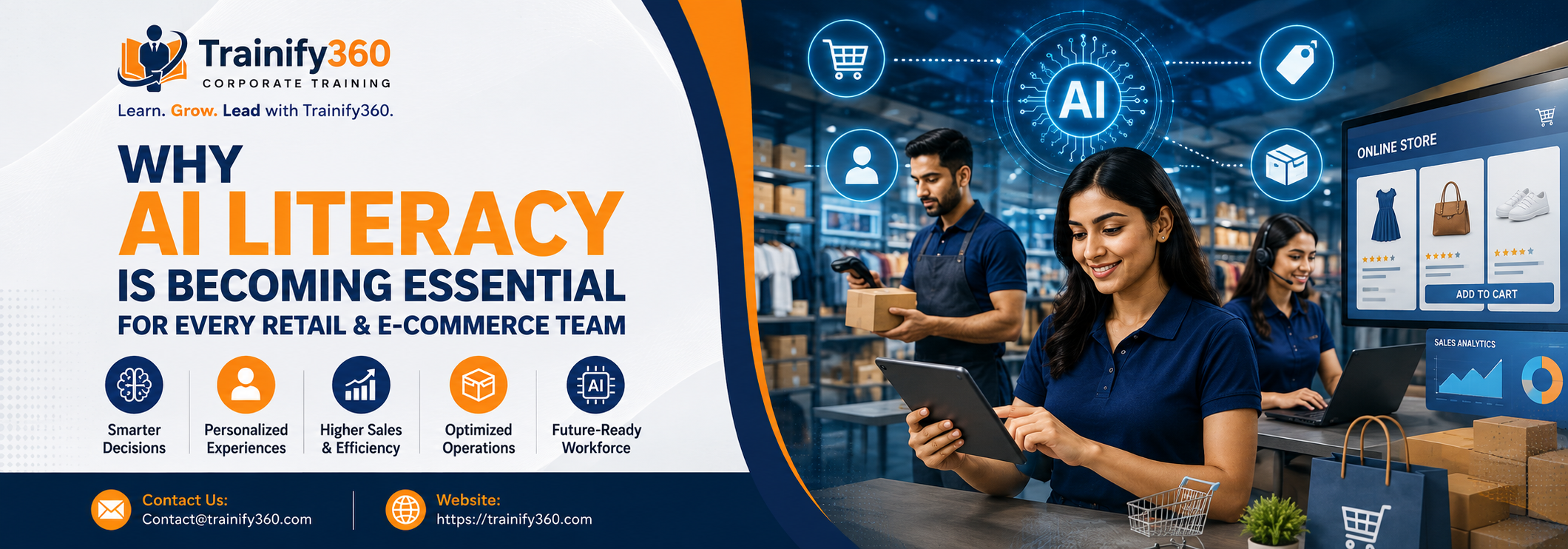
Why AI Literacy Is Becoming Essential for Every Retail and E-commerce Team
A few months back, I sat in on a merchandising review at a mid-sized retail chain. The team was using an AI-powered demand forecasting tool to plan inventory for the next quarter. Halfway through the meeting, someone asked a fairly reasonable question: how confident was the model actually in this number?
Nobody in the room could answer. Not the category manager running the meeting, not the two analysts who'd pulled the report.
I want to be clear that this wasn't a story about bad technology. The tool was doing exactly what it was built to do. The gap was in the room, not the software; nobody had been taught to interrogate an output like this, so nobody did.
I've since seen versions of this same scene play out across pricing teams, customer service desks, supply chain functions, marketing departments. Retail and e-commerce companies adopted AI tools well ahead of building the human capability to use them properly, and that mismatch is starting to show up somewhere leaders actually pay attention to: the numbers.
Retail Adopted the Tools Faster Than It Trained the People
Retail and e-commerce were early movers on AI, earlier than most industries, honestly. Recommendation engines, chatbots, dynamic pricing, demand forecasting, fraud detection these have been sitting inside daily operations for years now.
What didn't keep pace was capability building. In most organisations I've worked with, the rollout ran through IT and got treated as a technical implementation rather than a workforce shift. Store managers got a login and a fifteen-minute walkthrough. Category teams got a dashboard and a training video that, if we're honest, almost nobody watched a second time.
What you end up with is a workforce that can click through an AI system competently enough, but doesn't really understand what's happening underneath the hood. That sounds like a small distinction. It isn't.
Where the Gap Shows Up in Practice
These gaps rarely announce themselves loudly. They tend to show up as small, recurring friction points the kind that don't get escalated individually but quietly add up over a couple of quarters.
Merchandising teams either trust forecasting outputs without question or ignore them entirely and revert to gut instinct, both of which defeat the point of having bought the tool in the first place. Customer service agents escalate issues a well-understood AI system could have handled on its own or worse, let the system loose on situations it was never designed for. Marketing teams lean on generative tools to produce content at volume, but without the judgment to catch a tone problem or a factual slip before it goes live. Pricing and promotions teams accept algorithmic recommendations at face value, which is fine right up until market conditions shift and the assumptions baked into the model no longer hold.
None of that is a technology failure. The tools are working as designed. It's the people around them who haven't been given the grounding to work with them properly.
This Is an L&D Problem Before It's an IT One
There's a habit in a lot of organisations of treating AI rollout as purely a systems project get the tool live, hand support off to IT, move on to the next thing. That misses something fairly important: AI literacy isn't a technical skill in the way learning a new software interface is. It's closer to a reasoning skill.
Nobody on a merchandising team needs to understand the mathematics behind a forecasting algorithm. But they do need a working sense of what the tool is actually optimising for, and just as importantly, what it isn't. They need to know when an output is worth trusting and when it's worth questioning. They should have some idea of what data the system is drawing from, and where that data might be thin or skewed. And they need to be able to spot the moment a tool is confidently wrong because these systems are very good at sounding certain even when they're not.
That's not something you cover in a one-time onboarding session and consider done. It needs building deliberately, over time, much the way organisations built digital literacy a decade ago and data literacy more recently.
CHROs and CLOs who let this sit purely with IT tend to end up with employees who can operate a tool but can't reason about it. That's not a comfortable place to be standing when the tool gets something wrong in front of a customer.
What Good AI Literacy Actually Looks Like
Having helped build a fair number of these programmes across retail and e-commerce clients, a few patterns keep showing up in the ones that actually work.
They're built around the role, not a generic curriculum. A warehouse operations lead and a digital marketing manager need genuinely different things. Generic "introduction to AI" modules get politely tolerated and then forgotten, mostly because they don't map onto anyone's actual job. The training that sticks is anchored to the specific tools each function already touches.
They build judgment, not just familiarity with the interface. Employees need practice spotting when an AI output looks off, not just a walkthrough of which buttons to press. Case-based learning reviewing real or realistic outputs and deciding whether to trust them tends to land far better than a feature demo ever does.
They don't skip the risk and ethics piece. Retail and e-commerce sit close to consumer data, pricing fairness, and personalisation decisions that can go wrong in very public ways. People need a working understanding of where the guardrails sit, not just how to get the tool to do what they want.
They're ongoing, not a one-off launch event. These tools change fast. Training delivered once at rollout is stale within a couple of quarters. The organisations getting this right treat AI literacy as a continuous track, with refreshers tied to major tool updates rather than the calendar.
The Business Case, in Plain Terms
Beyond the operational argument, there's a fairly straightforward business case here, and it's one most leaders respond to quickly once it's laid out.
Teams with genuine AI literacy adopt new tools faster and with more confidence, which shortens the payback period on whatever the organisation just spent on the technology. They make fewer costly errors born out of blind trust in automated recommendations. They collaborate better across functions, because everyone's working from a shared vocabulary instead of talking past each other. And retention tends to hold up better too; employees notice, more than leaders sometimes assume, when their employer hasn't bothered to help them understand the systems that are reshaping their day-to-day work.
That last point is worth sitting with if you're a talent leader. In retail and e-commerce specifically, where AI tools now touch almost every function, this isn't a peripheral engagement issue. It's becoming a fairly central one.
Where to Start, Practically
A phased approach tends to work better here than a big-bang rollout across the whole organisation at once.
Start by auditing where AI already touches the business most leadership teams are surprised by how many tools already qualify once they actually look. Segment the response by role and risk exposure; customer-facing and decision-making roles need deeper literacy than back-office administrative functions. Build the literacy programme ahead of your next major tool launch rather than after adoption problems have already surfaced, because retrofitting training onto a tool people have already formed bad habits around is a much harder job. And measure understanding, not just completion a course completion rate tells you nothing about whether someone can actually reason through an AI output when it matters.
Final Thoughts
AI literacy in retail and e-commerce has stopped being a nice-to-have training topic. At this point it's a basic operating requirement, on par with knowing how to read a P&L or manage a team. Organisations that treat it that way now will spend a lot less time firefighting AI-related mistakes down the line, and their teams will be in a genuinely stronger position to make the most of these tools.
If your organisation is still treating AI adoption as an IT rollout rather than a capability-building effort, it's worth revisiting that before the next tool goes live not after something's already gone wrong.
Trainify360 works with retail and e-commerce organisations to build role-specific AI literacy programmes that go beyond tool training into real decision-making capability. If you're planning your next AI rollout, talk to us before you launch, not after.
Frequently Asked Questions
What does AI literacy actually mean at work? It's the ability to understand, evaluate, and work responsibly with AI-driven tools and their outputs — knowing when to trust a result and when to push back on it, rather than just knowing which buttons operate the software.
Why does this matter more in retail and e-commerce than elsewhere? These industries adopted AI tools like recommendation engines, demand forecasting, and chatbots earlier and more broadly than most sectors, and the workforce training hasn't kept pace with that adoption.
Which teams need this training first? Customer-facing staff, merchandising and inventory planning, pricing, and marketing tend to carry the highest exposure, since AI-driven decisions in those areas hit customers and revenue directly.
How is this different from standard AI tool training? Tool training teaches someone how to use a specific system's features. AI literacy builds the underlying judgment to evaluate outputs and understand a tool's limitations a skill that carries across multiple systems, not just one.
How often should it be refreshed? Given how quickly these tools change, most organisations should plan on refresher training tied to major updates, at minimum every six to twelve months.