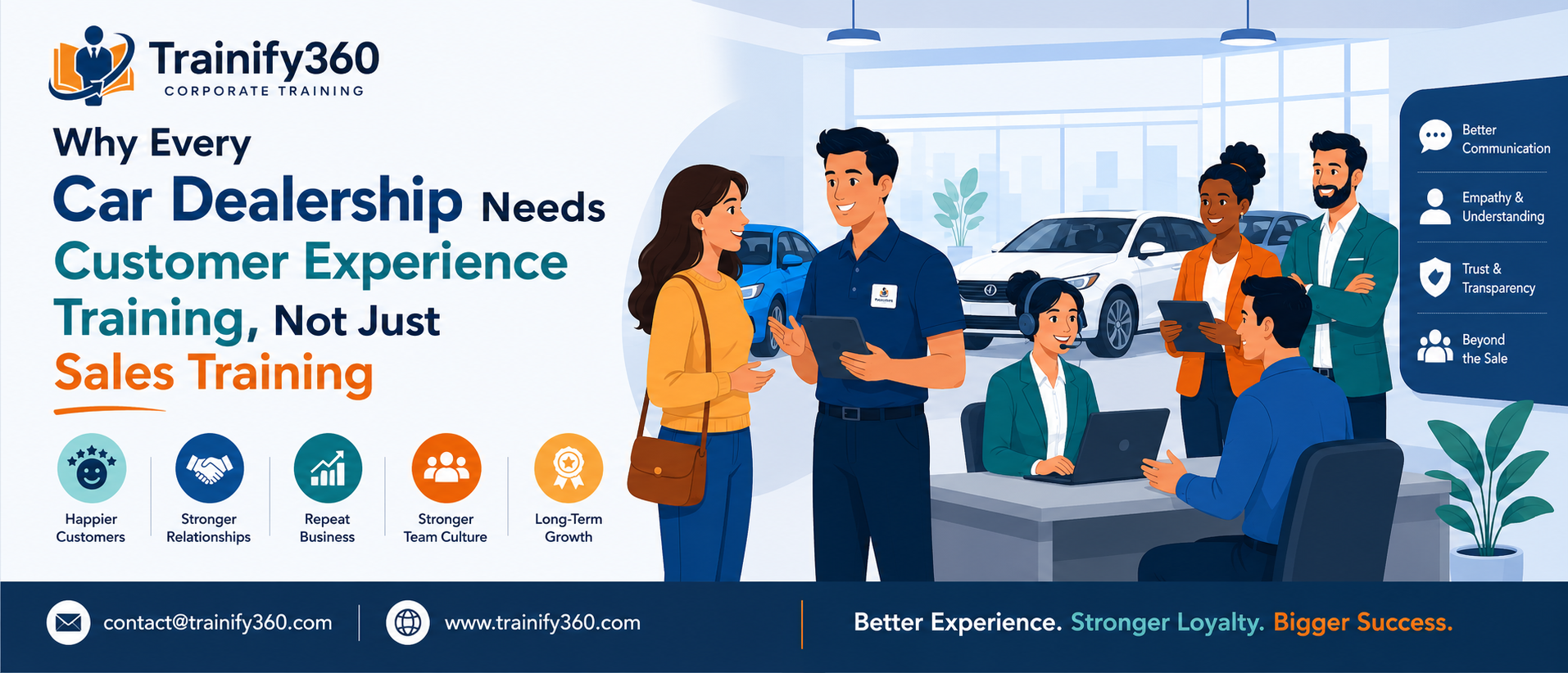
Why Every Car Dealership Needs Customer Experience Training, Not Just Sales Training
Walk into ten different car showrooms and you'll notice something interesting. The cars are similar. The prices are competitive. The financing options barely differ. Yet some dealerships are packed with happy buyers while others struggle to close a single deal in a day.
The difference almost never comes down to the product. It comes down to how the customer feels while buying it.
This is why automobile businesses from dealerships to service centers to spare parts retailers are shifting their focus from traditional "sales training" to a broader approach: Sales, Customer Experience, and Relationship Management (CRM) Training. Let's break down why this matters and how it actually works.
The Problem With Old-School Car Sales Training
For decades, automobile sales training focused on one thing only: closing the deal. Salespeople were taught scripts, objection-handling tricks, and pressure tactics to get a signature before the customer walked out.
This worked when customers had fewer choices and less information. Today, that model is broken for three reasons:
- Customers research before they arrive. Most buyers already know the price, mileage, and comparable models before stepping into a showroom. A pushy pitch feels outdated and insulting to someone who has done their homework.
- Trust decides the sale, not pressure. A customer spending lakhs of rupees on a vehicle wants to feel understood, not sold to.
- The relationship doesn't end at delivery. Service visits, insurance renewals, resale, and referrals all depend on how the customer was treated after the sale — not just during it.
This is exactly where Customer Experience (CX) and Relationship Management training step in.
What This Training Actually Covers
A good Sales + CX + Relationship Management program for the automobile industry isn't just a motivational workshop. It's built around real, practical skills:
1. Understanding Buyer Psychology
Salespeople learn to read what a customer actually wants status, safety, savings, or convenience instead of assuming every customer wants the same thing. A first-time buyer and a family upgrading their second car have completely different emotional triggers.
2. Consultative Selling (Not Convincing, Advising)
Instead of pushing the highest-margin model, staff are trained to genuinely recommend what fits the customer's budget and lifestyle. Ironically, this approach increases sales because customers trust advisors who don't feel like they're "selling."
3. Handling Objections Without Pressure
Common objections in car sales "I'll think about it," "It's too expensive," "I'm comparing with another brand" are addressed calmly using facts and empathy, not scripted pressure lines.
4. Service Experience Training
This extends to service advisors and technicians too. A customer who has a bad service experience rarely returns, no matter how good the initial sale was. Training here focuses on clear communication, transparent pricing, and setting realistic expectations about repair timelines.
5. CRM Tools and Follow-Up Systems
Sales staff are trained to use CRM software properly logging customer preferences, past purchases, service history, and follow-up reminders. This turns one-time buyers into long-term, loyal customers.
6. Post-Sale Relationship Building
This includes training on follow-up calls, birthday/anniversary greetings, service reminders, and handling complaints gracefully. The goal is to make the customer feel remembered, not forgotten the moment they've paid.
Why It Matters More in the Automobile Industry Specifically
Cars aren't like everyday purchases. A few things make this industry unique, and training needs to reflect that:
- High-value, low-frequency purchases: Most people buy a car once every 5–7 years. Losing a customer's trust means losing them for years, not days.
- Long-term relationship potential: Unlike a one-time retail sale, a car customer interacts with the dealership repeatedly for servicing, accessories, insurance, and eventually, resale or upgrade.
- Word-of-mouth is powerful: In many markets, especially in India, car buying decisions are heavily influenced by recommendations from friends and family. One bad experience can silently cost a dealership dozens of future customers.
- Emotional purchase, rational justification: People buy cars emotionally (status, excitement, family pride) but justify it rationally (mileage, resale value, EMI). Good training teaches staff to speak to both sides.
The Business Impact: What Dealerships Actually Gain
When automobile businesses invest in this kind of training, the results usually show up in a few measurable ways:
- Higher conversion rates: Customers are more likely to buy from someone who listens rather than pitches.
- Increased repeat business: Satisfied customers return for service, accessories, and their next vehicle purchase.
- More referrals: Happy customers naturally recommend the dealership to others.
- Reduced complaints and escalations: Clear communication during sales and service prevents most misunderstandings before they turn into complaints.
- Better staff retention: Employees trained to build relationships (instead of just chasing targets) often report higher job satisfaction, since they aren't constantly dealing with angry, mismanaged customers.
What a Good Training Program Should Include
If you're evaluating or designing such a training program for an automobile business, here's a simple checklist to ensure everything important is covered:
|
Area |
What It Should Include |
|
Sales Skills |
Consultative selling, objection handling, product knowledge |
|
Customer Experience |
Body language, active listening, showroom etiquette |
|
Relationship Management |
CRM software usage, follow-up systems, loyalty programs |
|
Service Department |
Transparent communication, complaint handling, expectation setting |
|
Digital Interaction |
Handling online inquiries, social media responses, WhatsApp/chat etiquette |
|
Soft Skills |
Patience, empathy, cultural sensitivity for diverse customers |
A well-rounded program doesn't train only the sales team, it includes receptionists, service advisors, and even finance/insurance staff, since every touchpoint shapes the customer's overall impression.
A Simple Way to Think About It
Imagine two salespeople at competing dealerships selling the exact same car model at the exact same price.
Salesperson A recites features, pushes for a quick decision, and disappears after the sale.
Salesperson B asks about the customer's daily commute, family size, and budget concerns, offers honest comparisons, and follows up two weeks later just to check if everything's going well.
Which dealership do you think the customer will return to for their next car or recommend to a friend?
That's the entire point of Sales, Customer Experience, and Relationship Management training. It's not about replacing sales skills, it's about combining them with genuine human connection, so the sale becomes the beginning of a relationship, not the end of a transaction.
Final Thoughts
The automobile industry is more competitive than ever, with new brands, EV options, and online-first buying platforms entering the market constantly. In this environment, price and features alone can't guarantee loyalty.
What sets dealerships apart today is simple: how customers are treated before, during, and after the sale. Investing in proper Sales, Customer Experience, and Relationship Management training isn't just a "nice to have" anymore, it's becoming the deciding factor between dealerships that thrive and those that quietly lose customers to competitors who simply made people feel valued.