How AI is Transforming Automotive Manufacturing, Sales, and Customer Experience
Artificial Intelligence is no longer something automotive companies are experimenting with. Across the industry, it has become part of everyday business operations. Whether it's a production line identifying quality issues, a dealership understanding customer preferences, or a service centre predicting maintenance requirements, AI is steadily changing how work gets done.
Over the last few years, automotive organisations have invested heavily in digital technologies. Connected manufacturing systems, smart factories, advanced analytics, and AI-powered applications are now common across many businesses. Yet one thing has become increasingly clear: buying technology is often the easiest part of digital transformation.
Helping people use that technology confidently is where the real work begins.
Many organisations assume that once a new AI platform is introduced, employees will naturally adapt. In reality, that rarely happens. New systems only deliver value when people understand how to use them, trust the insights they provide, and know when to combine technology with their own professional judgement.
For CHROs, L&D leaders, Plant Heads and senior executives, this shifts the conversation. AI is no longer just an IT initiative; it's a workforce capability initiative. The organisations that gain the greatest business advantage will be those that invest in developing people alongside technology.
Manufacturing Is Becoming More Intelligent
Automation has been improving automotive manufacturing for decades. AI is taking that progress a step further by helping organisations make faster, more informed operational decisions.
Modern production facilities generate an enormous amount of data every minute. Machines continuously report their performance, sensors monitor production conditions, and quality systems capture inspection results throughout the manufacturing process. The challenge isn't collecting information anymore—most organisations already have more operational data than they can effectively use.
The real challenge is knowing which information deserves attention and acting on it before it affects production.
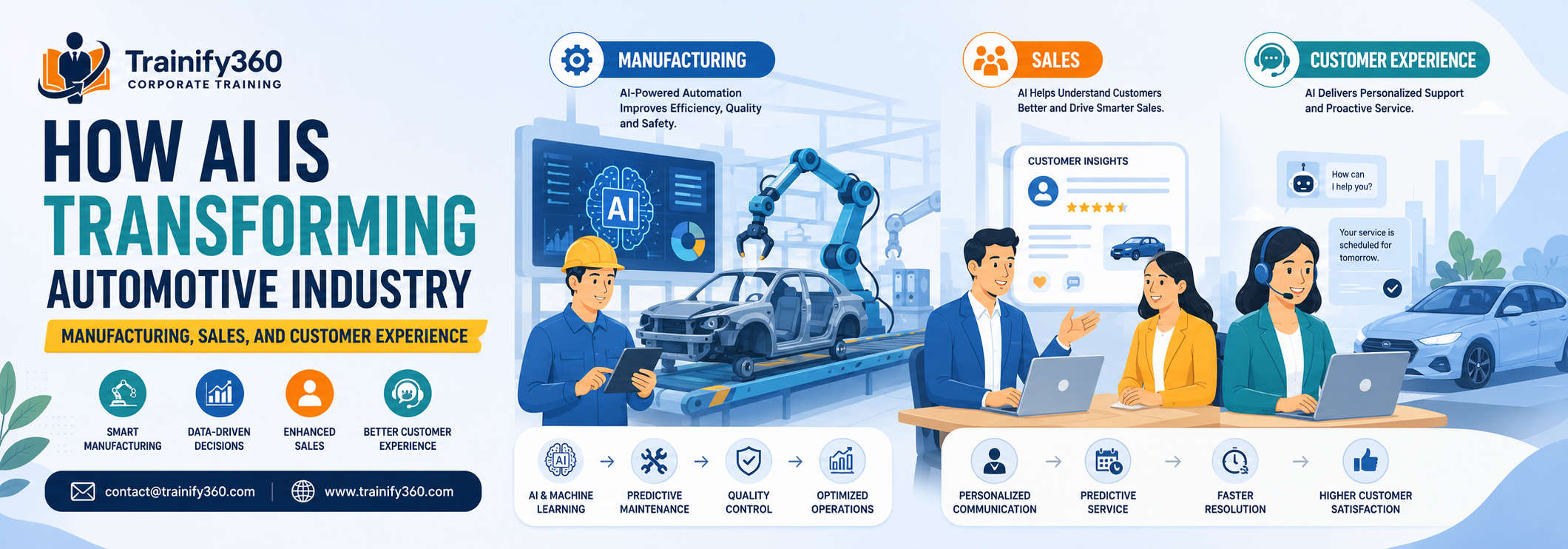
AI helps bridge that gap. By analysing thousands of data points in real time, it can identify patterns that would be almost impossible for people to detect manually. Instead of reacting after equipment fails or quality issues become visible, production teams receive early warnings that allow them to intervene before problems escalate.
Predictive maintenance illustrates this perfectly. Rather than replacing components based on fixed maintenance schedules, organisations can monitor the actual condition of equipment. AI highlights signs of wear long before they lead to unexpected downtime, giving maintenance teams the opportunity to plan repairs without disrupting production.
The result isn't just fewer breakdowns. It also means better resource planning, improved equipment reliability, and greater confidence in meeting production commitments.
Better Data Leads to Better Decisions
Production planning has become significantly more complex than it was even a few years ago.
Demand fluctuates more frequently. Supply chains remain unpredictable. Inventory levels need constant attention, and manufacturers continue facing pressure to improve efficiency while maintaining quality standards.
Making these decisions requires balancing multiple variables simultaneously.
AI helps simplify that complexity.
Instead of spending hours reviewing reports and spreadsheets, planners can use AI to analyse production capacity, supplier performance, inventory availability and customer demand almost instantly. The system provides recommendations based on current operating conditions, allowing managers to respond more quickly to changing business requirements.
That doesn't mean experienced production leaders become less valuable.
If anything, their role becomes even more important.
AI provides information. Managers provide context. They understand customer priorities, commercial commitments, operational risks and practical realities that software cannot always recognise. The best decisions continue to come from combining intelligent technology with experienced human judgement.
Sales Is Becoming More Customer-Centred
The automotive buying journey has changed dramatically.
Customers no longer visit dealerships simply to gather information. By the time they speak with a sales consultant, many have already researched vehicle specifications, compared models, explored financing options and read customer reviews.
This means sales conversations need to add value rather than simply provide information.
AI helps sales teams prepare for those conversations more effectively.
Customer relationship platforms analyse browsing behaviour, previous enquiries, purchase history and engagement patterns to provide advisors with valuable insights before they meet a customer. Instead of following a standard sales process, consultants can focus on understanding individual requirements and recommending solutions that genuinely fit the customer's needs.
Technology doesn't replace relationship-building.
It allows sales professionals to spend more time having meaningful conversations instead of collecting information that AI has already organised for them.
Managers also benefit from stronger forecasting capabilities. AI helps identify market trends, seasonal buying behaviour and inventory requirements, making planning more accurate across the dealership network.
Customer Experience Doesn't End When the Vehicle Is Delivered
For many years, organisations measured success by the number of vehicles sold.
Today, long-term customer relationships have become equally important.
After-sales service, maintenance support and ongoing communication all influence customer loyalty and future purchasing decisions.
AI is helping organisations strengthen these relationships in practical ways.
Connected vehicles can identify potential maintenance issues before customers experience a breakdown. Service teams receive alerts that allow them to schedule appointments proactively, improving convenience while reducing unexpected repairs.
Customer communication has also become far more personalised.
Rather than sending generic reminders to every vehicle owner, organisations can tailor messages based on servicing history, driving behaviour and individual preferences. Customers receive information that is timely, relevant and genuinely useful.
These improvements may seem small on their own, but together they create a noticeably better customer experience.
AI Makes People More Effective. It Doesn't Replace Them
Whenever artificial intelligence becomes part of workplace discussions, concerns about job security usually follow.
Inside automotive organisations, the conversation is far more balanced.
AI isn't replacing experienced professionals.
It's helping them work more effectively.
Production supervisors still make operational decisions. Quality engineers continue investigating manufacturing issues. Sales consultants build customer relationships, and service advisors solve complex problems that require empathy, communication and practical experience.
Technology can analyse large volumes of information in seconds.
People still provide judgement, context and accountability.
As AI becomes more capable, these human skills become even more valuable because organisations continue relying on employees to make decisions involving safety, customer relationships, compliance and business priorities.
The Workforce Will Determine Whether AI Delivers Business Value
Many digital transformation programmes concentrate heavily on implementing software.
The organisations that see lasting results focus just as much on preparing their people.
Employees don't need to become AI specialists.
What they need is confidence.
They need to understand how AI supports their work, recognise where its recommendations add value, appreciate its limitations and know when professional judgement should take priority.
Building that confidence requires more than technical training.
Learning needs to reflect the situations employees encounter every day. Practical workshops, real operational case studies, cross-functional projects and scenario-based learning help people develop confidence far more effectively than software demonstrations alone.
When learning connects directly to the workplace, adoption becomes much easier.
Leadership Will Shape the Success of AI
Technology doesn't change organisational culture.
Leaders do.
Employees pay close attention to how managers respond during periods of change. They notice whether leaders encourage learning, answer questions openly and create an environment where people feel comfortable experimenting with new ways of working.
When leaders explain why AI matters—not just what the technology does—employees are far more likely to engage with the change.
Successful digital transformation has always depended on people.
AI hasn't changed that reality.
Looking Ahead
Artificial Intelligence will continue influencing every part of the automotive industry, from manufacturing and supply chain management to sales, service and customer engagement.
The organisations that gain the greatest advantage won't simply be those investing in the latest AI platforms. They'll be the ones developing workforces that know how to use those platforms confidently, responsibly and effectively.
Technology creates opportunities, but people determine whether those opportunities become measurable business outcomes.
At Trainify360, we work with automotive organisations to build future-ready workforces through practical learning programmes that develop AI literacy, digital capability, leadership skills and workplace effectiveness. Our focus goes beyond teaching employees how technology works. We help them understand how to apply it to improve decisions, strengthen collaboration and deliver better business results. Because lasting transformation isn't achieved when new technology is installed—it's achieved when people have the confidence and capability to make that technology work for the organisation.
How AI is Transforming Automotive Manufacturing, Sales, and Customer Experience
Artificial Intelligence is no longer something automotive companies are experimenting with. Across the industry, it has become part of everyday business operations. Whether it's a production line identifying quality issues, a dealership understanding customer preferences, or a service centre predicting maintenance requirements, AI is steadily changing how work gets done.
Over the last few years, automotive organisations have invested heavily in digital technologies. Connected manufacturing systems, smart factories, advanced analytics, and AI-powered applications are now common across many businesses. Yet one thing has become increasingly clear: buying technology is often the easiest part of digital transformation.
Helping people use that technology confidently is where the real work begins.
Many organisations assume that once a new AI platform is introduced, employees will naturally adapt. In reality, that rarely happens. New systems only deliver value when people understand how to use them, trust the insights they provide, and know when to combine technology with their own professional judgement.
For CHROs, L&D leaders, Plant Heads and senior executives, this shifts the conversation. AI is no longer just an IT initiative; it's a workforce capability initiative. The organisations that gain the greatest business advantage will be those that invest in developing people alongside technology.
Manufacturing Is Becoming More Intelligent
Automation has been improving automotive manufacturing for decades. AI is taking that progress a step further by helping organisations make faster, more informed operational decisions.
Modern production facilities generate an enormous amount of data every minute. Machines continuously report their performance, sensors monitor production conditions, and quality systems capture inspection results throughout the manufacturing process. The challenge isn't collecting information anymore—most organisations already have more operational data than they can effectively use.
The real challenge is knowing which information deserves attention and acting on it before it affects production.
AI helps bridge that gap. By analysing thousands of data points in real time, it can identify patterns that would be almost impossible for people to detect manually. Instead of reacting after equipment fails or quality issues become visible, production teams receive early warnings that allow them to intervene before problems escalate.
Predictive maintenance illustrates this perfectly. Rather than replacing components based on fixed maintenance schedules, organisations can monitor the actual condition of equipment. AI highlights signs of wear long before they lead to unexpected downtime, giving maintenance teams the opportunity to plan repairs without disrupting production.
The result isn't just fewer breakdowns. It also means better resource planning, improved equipment reliability, and greater confidence in meeting production commitments.
Better Data Leads to Better Decisions
Production planning has become significantly more complex than it was even a few years ago.
Demand fluctuates more frequently. Supply chains remain unpredictable. Inventory levels need constant attention, and manufacturers continue facing pressure to improve efficiency while maintaining quality standards.
Making these decisions requires balancing multiple variables simultaneously.
AI helps simplify that complexity.
Instead of spending hours reviewing reports and spreadsheets, planners can use AI to analyse production capacity, supplier performance, inventory availability and customer demand almost instantly. The system provides recommendations based on current operating conditions, allowing managers to respond more quickly to changing business requirements.
That doesn't mean experienced production leaders become less valuable.
If anything, their role becomes even more important.
AI provides information. Managers provide context. They understand customer priorities, commercial commitments, operational risks and practical realities that software cannot always recognise. The best decisions continue to come from combining intelligent technology with experienced human judgement.
Sales Is Becoming More Customer-Centred
The automotive buying journey has changed dramatically.
Customers no longer visit dealerships simply to gather information. By the time they speak with a sales consultant, many have already researched vehicle specifications, compared models, explored financing options and read customer reviews.
This means sales conversations need to add value rather than simply provide information.
AI helps sales teams prepare for those conversations more effectively.
Customer relationship platforms analyse browsing behaviour, previous enquiries, purchase history and engagement patterns to provide advisors with valuable insights before they meet a customer. Instead of following a standard sales process, consultants can focus on understanding individual requirements and recommending solutions that genuinely fit the customer's needs.
Technology doesn't replace relationship-building.
It allows sales professionals to spend more time having meaningful conversations instead of collecting information that AI has already organised for them.
Managers also benefit from stronger forecasting capabilities. AI helps identify market trends, seasonal buying behaviour and inventory requirements, making planning more accurate across the dealership network.
Customer Experience Doesn't End When the Vehicle Is Delivered
For many years, organisations measured success by the number of vehicles sold.
Today, long-term customer relationships have become equally important.
After-sales service, maintenance support and ongoing communication all influence customer loyalty and future purchasing decisions.
AI is helping organisations strengthen these relationships in practical ways.
Connected vehicles can identify potential maintenance issues before customers experience a breakdown. Service teams receive alerts that allow them to schedule appointments proactively, improving convenience while reducing unexpected repairs.
Customer communication has also become far more personalised.
Rather than sending generic reminders to every vehicle owner, organisations can tailor messages based on servicing history, driving behaviour and individual preferences. Customers receive information that is timely, relevant and genuinely useful.
These improvements may seem small on their own, but together they create a noticeably better customer experience.
AI Makes People More Effective. It Doesn't Replace Them
Whenever artificial intelligence becomes part of workplace discussions, concerns about job security usually follow.
Inside automotive organisations, the conversation is far more balanced.
AI isn't replacing experienced professionals.
It's helping them work more effectively.
Production supervisors still make operational decisions. Quality engineers continue investigating manufacturing issues. Sales consultants build customer relationships, and service advisors solve complex problems that require empathy, communication and practical experience.
Technology can analyse large volumes of information in seconds.
People still provide judgement, context and accountability.
As AI becomes more capable, these human skills become even more valuable because organisations continue relying on employees to make decisions involving safety, customer relationships, compliance and business priorities.
The Workforce Will Determine Whether AI Delivers Business Value
Many digital transformation programmes concentrate heavily on implementing software.
The organisations that see lasting results focus just as much on preparing their people.
Employees don't need to become AI specialists.
What they need is confidence.
They need to understand how AI supports their work, recognise where its recommendations add value, appreciate its limitations and know when professional judgement should take priority.
Building that confidence requires more than technical training.
Learning needs to reflect the situations employees encounter every day. Practical workshops, real operational case studies, cross-functional projects and scenario-based learning help people develop confidence far more effectively than software demonstrations alone.
When learning connects directly to the workplace, adoption becomes much easier.
Leadership Will Shape the Success of AI
Technology doesn't change organisational culture.
Leaders do.
Employees pay close attention to how managers respond during periods of change. They notice whether leaders encourage learning, answer questions openly and create an environment where people feel comfortable experimenting with new ways of working.
When leaders explain why AI matters—not just what the technology does—employees are far more likely to engage with the change.
Successful digital transformation has always depended on people.
AI hasn't changed that reality.
Looking Ahead
Artificial Intelligence will continue influencing every part of the automotive industry, from manufacturing and supply chain management to sales, service and customer engagement.
The organisations that gain the greatest advantage won't simply be those investing in the latest AI platforms. They'll be the ones developing workforces that know how to use those platforms confidently, responsibly and effectively.
Technology creates opportunities, but people determine whether those opportunities become measurable business outcomes.
At Trainify360, we work with automotive organisations to build future-ready workforces through practical learning programmes that develop AI literacy, digital capability, leadership skills and workplace effectiveness. Our focus goes beyond teaching employees how technology works. We help them understand how to apply it to improve decisions, strengthen collaboration and deliver better business results. Because lasting transformation isn't achieved when new technology is installed—it's achieved when people have the confidence and capability to make that technology work for the organisation.