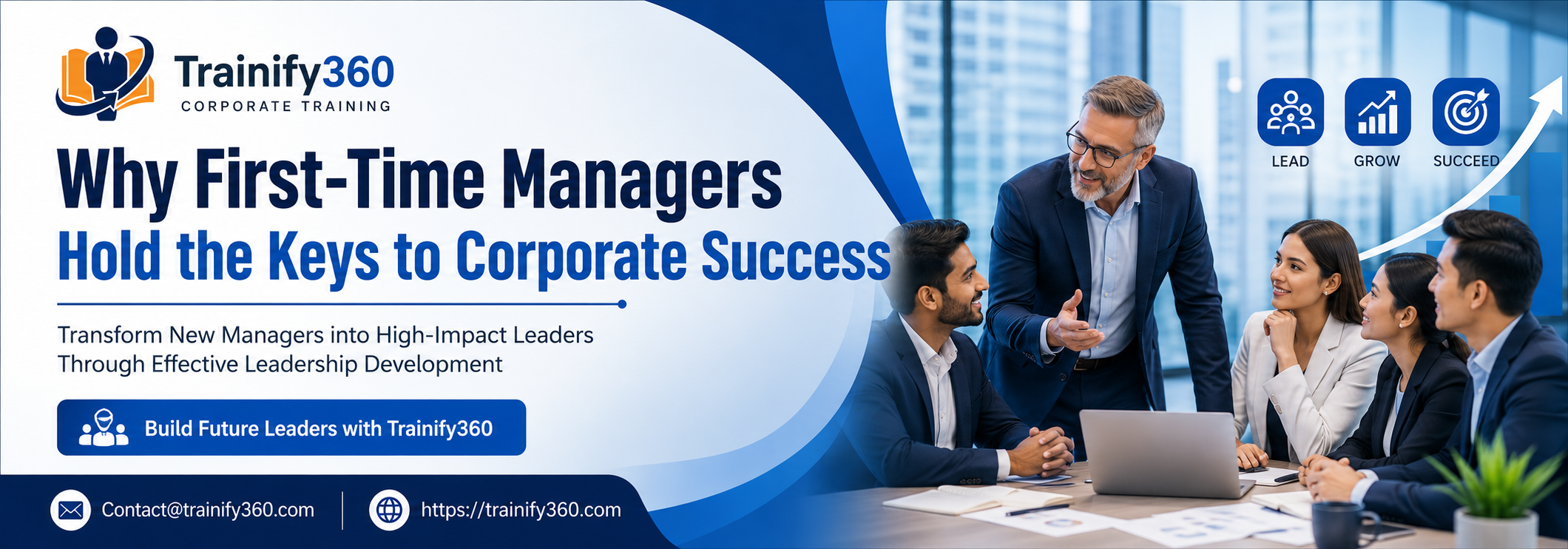
Round-Up Leadership: Why First-Time Managers Hold the Future of Your Organisation
When organisations discuss leadership capability, the spotlight naturally falls on the executive team. Strategic direction, business transformation, culture, and performance are often viewed through the lens of senior leadership.
Yet, some of the most important leadership decisions happen far from the boardroom. They happen when an individual contributor is promoted into their first management role.
It's a milestone that organisations celebrate every day. A high-performing employee consistently delivers results, demonstrates expertise, and earns the trust of stakeholders. Promotion seems like the obvious next step. However, leadership and performance are not the same thing.
Being exceptional at a role does not automatically prepare someone to lead people. And when organisations assume that leadership skills will develop naturally, they often create one of the most expensive talent challenges they face: the accidental manager.
For CHROs, HR leaders, and Learning & Development professionals, the transition from individual contributor to people manager represents one of the most critical moments in the employee lifecycle. It is a transition that directly influences employee engagement, retention, productivity, culture, and future leadership readiness.
Simply put, the quality of your first-time managers often determines the quality of your future organisation.
Why First-Time Managers Matter More Than Most Organisations Realise
Most managers spend more time interacting with employees than any other leader in the organisation.
While executives define the vision, frontline managers shape the daily employee experience. They determine how effectively goals are communicated, how feedback is delivered, how challenges are resolved, and whether employees feel supported enough to perform at their best.
Employees may hear organisational values during leadership town halls, but they experience those values through their manager every day. This is why manager effectiveness has such a profound impact on business outcomes.
Strong managers create clarity during uncertainty, build trust during change, and help employees connect their work to larger organisational goals. Weak management, on the other hand, can quietly erode engagement, productivity, and morale long before leadership notices the warning signs.
The reality is that employees rarely leave organisations overnight. More often, they leave because of a series of poor leadership experiences that gradually diminish commitment and motivation. For organisations competing for talent in today's market, that is a risk few can afford to ignore.
The Leadership Shift Nobody Talks About
One of the biggest misconceptions in business is that leadership is simply the next step after technical excellence. In reality, becoming a manager requires a complete shift in mindset.
As an individual contributor, success is measured by personal achievement. You are rewarded for solving problems, delivering results, and demonstrating expertise. Leadership changes the equation entirely.
Success is no longer defined by what you accomplish personally. It is defined by what your team accomplishes collectively.
The focus shifts:
|
As an Individual Contributor |
As a First-Time Manager |
|
Delivering results personally |
Enabling others to succeed |
|
Solving problems independently |
Facilitating solutions across the team |
|
Building technical expertise |
Building people capability |
|
Managing personal priorities |
Aligning team priorities |
|
Measuring individual performance |
Driving team outcomes |
This transition is often more difficult than organisations anticipate.
Many newly promoted managers continue operating as high-performing contributors. They remain deeply involved in tasks, hesitate to delegate, and feel responsible for solving every problem themselves.
While good intentions usually drive these behaviours, they often result in micromanagement, decision bottlenecks, and reduced team autonomy. Without targeted support, managers can become overwhelmed, and their teams can become dependent.
Neither outcome supports long-term business success.
The Capabilities That Separate Managers from Leaders
Successful first-time managers are not defined by authority or tenure. They are defined by a set of leadership capabilities that enable them to create performance through others.
Strategic Communication
Leadership begins with clarity. Employees perform best when they understand expectations, priorities, and how their work contributes to broader organisational goals. Effective managers communicate with purpose, provide meaningful feedback, and create an environment where dialogue flows in both directions.
When communication improves, alignment improves. When alignment improves, execution follows.
Emotional Intelligence
Technical expertise may earn a promotion, but emotional intelligence determines leadership effectiveness.
Today's managers are expected to navigate competing priorities, diverse teams, workplace conflict, and increasing expectations around employee wellbeing and engagement.
Leaders who demonstrate empathy, self-awareness, and emotional resilience are better equipped to build trust and maintain strong team relationships, particularly during periods of change.
Accountability and Ownership
High-performing teams are built on accountability, and accountability begins with leadership.
Managers who take ownership of decisions, acknowledge mistakes, and follow through on commitments establish a culture of trust and responsibility. Employees are far more likely to embrace accountability when they see it modelled consistently by their leaders.
Delegation and Empowerment
One of the most common mistakes new managers make is believing they need to remain the smartest person in the room. Effective leadership requires the opposite.
Delegation is not about reducing workload. It is about building capability. When managers empower employees with responsibility, autonomy, and decision-making opportunities, they accelerate development while creating more agile and resilient teams.
Coaching for Growth
The most effective leaders do not spend their time directing people. They spend their time developing them.
A coaching mindset helps managers move beyond supervision and into capability building. By asking better questions, encouraging critical thinking, and supporting continuous development, managers help employees unlock their potential and contribute at a higher level.
For organisations focused on future leadership pipelines, coaching is no longer optional. It is essential.
The Hidden Cost of Underdeveloped Managers
When organisations fail to invest in first-time manager development, the consequences often appear in unexpected places. Employee turnover increases.
Engagement scores decline. Performance conversations become inconsistent. High-potential talent leaves. Collaboration weakens. Culture becomes fragmented across teams.
What appears to be a retention challenge, engagement issue, or productivity problem often traces back to a leadership capability gap.
The cost of developing managers is visible. The cost of not developing them is far greater.
Leadership Development Is a Business Strategy, Not an HR Initiative
Progressive organisations no longer view leadership development as a standalone learning program. They recognise it as a strategic business investment.
The organisations building resilient, high-performing workforces are intentionally developing leadership capability at every level. They understand that strong managers drive stronger teams, stronger cultures, and ultimately stronger business results.
Most importantly, they understand that leadership capability is not built through a one-day workshop.
It is developed through structured learning journeys that combine practical application, coaching, peer learning, feedback, reflection, and ongoing reinforcement.
Leadership is a skill developed over time, not an event completed in a training room.
The Trainify360 Perspective
At Trainify360, we believe leadership development should begin long before individuals assume senior leadership positions.
Our experience working with organisations across industries consistently reinforces one reality: organisations that invest in first-time managers build stronger leadership pipelines, healthier workplace cultures, and more sustainable business performance.
By equipping emerging leaders with practical leadership skills, behavioural capabilities, coaching techniques, and people-management expertise, organisations create leaders who can confidently navigate complexity while bringing out the best in their teams.
The future of organisational success will not be determined solely by executive leadership. It will be shaped by the quality of leaders managing their very first team. And that is where the leadership journey truly begins.
Frequently Asked Questions
1. Why is first-time manager training important?
First-time manager training helps newly promoted leaders develop the people-management skills required to lead teams effectively. It reduces common leadership mistakes, improves confidence, and strengthens employee engagement and performance.
2. How long should a first-time manager development programme last?
The most effective programmes typically span three to twelve months and combine workshops, coaching, peer learning, practical application, and ongoing reinforcement to support lasting behavioural change.
3. What are the most important leadership skills for first-time managers?
Communication, emotional intelligence, delegation, coaching, accountability, conflict resolution, decision-making, and performance management are among the most critical capabilities for new managers.
4. How can organisations measure the success of leadership development initiatives?
Key indicators include employee engagement scores, retention rates, internal promotion metrics, manager effectiveness assessments, succession readiness, and overall team performance outcomes.
5. What business outcomes can leadership development improve?
Well-designed leadership development programmes can improve employee retention, productivity, engagement, collaboration, culture, leadership pipeline strength, and long-term organisational performance.