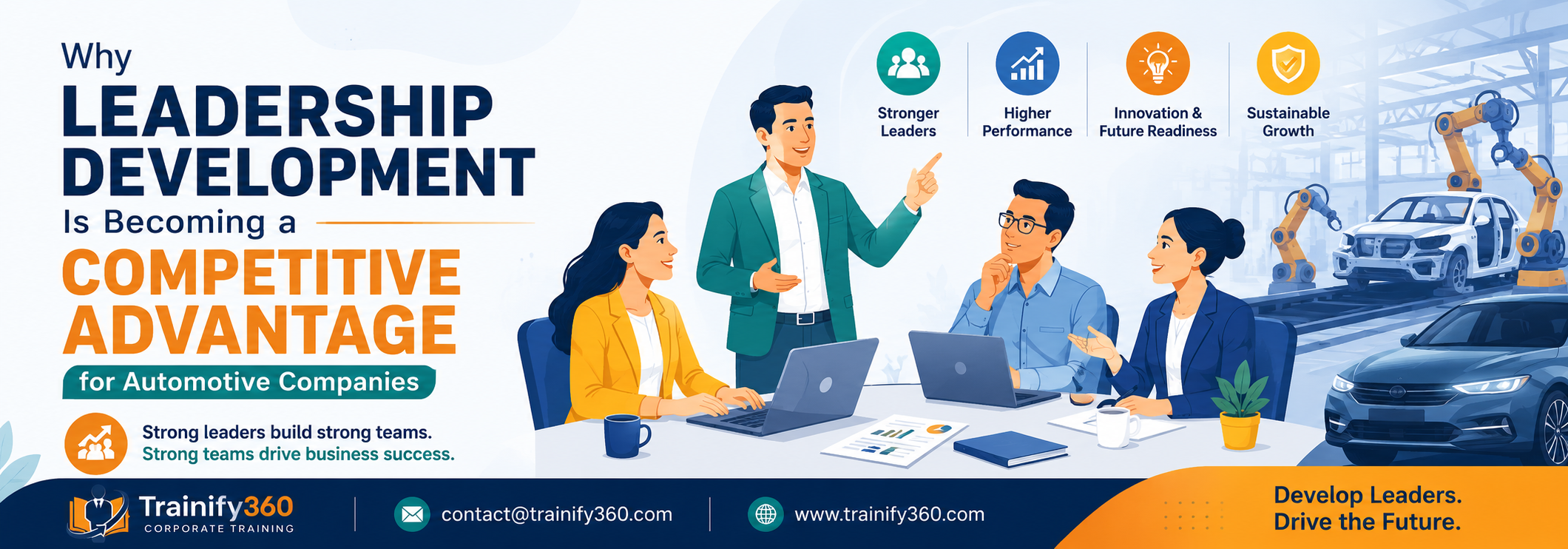
Why Leadership Development Is Becoming a Competitive Advantage for Automotive Companies
For decades, automotive companies built their competitive edge through world-class engineering, efficient manufacturing, reliable supply chains, and consistent product quality. Those strengths still matter, but they no longer guarantee long-term success.
The industry is changing at a pace few anticipated. Electric vehicles, connected manufacturing, Artificial Intelligence, automation, shifting customer expectations, and global supply chain disruptions are reshaping how automotive businesses operate. While organisations continue investing heavily in new technologies, one factor consistently determines whether those investments deliver results: leadership.
Technology can modernise a factory, automate production, or provide valuable business insights. It cannot inspire people to embrace change, solve problems together, or build high-performing teams. That responsibility still belongs to leaders.
This is why forward-thinking automotive companies are placing leadership development much higher on their business agenda. For CHROs, HR leaders, Chief Learning Officers, Plant Heads, and business executives, developing capable leaders is no longer simply about succession planning. It has become a strategic investment that directly influences productivity, employee engagement, innovation, and long-term business performance.
The Industry Is Moving Faster Than Traditional Leadership Approaches
The automotive sector has never stood still. From lean manufacturing and robotics to automation and digital production systems, every generation has experienced significant change.
The difference today is that transformation is happening across almost every part of the business at the same time.
Manufacturing plants are becoming smarter through AI-powered systems. Production teams rely on live dashboards to monitor performance. Supply chains use predictive analytics to improve planning, while customer expectations continue to evolve as digital experiences become the norm.
Technology is changing the way people work, but it is also changing what employees expect from their leaders.
Managers are no longer expected to simply supervise operations or ensure production targets are met. They must help employees navigate uncertainty, communicate change clearly, build trust, encourage collaboration, and create an environment where people feel confident learning new skills.
Installing new technology may take a few months.
Helping people adapt to it takes effective leadership.
Leadership Has a Direct Impact on Operational Performance
Many organisations focus heavily on improving systems and processes when looking to increase productivity.
Those investments matter, but they rarely deliver their full value without strong leadership.
Visit two automotive plants using similar equipment, production methods, and technology, and the results can still be very different. One consistently meets production goals, maintains high quality standards, and retains experienced employees. The other struggles with quality issues, missed deadlines, and high staff turnover.
The difference often comes down to leadership.
Good leaders create clarity. They communicate expectations, remove barriers that prevent teams from performing well, and encourage employees to solve problems before they become larger issues.
They don't simply manage production schedules.
They build confidence, accountability, and ownership within their teams.
Over time, those behaviours influence productivity far more than many organisations realise.
Frontline Leaders Shape the Culture Employees Experience Every Day
Workplace culture isn't defined by posters, mission statements, or company values displayed in reception areas.
Employees experience culture through their managers.
A supervisor who listens to concerns, provides constructive feedback, recognises good performance, and treats people fairly creates a workplace where employees feel respected and motivated.
On the other hand, a manager who communicates poorly or relies solely on authority can quickly damage morale, regardless of how strong the organisation's values appear on paper.
This is particularly relevant in manufacturing environments, where teams work under tight production schedules and operational pressure.
Employees look to their immediate leaders for guidance, support, and direction every day.
Developing frontline leadership capability is one of the most effective ways to strengthen workplace culture across the entire organisation.
Managing Change Has Become One of Leadership's Most Important Responsibilities
Few industries are changing as rapidly as automotive manufacturing.
Artificial Intelligence, connected equipment, automation, electric vehicle production, and digital quality systems are transforming how work gets done.
Introducing new technology is only one part of the journey.
The bigger challenge is helping employees understand why change is happening and giving them the confidence to work differently.
Even well-planned transformation projects can lose momentum if leaders fail to communicate effectively.
Employees naturally have questions.
How will this affect my role?
Will my job change?
Do I have the skills to succeed?
Leaders who answer these questions honestly, involve employees in the transition, and create opportunities to learn usually achieve far stronger engagement than those who simply announce new initiatives.
Technology changes processes.
Leadership influences whether people choose to embrace those changes.
Today's Leaders Make More Complex Decisions Than Ever Before
Manufacturing leaders are balancing multiple priorities every day.
They must deliver production targets while maintaining quality standards, controlling costs, managing workforce availability, meeting customer expectations, and ensuring workplace safety.
At the same time, they have access to more operational data than ever before.
Dashboards, predictive analytics, production metrics, and AI-generated recommendations provide valuable insights, but data alone doesn't make good decisions.
Leaders still need to interpret information, consider operational realities, evaluate risks, and exercise sound judgement.
That's why modern leadership development extends well beyond communication skills.
Organisations increasingly need leaders who can think critically, solve problems systematically, make informed decisions under pressure, and understand the wider commercial impact of their choices.
Employee Engagement Begins With the Manager
Companies often invest significant time and resources into employee engagement programmes, surveys, and recognition initiatives.
Yet one factor consistently has the greatest influence on employee engagement: the immediate manager.
People rarely leave organisations because of the business strategy.
More often, they leave because they don't feel supported by their leader.
Managers who coach their teams, provide regular feedback, recognise achievements, and encourage professional development create stronger relationships with employees.
Those relationships improve motivation, collaboration, retention, and overall performance.
Developing better leaders therefore strengthens both employee experience and business results.
Preparing Employees for the Future Starts With Leadership
The automotive workforce is changing rapidly.
Employees are expected to work confidently with digital tools, interpret production data, collaborate across departments, and increasingly use Artificial Intelligence as part of their daily responsibilities.
Creating that capability isn't solely the responsibility of Learning and Development teams.
Managers play an equally important role.
The best leaders encourage curiosity, support continuous learning, and create an environment where employees feel comfortable asking questions and developing new skills.
Rather than expecting people to know everything immediately, they help teams grow through coaching, practical experience, and ongoing feedback.
Organisations that develop learning-focused leaders are generally better prepared for future change because learning becomes part of everyday work rather than an occasional training event.
Leadership Development Should Mirror Real Workplace Challenges
Leadership programmes are most successful when they reflect the situations managers actually face.
Generic management courses often struggle to create lasting behavioural change because participants find it difficult to connect classroom theory with real workplace challenges.
Automotive organisations achieve better results when learning is practical and business-focused.
Leadership development should include realistic production scenarios, quality improvement exercises, coaching simulations, conflict resolution, decision-making workshops, and opportunities for cross-functional collaboration.
When managers can immediately apply what they've learned on the shop floor or within their departments, confidence grows much faster.
Practical learning produces practical leadership.
Success Should Be Measured by Business Outcomes
One common mistake organisations make is judging leadership programmes purely by attendance numbers.
Completing a course doesn't necessarily mean leadership has improved.
The more meaningful question is whether behaviour has changed.
Has employee engagement increased?
Are teams collaborating more effectively?
Has productivity improved?
Are safety incidents reducing?
Has employee retention improved?
These business indicators provide a much clearer picture of leadership effectiveness than attendance certificates ever will.
When leadership development is aligned with measurable business goals, demonstrating return on investment becomes much easier.
Leadership Will Continue to Be a Competitive Advantage
Artificial Intelligence will become more advanced. Manufacturing systems will become increasingly connected. Automation will continue improving operational efficiency.
Eventually, most automotive organisations will have access to similar technologies.
What will continue to distinguish one company from another is the quality of its leadership.
Strong leaders help employees adapt to change faster, encourage innovation, improve collaboration, maintain quality standards, and create workplaces where people want to contribute their best work.
Technology can be purchased.
Leadership capability must be developed.
That makes leadership one of the few competitive advantages competitors cannot easily replicate.
Final Thoughts
The automotive industry has always rewarded organisations that combine operational excellence with forward-thinking leadership. While technology will continue shaping the future of manufacturing, sustainable success will still depend on people.
Organisations that invest in leadership development are building more than capable managers. They are creating resilient teams, improving employee engagement, strengthening decision-making, and developing cultures that can adapt to constant change.
For business leaders, leadership development is no longer simply an HR initiative. It has become a strategic investment that supports productivity, innovation, workforce capability, and long-term growth.
At Trainify360, we work with automotive organisations to develop leaders who can confidently guide teams through change while delivering measurable business results. Our programmes are built around real workplace challenges, helping frontline supervisors, plant managers, and senior leaders strengthen communication, decision-making, coaching, and people leadership skills. Because sustainable business success doesn't depend solely on advanced technology, it depends on leaders who know how to bring out the very best in their people.