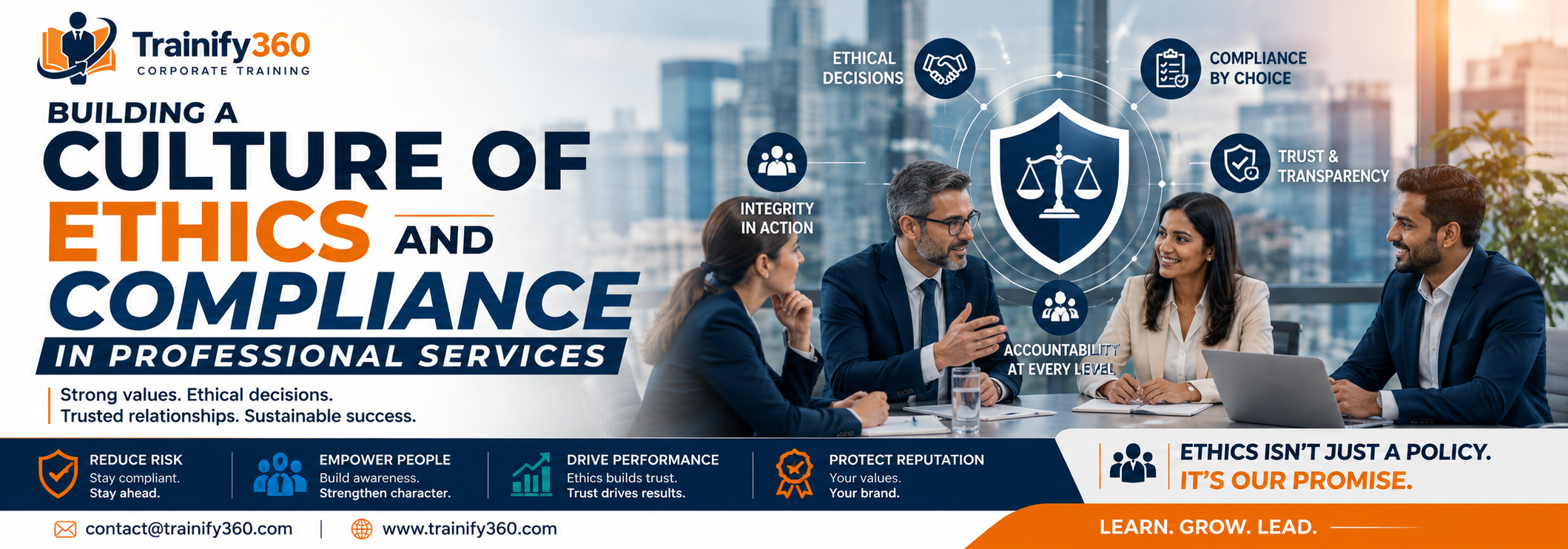
Building a Culture of Ethics and Compliance in Professional Services
I sat in on a post-mortem a few years ago after a mid-sized accounting firm had to restate a client's numbers. Not fraud, nothing criminal, just a set of judgment calls that had quietly drifted further and further from what the standards actually allowed, over about eighteen months. The partner running the engagement wasn't a bad actor. He was under fee pressure, the client kept asking for the same answer he'd given the year before, and nobody around him had ever said out loud that the drift was happening. That's the pattern I see again and again in this sector. It's rarely one dramatic decision. It's a series of small, defensible-sounding ones that add up to a real problem, in a culture that never built in a moment to stop and check.
Professional services firms have a compliance training industry built entirely around the assumption that the risk is ignorance. Teach people the rules, tick the box, move on. But most experienced people in these firms already know the rules perfectly well. What they don't have is permission, in the moment, to say the thing everyone's quietly avoiding.
Why This Sector's Risk Looks Different
Manufacturing compliance is mostly about following a fixed procedure correctly. Professional services compliance is messier, because so much of the job is judgment rather than procedure. An auditor deciding whether a valuation is reasonable, a consultant deciding whether a client's stated assumptions are defensible, a lawyer deciding how aggressively to interpret a grey area of the law none of that has a checklist that covers every case. The rules set boundaries. The judgment happens inside them, under commercial pressure, client relationship pressure, and fee pressure, often all at once.
That combination is exactly why standard compliance training doesn't work as well here as it does in other industries. A module explaining the code of conduct doesn't help someone navigate the moment a valued client is pushing back on a conclusion and a senior partner is signalling, without quite saying it, that keeping the relationship matters. The gap isn't knowledge. It's the confidence and the organisational backing to hold a line under that specific kind of pressure.
The Incentive Problem Nobody Wants to Name
Here's the uncomfortable part. Fee targets, partner compensation tied to client retention, and the general pressure to keep a big account happy all point, quietly, in the opposite direction from strict compliance. Nobody designs it that way on purpose. It just happens, because revenue is measured constantly and ethical judgment usually isn't measured at all until something goes wrong.
If a firm wants a real ethical culture, it has to be honest that this tension exists rather than pretending values statements alone resolve it. The firms that get into serious trouble aren't usually the ones with weak values pages. They're the ones where the values page says one thing and the comp model, promotion criteria, and daily behaviour of leadership say something else, and everyone below partner level can see the gap perfectly clearly.
What Actually Changes Behaviour
Training people on the rules matters, and it's not optional. But rules training solves for knowledge, not for courage. What determines whether someone actually raises a concern is whether they've seen it done before, safely, by someone senior enough that it didn't end badly for them.
I worked with a consulting firm a couple of years back that had exactly one rule for every new managing consultant: within your first year, you will see a partner walk away from a piece of work, or push back hard on a client, over an ethical line. If a new hire's first year passed without witnessing that, something had gone wrong with the induction, not with the individual. That's a very different design principle than "complete this compliance module by Friday." It puts the burden on leadership to demonstrate the behaviour, not on training content to describe it.
Escalation paths matter more than most firms realise too. Plenty of professional services organisations have a whistleblowing hotline buried in a policy document nobody reads. Far fewer have a genuinely known, trusted, informal route for someone to say "I'm not comfortable with this" to a person two levels up without it becoming a formal complaint, a paper trail, or a career risk. That informal, lower-stakes escalation option is often what actually gets used, long before anyone reaches for a hotline.
Where Training Fits, and Where It Doesn't
Training has a real job here, just a narrower one than most L&D functions assume. It should build fluency with the specific grey areas the firm actually encounters, using real, anonymised cases from the firm's own history rather than generic scenarios that feel disconnected from the work. A tax advisory team needs to work through the exact kind of aggressive planning judgment calls they see monthly, not a hypothetical about bribery in a country they've never operated in.
Training should also give people actual language to use under pressure. Most people who go along with something they're uneasy about don't do it because they lack values. They do it because they don't have a script for the conversation and freeze in the moment. Practising the specific words, "I want to flag something before we finalise this", in a low-stakes setting makes it far more likely someone can say it for real when the room goes quiet, and a client is waiting for an answer.
What training can't do is compensate for a comp model that rewards the opposite behaviour, or for a leadership team that's never been seen holding a line themselves. If a firm treats a single annual training session as the whole answer, it's solving the wrong 20 per cent of the problem and leaving the harder 80 percent, the incentives and the modelling, completely untouched.
Measuring the Right Thing
Completion rates for compliance training measure attendance, not culture. A better set of signals: how often concerns actually get raised and resolved before they escalate into something formal, whether people below partner level believe raising a concern would be taken seriously without career cost, and whether senior leaders can point to a specific recent example of walking away from revenue over an ethical line. That last one is the sharpest test available. A firm that can't name a recent instance, with specifics, probably hasn't actually built the culture it describes on its careers page.
Where to Start
Begin with an honest internal audit of where the comp model and the ethics policy actually pull in different directions, because that tension is where most drift begins. Then find a real recent example, even an uncomfortable one, where the firm got this right, and make sure people hear about it directly from a senior leader rather than through a slide in an onboarding deck. The training that follows will do far more good once people have already seen, in practice, that raising a concern here doesn't cost you anything.
Frequently Asked Questions
Why does standard compliance training often fail to prevent misconduct in professional services firms? Because most misconduct in this sector isn't caused by not knowing the rules. It's caused by pressure to bend a judgment call under fee, deadline, or client-relationship pressure, which training on rules alone doesn't address.
What's the biggest driver of an ethical culture in a partner-led firm? Visible, specific examples of senior leaders holding an ethical line, ideally at some commercial cost. Junior staff calibrate their own behaviour against what they've seen leadership actually do, not what a policy document says.
Should ethics training use generic scenarios or firm-specific cases? Firm-specific, anonymised cases work far better. Generic scenarios about unrelated industries or hypothetical situations don't transfer to the exact grey areas a firm's own teams face regularly.
How can HR or L&D leaders measure whether an ethical culture is actually working? Look past training completion rates. Track how often concerns get raised and resolved informally before escalating, and whether the firm can point to a recent, specific instance of walking away from revenue over an ethical issue.