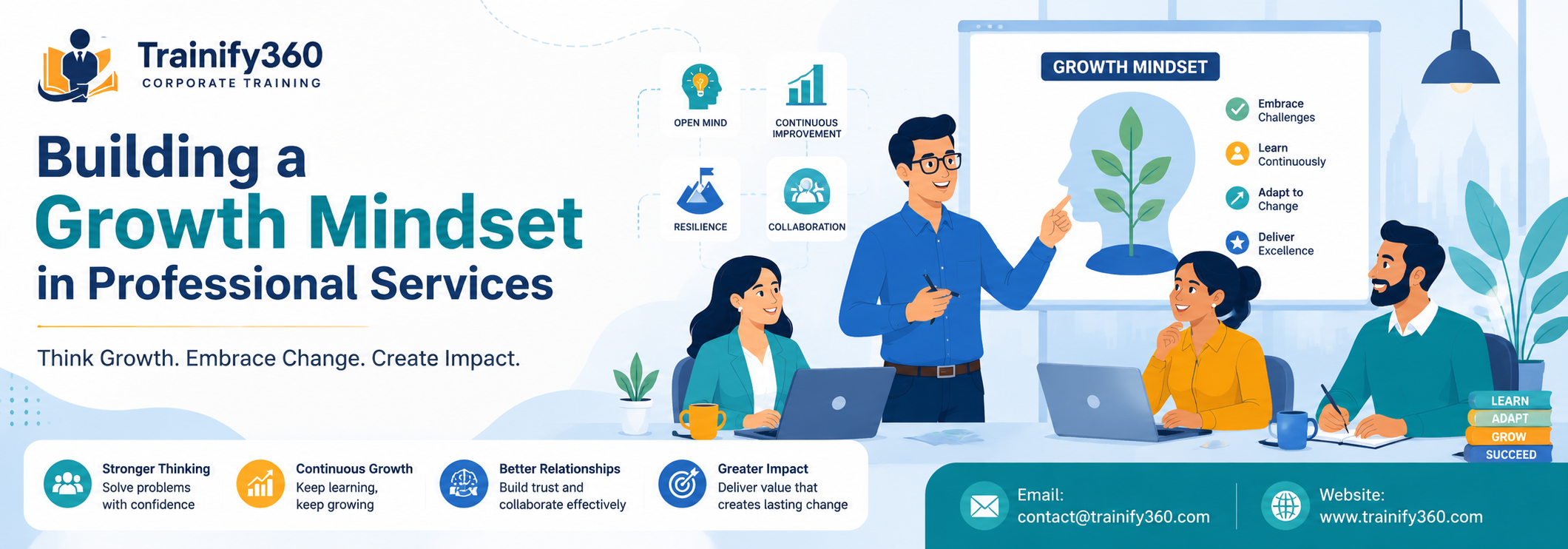
Building a Growth Mindset in Professional Services
A law firm partner said something to me a few years back that I still think about. "We hire the smartest people in the room," he said, "and then spend the next ten years teaching them it's fine not to be." He wasn't being cynical about it either. He'd just put his finger on the exact thing that makes growth mindset so hard to build in a firm like his.
Here's the difference. Most industries pushing growth mindset are trying to get people okay with failing. Professional services firms have to do that inside a culture built, deliberately, to reward certainty. Partners bill by the hour for their judgment. Clients hire consultants because they're supposed to already have the answer. Auditors and accountants build entire careers on precision, not exploration. Tell any of them to "get comfortable not knowing", and you'll get a polite nod, then absolutely no change in behaviour, because everything around them is still rewarding the opposite.
Why the Usual Workshop Doesn't Land
Most growth mindset training borrows straight from Carol Dweck's research and squeezes it into a half-day session: praise the effort, not the talent; treat mistakes as data; add a "yet" to the end of sentences. None of that is bad psychology. It just doesn't survive contact with a firm where a missed deadline can cost a client relationship, where one wrong figure creates real liability, and where compensation is basically a scoreboard for who bills the most hours with the most confidence.
The content isn't the problem. The problem is assuming mindset can be taught in a room that's disconnected from everything shaping behaviour the other 39 hours of the week. If promotions still go to whoever looks most technically flawless and client-polished, no amount of "growth" language in a workshop is going to move anyone. People do what gets rewarded. They don't do what gets said in a training session, however well it's delivered.
What This Actually Looks Like Day to Day
Cut through the workshop language, and it comes down to two fairly simple questions. Can a senior person say "I got that wrong" in front of a client without it costing them credibility? And can a junior person ask a question that feels embarrassingly basic without it showing up against them at review time?
Those two things tell you more about whether a firm has a real learning culture than any poster in the break room ever will. And neither one is decided by L&D. It's decided by what leadership actually does when the pressure's on.
I watched a managing partner do this well once. Mid-presentation, she stopped, turned to the client, and said her original recommendation had missed something a junior analyst on her team had caught the week before. She named the analyst. Credited him, in front of the client, on the spot. Those thirty seconds did more for that firm's learning culture than the entire onboarding programme put together. Everyone in that room recalibrated, right then, what was safe to say out loud.
The Barriers Worth Naming Honestly
A few things get in the way here, and it's worth being blunt about them rather than talking around them.
Billable hours don't reward exploration. Time spent learning something new, outside a client engagement's exact scope, doesn't show up as a good number on a utilisation report. If a firm actually wants a learning culture, it has to protect time for that explicitly. Saying it's encouraged while the metrics say otherwise doesn't fool anyone.
Partner-track pressure rewards certainty, not curiosity. Getting to partner usually means being seen as decisive and sure of yourself. Admitting uncertainty, even when it's the more honest position, can read as weakness right when a promotion committee is watching. Firms need to admit that incentive exists before they stand a chance of counteracting it.
Client-facing work builds a kind of mask. Consultants spend most of their working life performing confidence for people who are, quite literally, paying for that confidence. Switching that off and admitting a gap to a colleague five minutes after a client call isn't a small ask. It's a genuinely awkward transition, and most people never learn how to make it well.
And then there's the competition sitting quietly underneath all of it. In an up-or-out firm, the colleague next to you is also, in some sense, competing with you for the next partner slot. Asking a question that makes you look unsure, in front of someone you're up against for promotion, takes a level of trust that doesn't just appear because HR asked for it.
None of that gets fixed with a workshop. It gets fixed by changing what's measured, what's modelled by leadership, and what actually gets rewarded when it counts. Training has a role here, but it's a supporting one, not the main event.
What the Firms Getting This Right Actually Do
They start with an honest look at what their systems reward, not what the values statement on the website claims. If a promotion committee never once asks what someone learned from a failure, that's the first thing to fix before anyone books a training room.
They build the habit of debriefing into the work itself, rather than treating reflection as something separate from delivery. A short, honest conversation after an engagement. What worked, what didn't, what we'd change normalises the idea that every project, even the ones that went well, has something worth learning from.
They train the senior people first, and they do it visibly. In a hierarchical firm, this kind of behaviour spreads downward, never up. If partners haven't sat with their own blind spots honestly, asking associates to go first is asking them to take a risk nobody above them has actually taken.
They keep the skill of learning separate from the performance of confidence. Client-facing training and internal reflection are different disciplines, and squeezing them into one session waters both down. Consultants need explicit permission to be one person on a client call and a more open, questioning version of themselves an hour later in debrief.
And they measure behaviour instead of sentiment. Asking people in a survey whether they "feel safe to make mistakes" mostly gets you the answer people think they're supposed to give. What actually tells you something is whether junior staff raise concerns out loud in client meetings, and whether senior staff give credit to the people who caught the mistake.
Where to Start
If you only do one thing, start with how failure gets talked about at the top. Pick something recent and real a lost pitch, a flawed recommendation, a missed deadline and have a senior leader walk the firm through it honestly. What happened, what got misjudged, what changed afterwards. Do that consistently and publicly, and whatever training follows will land on ground that's already been prepared. Skip it, and even a well-designed workshop is just an hour people sit through before going back to a culture that never actually moved.
Frequently Asked Questions
Why does growth mindset training often fail specifically in professional services firms? Because these firms reward certainty, precision, and billable performance more directly than most industries, and a half-day workshop can't override daily incentives pulling in the opposite direction.
Who should go through growth mindset training first in a partner-led firm? Senior leadership and partners, not associates. Behaviour spreads downward in hierarchical firms, so junior staff will only take the risk once senior staff have visibly modelled that it's safe.
How is growth mindset different for client-facing consultants versus internal teams? Client-facing consultants have to perform confidence externally while still practising honest reflection internally. Training needs to treat these as two related but separate skills, not one blended message.
What's a practical first step for an HR or L&D leader trying to build this? Look honestly at what your promotion and performance systems actually reward, before you run any training at all. If admitting a mistake still costs someone their career trajectory, fix that first; otherwise, the training won't change a thing.