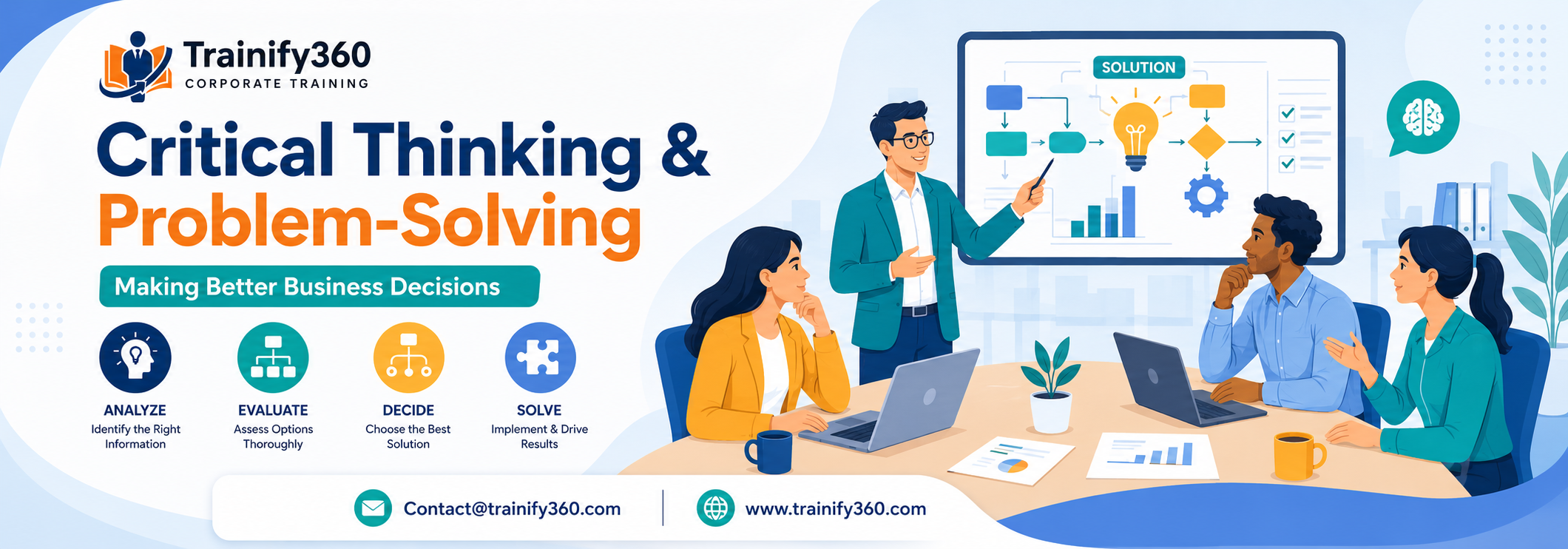
Critical Thinking and Problem-Solving Skills for Better Business Decisions
Every organisation talks about making better decisions. Few stop to ask what actually makes a good decision possible.
Technology has undoubtedly changed the way businesses operate. Teams have instant access to dashboards, reports, customer insights, financial data, and AI-powered recommendations. Information is everywhere.
Yet despite having more data than ever before, organisations still make costly mistakes. Projects go over budget. Customer issues take longer to resolve. Teams solve the wrong problems. Leaders revisit decisions that should have been right the first time.
The issue isn't a lack of information. It's the ability to think clearly before acting. That's why critical thinking and problem-solving have become two of the most valuable skills in today's workplace.
They're no longer qualities expected only from senior leaders. Every employee from frontline teams to department heads makes decisions that affect customers, colleagues, and business outcomes.
For organisations looking to build stronger leaders and more capable teams, investing in these skills isn't simply about learning and development.
It's about improving the quality of decisions across the business.
Why This Matters More Today Than Ever Before
Business has become far more complex than it was even a few years ago. Customer expectations change quickly. Markets shift unexpectedly.
Technology evolves at an incredible pace. And employees are expected to adapt almost overnight.
While organisations have invested heavily in digital transformation and artificial intelligence, these tools don't eliminate the need for human judgement.
They simply provide more information. The real challenge is deciding what that information actually means. Think about a typical management meeting.
Everyone is looking at the same dashboard. The same reports. The same performance numbers. Yet different people often reach completely different conclusions. Why? Because decision-making isn't driven by data alone.
It's driven by how people interpret it. That's where critical thinking makes the difference.
Critical Thinking Isn't About Being Critical
The phrase often creates the wrong impression. People assume critical thinking means questioning everything or finding flaws in every idea.
In reality, it's much simpler. It's about approaching situations with curiosity instead of assumptions. Rather than accepting the first explanation, critical thinkers naturally pause and ask questions.
What evidence supports this conclusion?
Could there be another explanation?
Are we solving the real issue or just reacting to the symptoms?
What information are we missing?
Those questions don't slow organisations down. They help prevent expensive mistakes. And over time, they create better business outcomes.
Great Problem-Solvers Don't Rush to Solutions
One of the biggest differences between average managers and exceptional leaders is how they approach problems. Average managers often focus on fixing what's immediately visible.
Strong leaders focus on understanding why it happened. Imagine customer complaints suddenly increase. The obvious reaction is to improve customer service.
But what if the real issue is delayed deliveries?
Or confusing communication?
Or inconsistent product quality?
Improving customer service won't solve those problems. The same applies internally. If employee engagement drops, organisations often introduce new benefits or recognition programmes.
Sometimes that's exactly what's needed. Sometimes the real issue is leadership behaviour, workload, or a lack of career opportunities. Until the organisation understands the root cause, every solution is a little more than an educated guess.
Good problem-solvers know that the quality of the solution depends entirely on the quality of the thinking that comes before it.
Every Employee Makes Decisions That Matter
There was a time when strategic thinking was expected only from executives. Today's workplace doesn't work that way.
A recruiter decides which candidates move forward.
A project manager balances priorities and resources.
A sales executive identifies where to invest time.
A customer service representative resolves situations that influence customer loyalty.
An HR Business Partner recommends workforce strategies.
These may seem like individual decisions. Collectively, they shape organisational performance. That's why critical thinking shouldn't be viewed as a leadership skill alone. It's a capability that benefits every function, every department, and every employee.
Building a Culture Where People Think for Themselves
Many organisations say they want employees who take ownership. Ownership doesn't happen because it's written in a company handbook.
It develops when leaders encourage independent thinking. The questions managers ask have a huge influence on how teams solve problems.
Instead of saying,
"Here's what we're going to do."
Consider asking,
"What options have we explored?"
"What evidence supports this recommendation?"
"What risks should we prepare for?"
"What would success look like?"
Simple questions like these change conversations. Over time, they change culture.
Employees become more confident sharing ideas because they're encouraged to think not simply follow instructions.
Why Practical Learning Makes the Difference
Critical thinking can't be developed through PowerPoint presentations alone. People improve these skills by practising them.
That's why the most effective learning programmes move beyond theory. Participants work through realistic business scenarios.
They analyse case studies. Discuss different viewpoints. Solve workplace challenges. Make decisions under pressure.
Reflect on the outcomes. This approach mirrors real work. And that's exactly why it produces lasting results.
How Trainify360 Helps Organisations Build Better Decision-Makers
At Trainify360, we believe learning should prepare people for the decisions they face every day.
Our programmes are designed around real business challenges rather than textbook examples.
Participants learn how to evaluate information objectively, identify root causes, collaborate effectively, and make confident decisions that align with organisational goals.
Every workshop is tailored to the organisation's business priorities, ensuring that learning isn't just engaging; it delivers measurable workplace impact.
Final Thoughts
Every organisation invests in technology. The organisations that stand out also invest in how their people think.
Critical thinking and problem-solving aren't simply behavioural competencies. They're business capabilities that influence leadership, innovation, collaboration, customer experience, and long-term organisational success.
When employees learn to ask better questions, analyse situations objectively, and make decisions with confidence, the entire organisation benefits.
For CHROs, HR leaders, Learning & Development teams, and business executives, building these capabilities is one of the smartest investments they can make.
At Trainify360, we're committed to helping organisations develop professionals who think clearly, solve problems effectively, and make decisions that create lasting business value.
Frequently Asked Questions (FAQs)
1. What are critical thinking and problem-solving skills in the workplace?
Critical thinking is the ability to evaluate information objectively, question assumptions, and make well-informed decisions. Problem-solving complements this by helping employees identify the root cause of a challenge, explore possible solutions, and implement the most effective course of action. Together, these skills enable professionals to make smarter business decisions and respond confidently to workplace challenges.
2. Why are critical thinking skills important for organisations?
Organisations face increasingly complex business environments where decisions need to be made quickly and accurately. Employees with strong critical thinking skills are better equipped to analyse situations, reduce errors, solve problems effectively, and make decisions based on evidence rather than assumptions. This leads to improved productivity, innovation, and business performance.
3. Who should receive critical thinking and problem-solving training?
These skills are valuable for professionals at every level of an organisation. Managers, team leaders, HR professionals, sales teams, customer service representatives, project managers, and senior executives all benefit from developing stronger analytical thinking and structured problem-solving capabilities.
4. How do critical thinking skills improve leadership effectiveness?
Effective leaders don't just provide answers—they ask the right questions. Critical thinking helps leaders evaluate different perspectives, assess risks, make informed decisions, and guide teams through uncertainty. It also encourages a culture of collaboration, accountability, and continuous improvement across the organisation.
5. What is the difference between critical thinking and problem-solving?
Critical thinking focuses on analysing information, evaluating evidence, and understanding a situation before making a decision. Problem-solving is the process of identifying challenges, exploring possible solutions, and implementing the best course of action. Critical thinking strengthens problem-solving by ensuring decisions are based on sound judgement rather than assumptions.