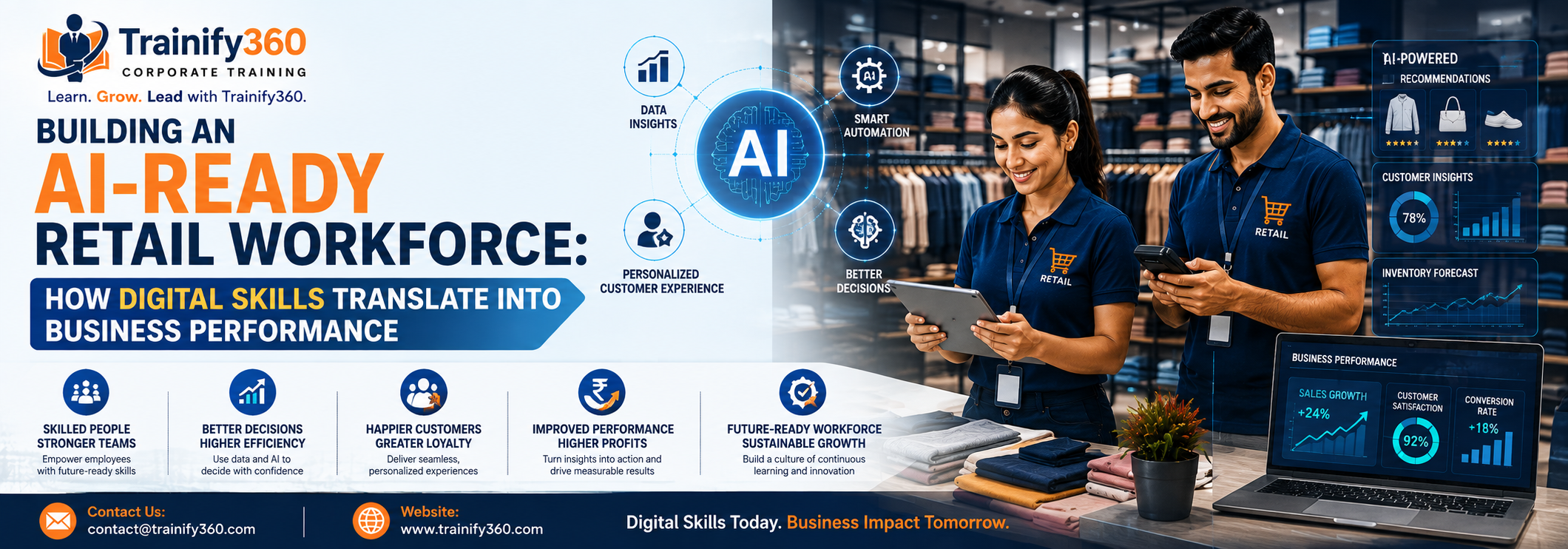
Building an AI-Ready Retail Workforce: How Digital Skills Translate into Business Performance
A CFO I worked with last year said something fairly blunt during a budget review. He'd signed off on a seven-figure AI-driven inventory system eighteen months earlier, and adoption across the stores was still patchy at best. Some regions were using it properly, and their forecasting accuracy kept improving month after month. Others had quietly gone back to spreadsheets, staff overriding the system's recommendations whenever they felt like it, because nobody had ever really explained why the tool was making the calls it made.
Same system. Same rollout budget. Wildly different results and the difference came down entirely to whether the people using it actually understood it well enough to trust it.
I keep running into a version of that story with retail clients right now. The technology decision gets made with real rigour at the top: proper vendor evaluation, careful contract terms, the works. The workforce decision, whether the people actually using the tool day to day are equipped to use it well, tends to get treated as an afterthought bolted on near the end. And that's usually exactly where the return on investment quietly falls apart.
The Skills Gap Isn't Where Most Leaders Assume
There's a fairly common assumption among retail leadership that AI readiness is basically a technical problem something for IT or the data team to handle, with everyone else needing little more than a quick tutorial. That assumption doesn't survive much contact with how AI tools actually sit inside a retail business.
Most front-line and mid-level staff don't need to understand how a model was trained, or what's happening underneath a recommendation mathematically. What they need is a working ability to read outputs, notice when something looks off, and adjust their own decisions accordingly. A store manager looking at a demand forecast needs enough grounding to know when local knowledge should override the model not just enough training to read the number off the screen.
That's a genuinely different skill from technical AI literacy, and it's the one almost every training programme skips. Vendors train on features: how to log in, where the dashboard lives, which button produces which report. Almost nobody trains on judgment when to trust an output, when to push back on it, and what to actually do once you realise it's wrong.
Why This Bites Harder in Retail Than Most Sectors
A few things about retail specifically make workforce AI readiness a bigger deal than it might be elsewhere. The workforce is large and spread thin, often across hundreds of locations, which makes consistent training genuinely difficult to deliver and very easy to underfund. Turnover runs high too, particularly in front-line and seasonal roles, so whatever capability you build has to survive constant staff replacement rather than sitting as a one-off investment in a stable team. And AI tools in retail tend to sit right inside customer-facing work, pricing, personalisation, service chatbots, so a poorly understood tool doesn't just create some internal inefficiency nobody notices. It shows up in front of the customer, sometimes visibly.
Put those three together, and "we'll figure it out as we go" starts to look like a genuinely risky plan rather than a pragmatic one.
What an AI-Ready Workforce Actually Looks Like
Being AI-ready doesn't mean turning your whole retail workforce into data scientists. It means people in different roles have the specific capability their actual job calls for, nothing more, nothing less.
Store and category managers need enough grounding to look at a forecasting or pricing tool critically, to understand what's sitting behind a recommendation and when their own local knowledge should win out over it. Customer-facing staff working alongside AI, chatbots handling the first line of queries, engines suggesting products, need a sense of what the tool's actually good at and where it tends to fall, so they can step in smoothly instead of treating it as either gospel or background noise. Merchandising and supply chain teams need to feel comfortable questioning a model's assumptions rather than nodding along, especially once market conditions shift into territory the training data never saw. And team leaders, more broadly, need enough fluency to coach their own people through AI-assisted decisions, because most employees will ask their manager a question long before it occurs to them to escalate anything to IT.
None of that calls for deep technical training. It calls for deliberate, role-specific capability building, which is a fairly different thing from the generic "AI awareness" sessions most organisations are currently running.
Where Most Rollouts Actually Go Wrong
Having watched a good number of these rollouts play out up close, the same mistakes tend to show up again and again, across organisations that otherwise look nothing alike.
Training gets treated as a launch event rather than something ongoing, so whatever understanding people picked up fades within a couple of months, well before it's had time to turn into an actual habit. Content usually gets built by the vendor rather than by anyone who really understands how that specific retail workforce operates day to day, so it ends up optimised for covering features rather than building the judgment employees actually need. Frontline managers get left out entirely, handed the same generic session as their teams instead of the deeper grounding that would let them coach and reinforce it afterwards, on the floor, when it counts. And measurement stops dead at completion rates who finished the module- not whether anyone can actually use the tool well six months later, which tells leadership next to nothing about whether the money was well spent.
Any one of these problems on its own is manageable. Together, which is how they typically show up, they quietly undo a technology investment that looked perfectly sound on paper.
What the Better Organisations Do Instead
The organisations getting a genuine return on their AI spend tend to build workforce readiness alongside the technology rollout, not after it's already live, treating capability as part of the implementation plan rather than something to circle back to eventually.
They build training around the specific tools and workflows their teams will actually be using, not generic AI concepts pulled straight from a vendor's standard deck. They put real investment into managers specifically, since managers are the ones doing the reinforcing and troubleshooting long after the initial launch buzz has worn off. They build in refreshers tied to actual tool updates, rather than assuming one session will hold up against a tool that's going to keep changing underneath everyone. And they measure real usage and decision quality, not just who clicked through the training, checking whether people are genuinely using the outputs well rather than blindly following them or ignoring them altogether.
The Business Case, Without the Padding
For CHROs and CLOs building the case for investment here, the argument is fairly direct. Workforce readiness is what actually determines whether an AI investment pays back on schedule, because a tool nobody trusts or understands properly simply doesn't get used well, no matter how sophisticated it is underneath. It also cuts the operational risk of AI-driven mistakes reaching customers, since staff who understand a tool's limits catch problems before they ever become visible outside the business. And it makes the case for the next technology investment noticeably easier, since leadership teams who've watched one AI rollout land well tend to find far less resistance backing the next one.
Where to Start
Before your next AI tool goes live, map out exactly who needs to interpret its outputs day to day, not just who needs to know how to log in. Build role-specific training instead of one generic session for the whole organisation. Put real investment into manager capability specifically, since they'll be doing most of the reinforcing once the rollout team has moved on to the next project. And track adoption and decision quality over the following months, not just completion numbers at launch, so you actually know whether the thing worked.
Final Thoughts
Retailers are investing seriously in AI, and that's only going to grow from here. The businesses getting a genuine return aren't necessarily the ones running the most sophisticated technology. They're the ones whose people actually understand what they're working with, well enough to trust it when it's right and push back when it's not. That kind of understanding doesn't build itself alongside a system rollout, no matter how good the software is. It has to be planned for, deliberately, with the same care that goes into choosing the technology in the first place.
Trainify360 helps retail organisations build the role-specific AI capability that turns technology investment into real business performance. If your next AI rollout is on the calendar, it's worth talking to us before launch, not after.
Frequently Asked Questions
What does it actually mean for a retail workforce to be "AI-ready"? It means employees across different roles have the specific judgment needed to interpret AI tool outputs, know when to trust them, and understand when local knowledge should override a recommendation, rather than just knowing how to operate the software.
Why do AI rollouts in retail often underdeliver despite heavy technology spend? Because workforce readiness usually gets treated as an afterthought. Training focuses on tool features rather than judgment, and it's delivered once rather than reinforced over time, so understanding fades before it ever becomes habit.
Which retail roles need this capability built first? Store and category managers, customer-facing staff working alongside AI tools, and merchandising or supply chain teams tend to carry the highest exposure, since their decisions have a direct line to customers and revenue.
How is AI-readiness training different from standard vendor tool training? Vendor training typically covers features and navigation. Workforce readiness training focuses on interpreting outputs, spotting when a tool's gone wrong, and building the judgment to know when to override it.
How should leaders actually measure whether this training worked? By tracking adoption and decision quality over time, not just completion rates, since completion tells you almost nothing about whether employees can genuinely use the tool well months after launch.