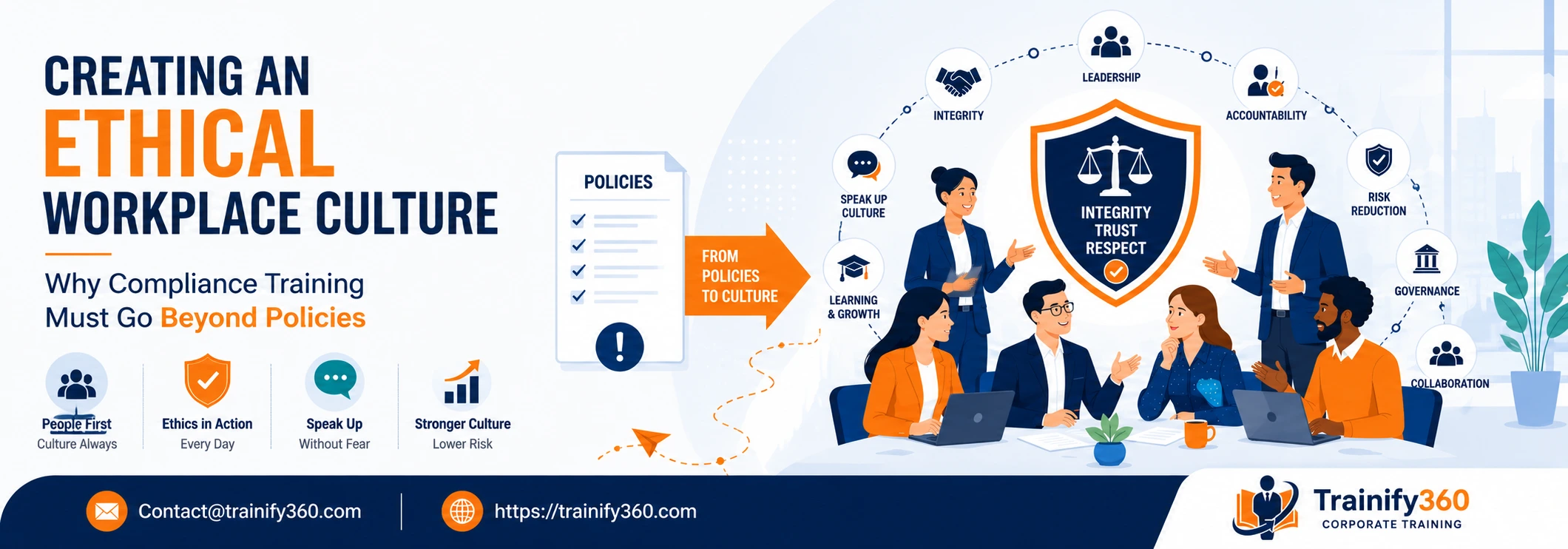
Creating an Ethical Workplace Culture: Why Compliance Training Must Go Beyond Policies
If you've spent any time leading HR, Learning & Development, or Compliance, you've probably seen the same annual routine.
Mandatory training is assigned. Reminder emails follow. Employees complete their courses, pass a short assessment, and download a certificate. HR updates the completion report, leadership receives confirmation that regulatory requirements have been met, and the organisation moves on. From an administrative perspective, everything looks successful.
The more important question is whether anything has actually changed. Will employees recognise an ethical issue before it becomes a business risk? Will a manager know how to respond when they're faced with a difficult decision involving a customer, supplier, or colleague? Will someone feel confident enough to raise a concern when they notice something isn't quite right?
Those are the moments that define an organisation's ethical workplace culture. They rarely happen inside a training module. They happen during ordinary working days, often when people are under pressure, balancing competing priorities, or trying to solve a problem quickly.
That's why compliance training deserves a broader role than simply helping organisations meet regulatory obligations. When it's designed well, it develops judgement, reinforces organisational values, and helps employees make better decisions long after the course has finished.
Policies Set Expectations. Culture Determines Behaviour.
Most organisations already have well-written policies.
There are guidelines covering workplace conduct, data privacy, cybersecurity, conflicts of interest, anti-bribery, information security, and countless other compliance requirements. They're reviewed by legal teams, approved by leadership, and made available to every employee.
Yet organisations with comprehensive policies still experience compliance failures, ethical breaches, and reputational damage.
The problem usually isn't the quality of the policies.
It's the assumption that publishing a policy automatically changes behaviour.
In reality, employees don't pause to read a policy document every time they face a difficult situation. They rely on experience, judgement, advice from colleagues, and the behaviours they see demonstrated by their managers.
That's where culture comes into play.
Culture influences the decisions people make when nobody is reminding them about the rules. It shapes how comfortable employees feel about asking questions, reporting concerns, admitting mistakes, or challenging decisions that don't seem right.
Policies explain what's expected.
Culture influences what actually happens.
Where Many Compliance Programmes Fall Short
Most organisations don't intentionally create ineffective compliance training. The issue is that many programmes have been designed to satisfy regulatory requirements rather than improve workplace behaviour.
Employees work through lengthy presentations, answer multiple-choice questions, and receive a completion certificate. The organisation can demonstrate that learning has been delivered, which is often essential during audits.
But completing a course isn't the same as developing sound judgement.
Most people forget information that isn't reinforced or applied. Generic examples rarely connect with the challenges employees face in different roles, and annual refresher courses often feel disconnected from everyday work.
This creates a false sense of confidence.
On paper, the organisation has achieved a 100% completion rate.
In practice, employees may still be uncertain about how to respond when they're faced with an ethical dilemma.
That's the gap many organisations need to close.
Ethical Decisions Are Usually Made Under Pressure
Compliance failures rarely begin with someone deliberately choosing to ignore company policy.
More often, they begin with ordinary decisions made during a busy working day.
A procurement manager approves a supplier without recognising a potential conflict of interest because a project deadline is approaching.
A salesperson shares information too freely while trying to strengthen a client relationship.
A finance analyst notices an unusual transaction but assumes another colleague has already investigated it.
An employee uses a public AI tool to summarise confidential business information without fully understanding the privacy implications.
None of these individuals intends to create organisational risk.
They're trying to do their jobs.
The challenge is that business pressure can influence decision-making. Tight deadlines, commercial expectations, customer demands, and workload all compete for attention. Without practical guidance and regular reinforcement, employees may choose the quickest solution rather than the most appropriate one.
That's why effective compliance training focuses on developing judgment, not simply increasing awareness.
Move Beyond Policy Awareness
Many organisations still measure compliance learning by asking one question:
"Has everyone completed the course?"
A more valuable question would be:
"Would employees know what to do if they encountered an ethical issue tomorrow?"
There's an important difference.
Employees don't need to memorise every section of a Code of Conduct. They need to understand how those principles apply in situations they're likely to encounter.
Scenario-based learning helps bridge that gap.
Instead of presenting pages of policy text, present realistic workplace situations.
How should a manager respond if a team member reports inappropriate behaviour but doesn't want to make a formal complaint?
What should an employee do if confidential customer information is accidentally shared with the wrong recipient?
How should someone respond if they're offered an expensive gift while negotiating a supplier contract?
These conversations encourage employees to think critically, consider the consequences of different actions, and develop the confidence to make responsible decisions.
That's far more valuable than simply remembering policy wording.
Leadership Has a Greater Influence Than Any Policy
Employees pay close attention to leadership behaviour.
They notice how managers respond when mistakes happen.
They observe whether difficult conversations are handled openly or avoided altogether.
They recognise whether leaders demonstrate the same standards they expect from everyone else.
An organisation can't build an ethical workplace culture through documentation alone.
Employees need to see those values reflected in everyday decisions.
When leaders discuss ethical challenges openly, encourage questions, and explain the reasoning behind difficult decisions, compliance becomes part of the organisation's culture rather than another annual requirement.
That's where meaningful change begins.
Build a Culture Where People Feel Comfortable Speaking Up
Even the most comprehensive compliance programme can't anticipate every situation employees will face. New technologies emerge, regulations change, and business pressures evolve. There will always be moments when someone has to make a judgment call.
What often determines the outcome isn't the policy itself but whether employees feel comfortable asking questions before making a decision.
Most organisations say they have an open-door culture. The real test is whether employees believe it.
Would a new employee feel confident reporting a potential conflict of interest? Would a manager admit they'd made a mistake before it became a larger issue? Would someone challenge a decision if they believed it compromised the organisation's values?
These situations don't depend on policy documents. They depend on trust.
Building that trust takes consistent leadership. Managers need to create an environment where asking questions isn't seen as a weakness and reporting concerns isn't viewed as creating problems. When employees know they'll be listened to fairly and respectfully, they're far more likely to raise issues early, when they're still manageable.
An organisation where people speak up is almost always better equipped to identify risks before they become costly incidents.
Compliance Learning Shouldn't Be an Annual Event
One of the biggest misconceptions about compliance training is that it can be delivered once a year and remain effective for the next twelve months.
Learning doesn't work that way.
Employees make decisions every day. Business priorities shift, regulations are updated, and new risks emerge far more frequently than annual training cycles.
Think about how quickly workplaces have changed over the past few years. Hybrid working has become commonplace. Artificial Intelligence is being introduced across different business functions. Cybersecurity threats continue to evolve. The situations employees encounter today are often very different from those they faced even a year ago.
That's why leading organisations are moving away from viewing compliance as a yearly exercise. Instead, they're embedding learning into everyday work through shorter, more frequent interventions.
A five-minute discussion during a team meeting. A short scenario based on a recent industry incident. A quarterly refresher on cybersecurity or data privacy. A manager sharing lessons learned from a real business situation.
These small learning moments keep compliance relevant without adding unnecessary complexity. More importantly, they encourage employees to think about ethical decision-making as part of their daily responsibilities rather than something connected only to mandatory training.
Measure What Really Matters
Completion rates have their place. They help demonstrate that mandatory learning has been delivered and provide evidence during audits.
But they shouldn't be mistaken for evidence of an ethical culture.
A report showing 100 percent completion doesn't tell you whether employees feel confident challenging inappropriate behaviour. It doesn't reveal whether managers are having better conversations about ethics or whether teams are recognising potential risks earlier than before.
If organisations want to understand whether compliance training is making a difference, they need to look beyond attendance figures.
Questions worth asking include:
- Are employees reporting concerns earlier?
- Have repeat compliance incidents reduced over time?
- Do managers feel more confident handling ethical issues?
- Has awareness of cybersecurity and information security improved?
- Are employees applying company policies more consistently in day-to-day decisions?
These indicators provide a far clearer picture of whether learning is influencing behaviour.
Ultimately, the purpose of compliance training isn't to produce certificates. It's to help people make better decisions when it matters most.
How Trainify360 Supports Ethical Workplace Culture
Creating an ethical workplace isn't about delivering more training. It's about delivering the right learning in the right way.
At Trainify360, we work with HR leaders, Learning & Development teams, compliance professionals, and business executives to design learning programmes that reflect the realities of today's workplace. Rather than relying on generic content, we develop practical, role-based learning that employees can relate to and apply in their everyday work.
Whether the focus is workplace ethics, cybersecurity awareness, information security, AI governance, code of conduct, anti-harassment, or regulatory compliance, every programme is designed with one objective in mind: helping employees make informed, responsible decisions that support both organisational values and business performance.
When learning reflects real workplace situations, employees engage more actively, retain knowledge for longer, and feel more confident applying what they've learned. Over time, those individual decisions contribute to a stronger culture, one where ethical behaviour becomes part of how the organisation operates, not simply another compliance requirement.
Final Thoughts
Creating an ethical workplace culture doesn't begin with a policy manual, and it certainly doesn't end with an annual compliance course.
It develops through everyday decisions, consistent leadership, and learning that helps employees understand not only what the rules are, but why those rules matter.
Organisations that approach compliance in this way gain far more than regulatory assurance. They build trust with employees, strengthen accountability across teams, reduce business risk, and create an environment where people are confident in making the right decisions even when the answer isn't obvious.
Policies establish expectations, but people bring those expectations to life.
When organisations invest in practical, relevant compliance learning, they're not simply meeting regulatory requirements. They're building a culture where integrity becomes part of everyday business.
If you're looking to strengthen your organisation's approach to compliance learning, Trainify360 can help. We partner with organisations to design engaging, business-focused learning programmes that support ethical decision-making, reinforce organisational values, and help build resilient, high-performing teams for the future.