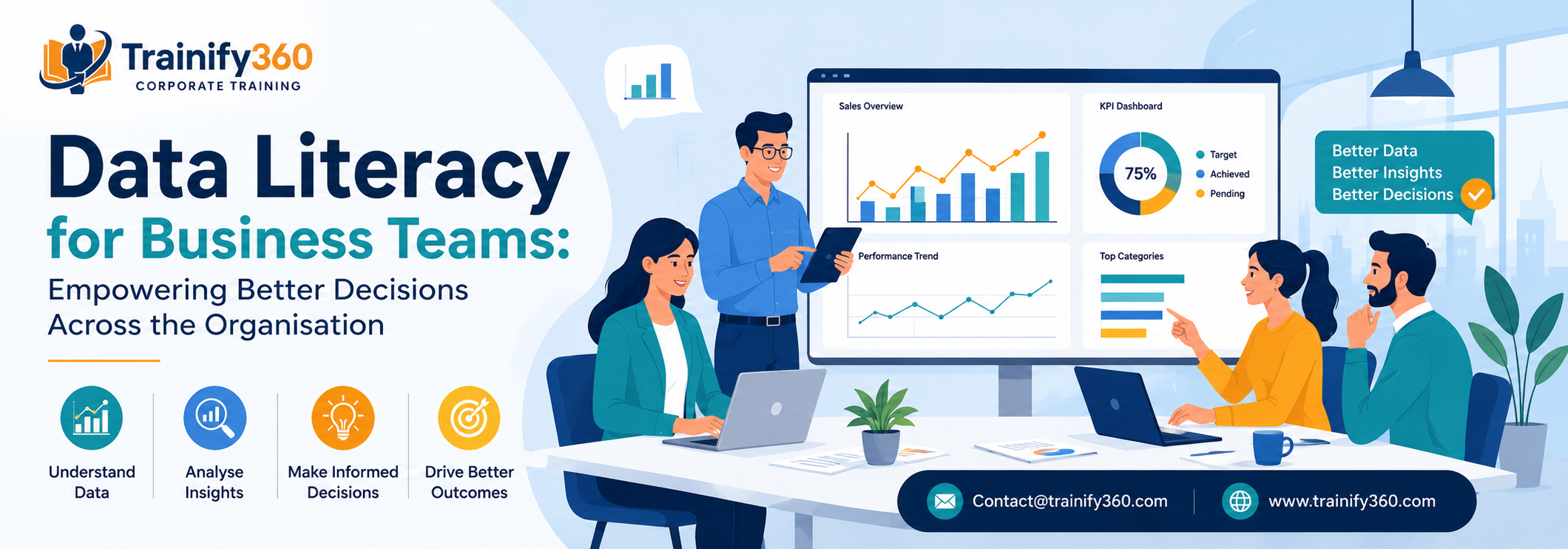
Data Literacy for Business Teams: Empowering Better Decisions Across the Organisation
Every organisation talks about becoming data-driven. Few stop to ask whether their people are actually equipped to work with data confidently.
Across departments, employees have access to dashboards, reports, KPIs, customer insights, financial metrics, and operational data. Yet many important business decisions still rely on instinct, experience, or assumptions rather than evidence.
The issue isn't the availability of information. It's the ability to understand it, question it, and apply it effectively.
This is where data literacy has become a critical organisational capability. It is no longer a skill reserved for analysts or technology professionals. Business leaders, HR teams, managers, sales professionals, marketers, and operations teams all make decisions influenced by data every day.
The organisations that invest in developing this capability are seeing stronger collaboration, faster decision-making, and better business outcomes.
What Is Data Literacy?
Data literacy is the ability to read, understand, interpret, and communicate information so that better business decisions can be made.
It isn't about writing complex formulas or building analytical models.
Instead, it helps employees answer questions such as:
- What is this report telling us?
- Why has performance changed?
- Which metrics should we prioritise?
- Are we solving the right problem?
- What evidence supports this recommendation?
These are practical business questions.
The confidence to answer them separates organisations that simply collect data from those that genuinely use it.
Why Data Literacy Has Become a Business Priority
Organisations have invested millions in digital transformation, business intelligence platforms, automation, and AI-powered reporting.
Yet technology alone doesn't improve decision quality. A dashboard can highlight declining customer retention. It cannot explain the underlying reasons.
An HR analytics platform can identify higher attrition. It cannot determine which intervention will improve retention. Software delivers information. People provide judgement.
That judgement becomes stronger when employees understand how to interpret data within the context of the business.
This is why data literacy has become a strategic priority for organisations focused on sustainable growth.
The Business Cost of Low Data Literacy
When employees struggle to interpret information confidently, organisations often experience challenges that extend beyond reporting.
Common signs include:
- Decisions based on assumptions rather than evidence
- Conflicting interpretations of the same data
- Slow decision-making because teams wait for analysts
- Low confidence during business reviews
- Missed opportunities hidden within reports
- Difficulty measuring the impact of initiatives
These issues rarely appear in isolation.
Over time, they influence productivity, profitability, customer satisfaction, and organisational agility.
Data Literacy Is Everyone's Responsibility
One misconception is that only technical teams need strong analytical skills.
Today's workplace tells a different story.
HR Teams
People analytics has become central to workforce planning, employee engagement, succession planning, retention, and learning effectiveness.
HR professionals increasingly rely on data to shape strategic conversations with business leaders.
Understanding the numbers is no longer optional.
Sales Leaders
Sales teams analyse customer behaviour, conversion rates, pipeline performance, and forecasting data.
Interpreting these insights effectively allows teams to prioritise opportunities and improve revenue outcomes.
Marketing Teams
Marketing decisions rely heavily on campaign analytics, customer segmentation, digital engagement, and return on investment.
Without data literacy, organisations risk making marketing investments based on incomplete understanding.
Operations
Operational leaders depend on performance metrics to improve quality, efficiency, utilisation, and productivity.
The ability to identify trends early often determines operational success.
Business Leaders
Executives make strategic decisions every day.
While analysts provide information, leaders must interpret that information alongside business priorities, market conditions, and organisational objectives.
This requires data confidence not technical expertise.
Data Literacy Creates Better Conversations
One of the biggest benefits of improving data literacy isn't found in dashboards. It's found in meetings. Instead of conversations beginning with opinions, they begin with questions.
What changed?
What does the data suggest?
What assumptions are influencing this conclusion?
Do we have enough evidence to move forward?
These discussions encourage collaboration rather than debate.
Departments become more aligned because decisions are based on a shared understanding rather than individual interpretation.
This creates a stronger decision-making culture across the organisation.
Why Traditional Data Training Often Falls Short
Many organisations approach data literacy through software demonstrations. Employees learn where reports are located.
They understand dashboard navigation. They become familiar with analytics tools. But they don't necessarily become better decision-makers.
Effective learning programmes should focus on interpretation rather than technology. Participants should work through real business scenarios.
They should analyse organisational data, discuss practical challenges, identify trends, and present recommendations.
Learning becomes meaningful when employees can immediately apply it in their own roles.
Building a Data-Literate Organisation
Developing organisational capability requires more than a single workshop. Successful organisations take a structured approach. Start with Leadership
Leaders influence organisational behaviour. When leaders consistently ask evidence-based questions, employees naturally become more comfortable using data in discussions and decision-making.
Assess Current Capability
Not every department requires the same level of analytical confidence.
Understanding current capability allows organisations to create learning pathways suited to different business functions.
Focus on Practical Learning
Employees learn more effectively when training reflects real workplace challenges.
Business simulations, case studies, collaborative exercises, and practical discussions create stronger learning outcomes than theoretical instruction alone.
Reinforce Learning
Capability develops through continuous application.
Coaching, peer discussions, learning communities, and regular use of business metrics help embed new behaviours over time.
The Role of Learning & Development
Learning and Development teams have an important opportunity to influence organisational capability. Data literacy should not be viewed as another technical course.
It should become part of leadership development, managerial capability, problem-solving, decision-making, and business acumen programmes.
When employees understand data, they ask better questions. When managers understand data, they make better decisions. When leaders understand data, organisations perform better. That is the real value of data literacy.
How Trainify360 Supports Data Literacy
At Trainify360, we believe data literacy is about developing confident decision-makers not analysts.
Our corporate learning programmes are designed around real business challenges faced by managers, HR professionals, functional leaders, and cross-functional teams.
Rather than focusing solely on tools, we help participants:
- Interpret business metrics with confidence
- Understand organisational performance indicators
- Ask evidence-based questions
- Analyse trends and patterns
- Present recommendations supported by data
- Improve decision-making across teams
Every programme is customised to align with organisational goals, business priorities, and industry requirements, ensuring that learning translates into measurable workplace outcomes.
Final Thoughts
Organisations already possess vast amounts of information.
The real advantage lies in helping people use it effectively.
Data literacy empowers employees to move beyond reporting and become more confident contributors to business success. It improves collaboration, strengthens strategic thinking, and creates a culture where decisions are guided by evidence rather than assumptions.
For CHROs, Learning & Development leaders, and business executives, investing in data literacy is more than a training initiative. It is a long-term investment in organisational capability, leadership effectiveness, and sustainable growth.
At Trainify360, we partner with organisations to build these capabilities through practical, business-focused learning experiences that prepare teams to make smarter decisions in an increasingly data-driven world.
Frequently Asked Questions (FAQs)
1. What is data literacy in the workplace?
Data literacy is the ability of employees to read, interpret, analyse, and communicate data effectively to support informed business decisions.
2. Why is data literacy important for business teams?
It enables employees across departments to make evidence-based decisions, improve collaboration, identify trends, and respond more effectively to business challenges.
3. Is data literacy only relevant for analysts?
No. Managers, HR professionals, sales teams, marketers, finance professionals, and operations leaders all benefit from understanding and applying data in their day-to-day work.
4. How can organisations improve data literacy?
By combining practical workshops, real-world business scenarios, leadership support, continuous learning, and opportunities to apply data in everyday decision-making.
5. How does Trainify360 help organisations build data literacy?
Trainify360 delivers customised corporate training programmes that focus on practical business application, helping teams interpret data confidently, improve decision-making, and build a stronger data-driven culture.