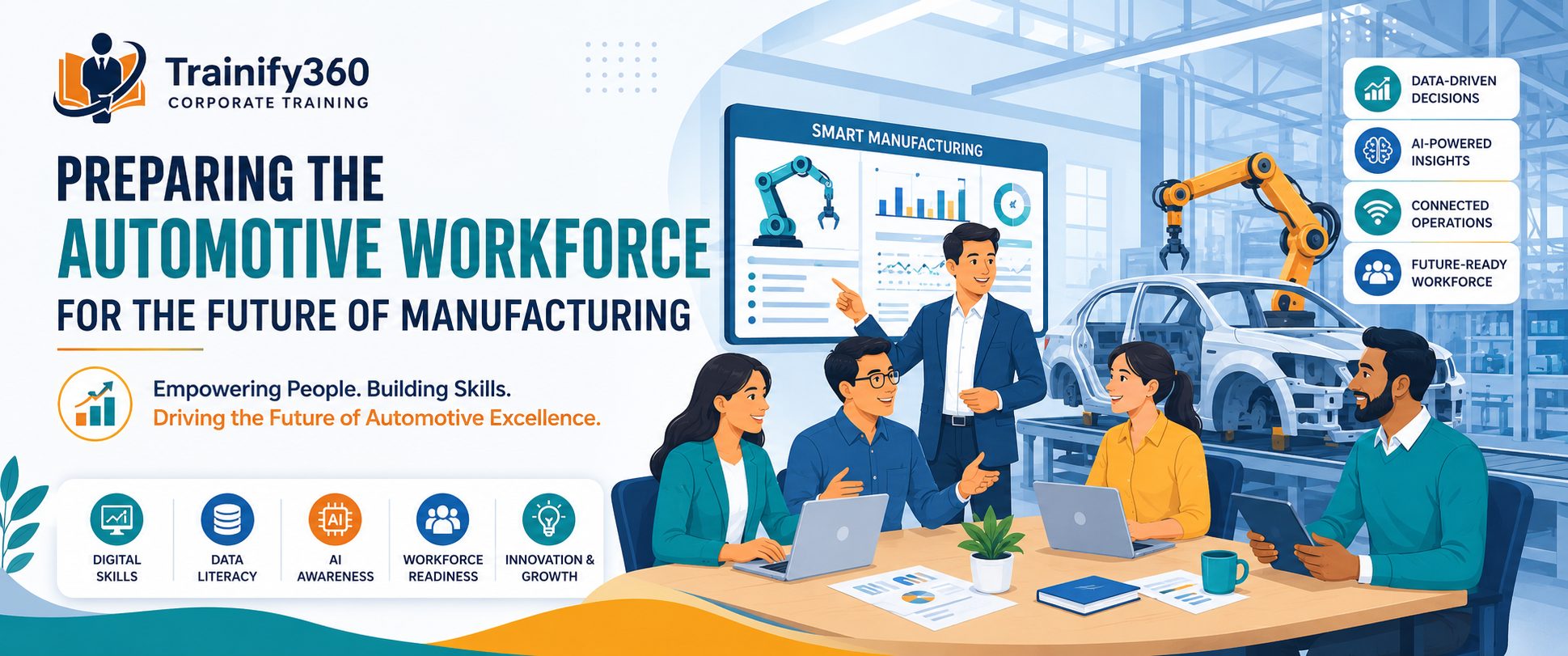
Preparing the Automotive Workforce for the Future of Manufacturing
Technology has always shaped the automotive industry.
From assembly lines and industrial robotics to automation and smart manufacturing, every major advancement has changed the way vehicles are designed, manufactured and delivered. Today, organisations are entering another phase of transformation. Artificial intelligence, data analytics and connected technologies are becoming part of everyday business operations, influencing decisions across manufacturing, quality, supply chain, customer service and workforce management.
Most automotive organisations have already invested significantly in digital technologies. Production equipment generates real-time data, AI supports quality inspections, predictive maintenance systems reduce unplanned downtime, and business leaders have greater visibility into operations than ever before.
Yet many organisations are discovering that technology itself is rarely the biggest challenge.
The greater challenge is helping people work confidently with it.
Installing a new system is usually a defined project with clear timelines and measurable milestones. Developing employees who know how to interpret data, question AI recommendations and use digital tools to improve business decisions takes considerably longer.
This is where many digital transformation programmes succeed or struggle.
Technology may create new possibilities, but business value is realised only when employees have the confidence and capability to use it effectively.
For CHROs, Learning and Development leaders, Plant Heads and business executives, workforce capability has become just as important as technology investment.
Digital Skills Are Now Business Skills
There was a time when digital capability was associated almost entirely with IT departments and engineering teams.
That distinction has disappeared.
Today, digital technology supports almost every business function within an automotive organisation.
A production supervisor relies on live dashboards to monitor output and quality throughout the shift. Maintenance engineers review predictive maintenance reports before equipment failures occur. Quality teams work alongside AI-assisted inspection systems that identify defects with greater consistency than traditional manual inspections.
The same shift is taking place outside manufacturing.
Procurement teams evaluate supplier performance using digital analytics. Finance departments depend on business intelligence tools for operational reporting. Sales teams use customer insights to personalise engagement, while HR professionals increasingly rely on workforce data to support recruitment, succession planning and capability development.
Digital capability is no longer a specialist requirement.
It has become part of everyday work across the organisation.
Technology Doesn't Deliver Results on Its Own
Many organisations expect new digital platforms to produce immediate improvements in productivity, quality and operational efficiency.
Sometimes those expectations are met.
Quite often, they are not.
The difference usually has very little to do with the technology itself.
Instead, it comes down to whether employees understand how to use it confidently in their daily work.
This is something many organisations underestimate.
Employees rarely resist technology because they dislike change. More often, they continue using familiar methods because they are uncertain about interpreting new information or concerned about making mistakes.
As a result, valuable dashboards remain underused, AI-generated insights are overlooked and reporting systems become little more than data repositories.
Technology creates opportunities.
Employees determine whether those opportunities become measurable business outcomes.
That is why capability development should be considered a strategic investment rather than simply another training initiative.
Data Literacy Is Becoming Essential Across the Organisation
Automotive businesses generate enormous amounts of information every day.
Production metrics, machine performance, supplier data, quality reports, inventory levels, customer feedback and financial dashboards all contribute to operational decision-making.
The challenge is no longer accessing information.
The challenge is understanding it.
Employees need to recognise patterns, identify operational risks, interpret trends and distinguish useful insights from routine reporting.
These capabilities are becoming valuable in every department—not only among analysts or data specialists.
A supervisor who can identify a recurring production issue before it affects quality contributes just as much to business performance as an engineer analysing complex manufacturing data.
Organisations that develop strong data literacy create faster decision-making, fewer operational surprises and greater confidence across teams.
AI Is Changing the Way People Work
Artificial intelligence has become one of the most widely discussed topics across manufacturing.
Much of the public conversation focuses on automation and whether jobs will eventually disappear.
Inside automotive organisations, however, the conversation is becoming much more practical.
AI is increasingly supporting employees rather than replacing them.
Manufacturers use computer vision systems to identify quality defects. Predictive analytics helps maintenance teams reduce equipment downtime. Planning teams use AI to improve production scheduling and inventory forecasting. Customer-facing functions analyse buying patterns to deliver more personalised experiences.
These technologies improve efficiency, but they do not remove the need for human judgement.
Employees continue making decisions involving safety, customer relationships, compliance, quality standards and operational priorities.
AI can analyse information quickly.
People provide the experience, context and judgement needed to act on that information responsibly.
For this reason, organisations should focus on building AI literacy alongside digital capability.
Employees need to understand not only what AI can do, but also when human judgement remains essential.
Digital Transformation Is Also a Leadership Challenge
Technology projects often receive considerable executive attention during implementation.
The real work begins afterwards.
Employees look to their managers for guidance during periods of change.
Managers who encourage learning, create opportunities to practise new skills and explain why digital initiatives matter usually achieve stronger adoption than those who focus solely on implementation deadlines.
People are more willing to embrace new systems when they understand how those systems improve productivity, quality, customer experience or workplace safety.
Digital transformation therefore depends as much on leadership behaviour as it does on technology investment.
Learning Must Keep Pace With Technology
One-off software training sessions are rarely enough.
Technology evolves continuously, and workforce capability needs to evolve alongside it.
Organisations should think beyond implementation training and create continuous learning opportunities that allow employees to build confidence over time.
Practical workshops, scenario-based learning, peer collaboration, digital mentoring and short learning interventions often prove far more effective than lengthy classroom programmes.
Employees learn best when they can immediately apply new knowledge to the work they perform every day.
Final Thoughts
Digital transformation within the automotive industry is no longer defined by the technology organisations purchase. Increasingly, it is defined by how effectively employees use that technology to improve operational performance.
The organisations that achieve the strongest results are not always those investing in the most advanced digital platforms. More often, they are the ones investing equally in their people.
Developing digital confidence, strengthening data literacy and building AI awareness enables employees to make better decisions, adapt more quickly to change and contribute more effectively to business performance.
At Trainify360, we work with automotive organisations to develop these capabilities through practical learning programmes that combine digital skills, data literacy, AI awareness, leadership development and workplace effectiveness. Technology will continue to evolve, but organisations that continuously invest in their people will be the ones best positioned to succeed in the years ahead.