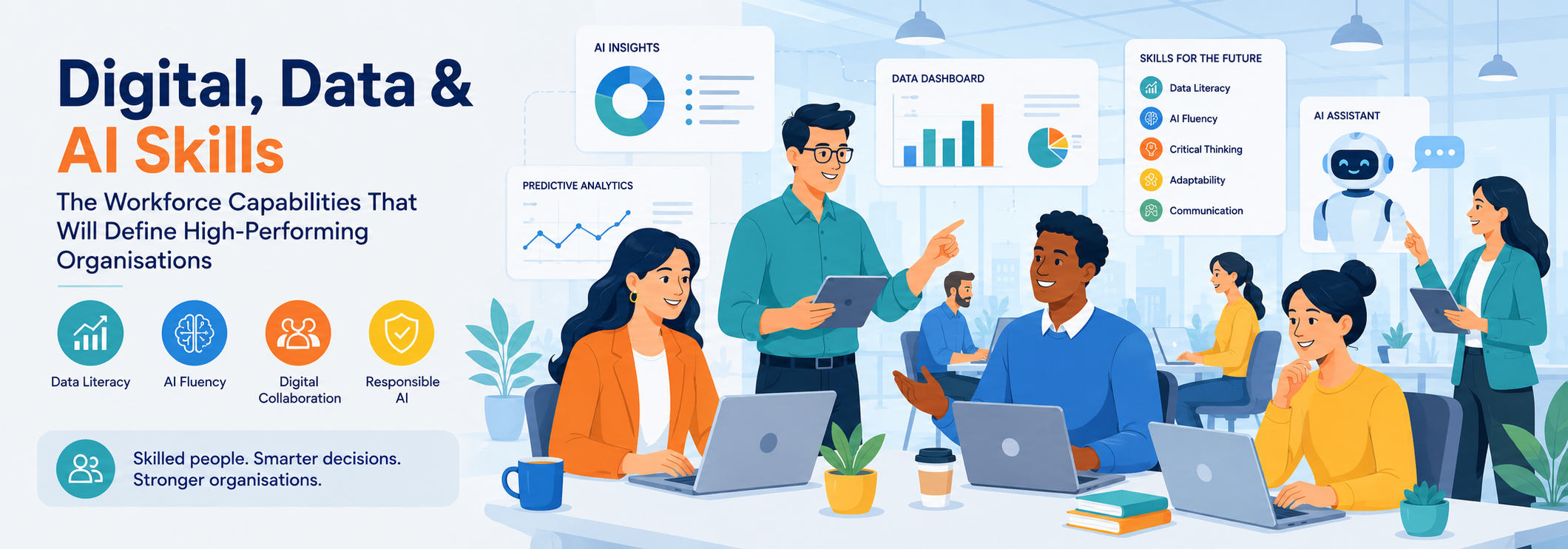
Digital, Data & AI Skills: The Workforce Capabilities That Will Define High-Performing Organisations
A conversation I had recently with a Chief Human Resources Officer has stayed with me because it reflects a challenge many organisations are facing.
Their company had invested significantly in artificial intelligence. New analytics platforms had been introduced, routine tasks were becoming increasingly automated, and employees had access to some of the latest AI-powered tools available.
Yet the results weren't matching expectations.
The technology worked exactly as intended. Adoption, however, was inconsistent. Some employees embraced the new tools almost immediately. Others continued relying on familiar processes, even when better alternatives were available. Managers noticed that people were generating reports more quickly, but they weren't always asking better questions or making stronger business decisions.
The CHRO's conclusion was simple.
"We've upgraded our technology faster than we've upgraded our workforce capabilities."
It's a challenge that extends well beyond one organisation.
Across industries, businesses are investing heavily in AI platforms, automation, advanced analytics, and digital transformation initiatives. These investments promise greater efficiency, faster decision-making, and improved customer experiences.
Technology certainly delivers many of those benefits. But technology alone doesn't create organisational capability.
Experience shows that digital transformation succeeds when employees know how to interpret data, question AI-generated recommendations, collaborate across functions, and apply sound judgement to increasingly complex decisions.
That's why conversations about AI are gradually shifting. The focus is moving away from software and towards skills.
The organisations making the greatest progress aren't simply teaching employees how to use new applications. They're helping people become more confident with data, more comfortable working alongside AI, and more capable of making informed decisions in environments where information is constantly evolving. Those capabilities are becoming every bit as valuable as technical expertise.
Why Digital Skills Mean Something Different Today
Not long ago, being digitally skilled often meant knowing how to use workplace software efficiently.
Employees attended training sessions to learn how to use spreadsheets, presentation tools, enterprise systems, or collaboration platforms. Once those systems became familiar, the expectation was that digital capability had largely been achieved.
That definition no longer reflects today's workplace. Digital capability now extends far beyond knowing where to click or how to generate a report.
Employees are increasingly expected to work alongside intelligent systems that analyse information, generate content, predict trends, and recommend actions. The role of the individual is changing from performing repetitive tasks to interpreting information, exercising judgement, and making better decisions.
That's a significant shift. Take a finance analyst, for example. An AI platform can analyse thousands of transactions in seconds and identify unusual spending patterns. The technology highlights potential issues remarkably quickly.
But deciding whether those findings represent genuine business risks still requires experience, commercial awareness, and professional judgement. The same applies across every function.
An HR team might use AI to shortlist candidates more efficiently. A marketing department can generate customer insights from vast amounts of behavioural data. Operations teams can forecast demand more accurately, while customer service professionals can resolve routine enquiries using intelligent virtual assistants.
In every case, technology improves speed. People determine quality. That's why digital capability can no longer be viewed as a technical competency alone. It has become a business capability that combines technology, critical thinking, communication, and sound decision-making.
One pattern we've observed across organisations is that employees often become comfortable using AI tools much faster than they become confident interpreting what those tools produce.
Knowing how to generate an AI report isn't the same as knowing whether its recommendations should be trusted. The strongest organisations recognise that difference.
Rather than focusing solely on software training, they're investing in broader capability development helping employees understand not just how AI works, but how to question it, validate its outputs, and apply its insights responsibly.
That mindset creates something far more valuable than digital literacy. It creates digital confidence.
Why Data Literacy Has Become a Business Skill, Not Just a Technical Skill
Every organisation talks about becoming data-driven. Far fewer spend enough time helping employees understand what that actually means in practice.
Access to data has never been the problem. Most businesses have more dashboards, reports, and analytics than they know what to do with. The real challenge is turning that information into better decisions.
I've seen leadership teams invest in sophisticated business intelligence platforms only to discover that managers were still relying on instinct because they weren't confident interpreting the data in front of them. The technology delivered exactly what it promised. The missing piece was capability.
Data literacy isn't about teaching everyone to become a data analyst. It's about helping people ask better questions.
Can we trust this data?
What story is it really telling us?
Are we looking at the complete picture, or just one part of it?
Could there be another explanation for what we're seeing?
Those questions matter because data rarely speaks for itself. It needs interpretation, context, and business judgement. Take customer experience as an example.
A dashboard might show that response times have improved by 30 percent after introducing AI-powered customer support. At first glance, that looks like a success.
But another report reveals customer satisfaction scores have declined over the same period. Without data literacy, teams may celebrate the first metric and overlook the second. With stronger analytical thinking, they begin asking why.
Perhaps customers received faster responses but struggled to reach a human adviser when dealing with complex issues. Suddenly, the conversation shifts from efficiency to customer experience.
That's the difference data literacy makes. It encourages curiosity instead of assumption. Across HR, finance, operations, sales, and customer service, employees who understand how to interpret data make stronger decisions because they recognise that numbers provide insight not certainty.
The AI Skills Every Employee Needs And They're Not Just Technical
When organisations begin discussing AI capability, the conversation often focuses on prompts, automation tools, or the latest software updates.
Those skills certainly have value. But they're only part of the picture.
The organisations seeing the greatest return from AI investment are developing a broader set of capabilities that combine technology with human judgement.
One capability is critical thinking. AI can produce reports, forecasts, presentations, and recommendations within seconds. That speed is impressive, but speed shouldn't replace professional judgement.
Employees need the confidence to pause and ask whether an AI-generated recommendation actually reflects business reality.
Another essential capability is decision-making. Technology can present several possible options, but someone still has to decide which one aligns with organisational priorities, customer expectations, and commercial goals.
Then there's communication. AI may generate insights, but people still need to explain those insights clearly to colleagues, customers, and senior leaders. The ability to translate complex information into practical business language has become even more valuable.
Perhaps the most overlooked skill is adaptability. AI tools are evolving rapidly. Platforms that seem advanced today may look very different twelve months from now.
Employees who are comfortable learning, experimenting, and adjusting to change will adapt far more successfully than those who focus solely on mastering one specific application.
One L&D leader recently shared an observation that resonates with many organisations.
"The people progressing fastest aren't necessarily the most technical. They're the ones who are curious enough to keep learning."
That curiosity has become one of the strongest predictors of long-term success.
Digital Skills Grow Faster When Departments Learn Together
One misconception that still exists is that AI capability belongs primarily to IT teams. In reality, digital transformation is a business-wide effort.
Every department now works with data in some form, and every function benefits when employees understand how AI supports better decision-making.
Think about how closely different teams already work together. HR relies on workforce analytics to improve hiring and retention.
Finance provides performance insights that shape investment decisions.
Marketing analyses customer behaviour to refine campaigns.
Sales teams use predictive tools to identify new opportunities.
Operations monitors supply chain performance through real-time dashboards.
Each department contributes a different perspective. When these teams understand one another's data, collaboration becomes far more effective.
I've seen organisations achieve remarkable improvements simply by bringing cross-functional teams into the same learning sessions. Rather than teaching AI in isolation, they explore real business scenarios together.
A marketing manager learns why finance validates forecasting assumptions.
Finance gains a better understanding of customer behaviour metrics.
HR sees how operational data influences workforce planning.
These discussions create something technology alone never can.
Shared understanding.
Employees stop viewing data as belonging to individual departments and begin seeing it as a shared business asset. That shift encourages stronger collaboration and better organisational decision-making.
Learning Must Keep Pace with Technology
One challenge many organisations underestimate is how quickly digital capability becomes outdated.
A single training programme delivered once a year is unlikely to prepare employees for technologies that evolve almost monthly. Successful organisations are approaching learning differently.
Instead of treating digital capability as a one-time project, they're building continuous learning into everyday work. Employees have opportunities to experiment with new AI tools, discuss practical challenges, share successful use cases, and learn from colleagues across different business functions.
Managers encourage teams to reflect on what worked, what didn't, and how technology can support better outcomes in the future.
That approach creates confidence because learning becomes part of the organisational culture rather than another mandatory training requirement.
People don't feel pressured to know everything. They feel encouraged to keep improving. The organisations that adapt most successfully aren't necessarily those investing the most in technology. More often, they're the ones investing consistently in helping their people grow alongside it.
Building a Workforce That's Ready for What's Next
When organisations talk about becoming "AI-ready," the conversation often centres on technology. New platforms are evaluated, budgets are approved, and implementation plans are carefully managed. Those investments matter, but they're only part of the picture.
Technology can be purchased. Workforce capability has to be developed.
One of the biggest differences between organisations that simply adopt AI and those that gain lasting value from it is their approach to learning. They don't see digital capability as another training programme to complete. They see it as a business capability that evolves alongside technology.
That changes the role of Learning and Development.
Instead of delivering occasional software training, L&D teams are becoming strategic partners in helping people build confidence, curiosity, and sound judgement. Their goal isn't just to teach employees how to use AI. It's to help them understand when to rely on it, when to question it, and how to combine technological insight with human experience.
The most effective learning strategies are practical rather than theoretical. Employees learn best when they can apply new skills to situations they recognise from their own work.
For example:
- HR teams can practise reviewing AI-generated candidate shortlists while discussing fairness, bias, and hiring decisions.
- Finance professionals can analyse AI-generated forecasts and explore how business context influences financial planning.
- Customer service teams can compare AI-generated responses with conversations that require empathy, negotiation, and relationship building.
- Sales teams can use customer analytics to identify opportunities while recognising that trust is built through genuine human interaction.
- Operations managers can explore predictive analytics alongside real-world factors that data alone cannot capture.
Learning becomes far more meaningful when employees see how AI supports their work instead of viewing it as a separate technical subject.
What Business Leaders Should Be Asking
As AI becomes part of everyday operations, senior leaders have an opportunity to shift the conversation from technology adoption to workforce readiness.
Rather than asking, "How many AI tools have we deployed?" a more valuable question might be:
"Do our people have the skills to use those tools wisely?"
That simple shift changes the focus from implementation to impact.
Here are a few questions worth discussing at the leadership table:
- Are employees confident interpreting data, or are they simply generating more reports?
- Have managers developed the judgement to challenge AI recommendations when something doesn't seem right?
- Are digital skills being developed across every function, or only within technical teams?
- Does our learning strategy encourage continuous development rather than one-off training sessions?
- Are collaboration, critical thinking, and communication receiving the same attention as technical capability?
The answers often reveal how prepared an organisation really is for the next phase of digital transformation.
Experience shows that businesses rarely struggle because employees lack access to technology. They struggle when people aren't given the opportunity to develop alongside it.
Learning Is Becoming a Competitive Advantage
The pace of technological change isn't slowing, and neither are business expectations.
New AI capabilities will continue to emerge. Data will become even more central to decision-making. Roles will evolve, and employees will need to adapt more frequently than they have in the past.
That isn't something organisations should fear.
It's an opportunity to rethink how learning supports business performance.
The strongest organisations are creating cultures where learning happens continuously—not because employees are required to complete another course, but because curiosity, experimentation, and knowledge sharing have become part of everyday work.
Managers encourage discussion after projects.
Teams share successful AI use cases.
Departments learn from one another rather than working in isolation.
Employees are given the confidence to experiment responsibly, ask questions, and challenge assumptions.
Those habits create something that technology alone never will.
A workforce that's prepared to keep learning.
Key Takeaways for Business Leaders
As organisations continue investing in AI, the conversation should extend well beyond software implementation.
Future-ready organisations focus on developing people as intentionally as they develop technology.
That means:
- Building strong digital literacy across every business function.
- Improving data literacy so employees can interpret information with confidence.
- Strengthening critical thinking and decision-making alongside AI capability.
- Encouraging collaboration between technical and non-technical teams.
- Creating continuous learning opportunities rather than relying on occasional training programmes.
- Helping leaders guide their teams through change with confidence and clarity.
When these capabilities come together, organisations become more adaptable, more resilient, and better equipped to turn technology into measurable business value.
Final Thoughts
Artificial intelligence is changing the way organisations work, but it isn't changing what successful organisations ultimately depend on.
They still depend on people who ask thoughtful questions, interpret information carefully, communicate effectively, collaborate across teams, and make sound decisions when the path forward isn't obvious.
Those qualities have always mattered. The difference now is that they're becoming even more valuable as technology takes over routine tasks.
Digital, data, and AI skills shouldn't be viewed as technical competencies alone. They're business capabilities that shape how organisations solve problems, serve customers, innovate, and compete.
The organisations that stand out over the next decade won't simply have the most advanced AI platforms. They'll have employees who know how to combine digital confidence with human judgement, analytical thinking, adaptability, and collaboration.
At Trainify360, we believe successful digital transformation begins with people. By helping organisations strengthen digital capability, data literacy, AI readiness, leadership development, and workplace skills, we enable teams to adopt new technologies with confidence while keeping human judgement at the centre of every business decision.
Technology will continue to evolve. The organisations that thrive will be those that invest just as thoughtfully in the people who use it.