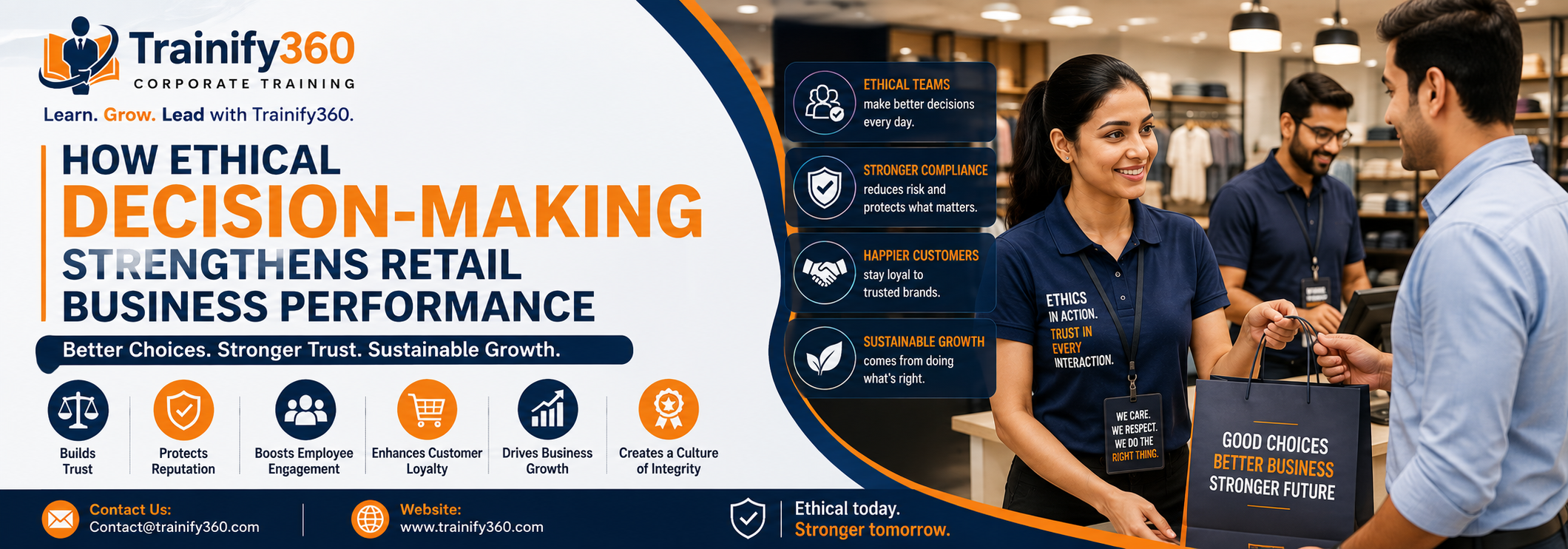
How Ethical Decision-Making Strengthens Retail Business Performance
A store manager I once worked with told me about a moment that's stayed with her for years. A customer came through the till with an item that had been mispriced due to a labelling error, priced at a fraction of what it should have cost. The cashier noticed. She had maybe four seconds to decide what to do before the queue behind the customer started shifting weight from one foot to the other.
She rang it up at the marked price and let it go.
Nobody trained her for that exact moment. There was no policy document covering mispriced labels and a queue of six people. She made a judgment call, on the spot, based on whatever sense of right and fair she'd picked up over the course of her working life. It happened to be a defensible call, arguably even the right one for customer goodwill. But it could just as easily have gone the other way, and there was nothing in her training that would have told her which direction to lean.
That's the part worth sitting with. Retail runs on thousands of these small ethical calls every single day, made by people who were mostly never taught how to make them well.
Ethics Isn't a Compliance Add-On
A lot of organisations bundle ethics training in with compliance and data protection, one module covering all three, delivered once a year, and move on. It's an understandable instinct. They overlap in places. But treating them as the same thing misses something important.
Compliance is largely about following defined rules. Ethics is about what happens when the rules run out, when there's no clear policy, no manager nearby, and a decision needs making anyway. In retail, that gap shows up constantly. What do you do when a regular customer asks you to bend a return policy slightly? How do you handle a colleague who's clearly cutting corners on stock checks to finish a shift early? What's the right response when a delivery arrives short and nobody's quite sure whether to flag it or just quietly make up the difference?
None of that is covered by a compliance manual. It's covered, if it's covered at all, by whatever judgment the individual employee happens to bring to work that day.
Why This Actually Shows Up in the Numbers
It's tempting to file ethics under culture, something soft, something that matters but doesn't move the needle on results. That's a mistake, and the data doesn't really support it.
Businesses with a genuine culture of ethical decision-making tend to see lower rates of internal shrinkage, since employees who feel a personal sense of responsibility toward the business are less likely to look the other way when something's clearly wrong, whether that's theft, expense fraud, or simple corner-cutting. Customer trust holds up better over time, because the small, consistent honesty employees show, admitting a mistake instead of hiding it, flagging an error instead of letting it slide, compounds into a reputation that's hard for competitors to replicate quickly. Employee retention tends to improve too, since people generally want to work somewhere they can respect, and a culture where cutting ethical corners is quietly tolerated erodes that respect faster than almost anything else. And escalations to management drop, because staff who've developed sound judgment resolve more situations themselves rather than pushing every awkward call upstairs.
None of these show up on a single line in a P&L. All of them show up, cumulatively, in the numbers leadership actually cares about.
Where Ethical Pressure Points Sit in Retail
Retail creates an unusually high volume of exactly the kind of moments where ethics matters, mostly because so much of the work happens with limited supervision and real-time pressure.
Front-line staff regularly face pricing errors, both in the business's favour and the customer's, and have to decide in the moment whether to correct them. Returns and refunds create constant grey areas, where policy is clear on paper but murky the second a genuinely sympathetic customer situation shows up in person. Colleague behaviour is another pressure point entirely; noticing a teammate padding hours, mishandling stock, or treating a customer poorly, and deciding whether to say something, is one of the harder calls retail employees face regularly, and it's rarely addressed directly in training. And target pressure creates its own ethical strain, particularly in commission-driven environments, where the incentive to oversell or misrepresent a product edges up against what's actually good for the customer.
Each of these moments is small on its own. Multiplied across a large workforce over a year, they add up to something that genuinely shapes how a brand is perceived, both by customers and by the people who work there.
What Effective Ethics Training Actually Looks Like
The programmes that work well share a few traits, and none of them involve a lecture on abstract moral philosophy, which is usually where ethics training goes wrong in the first place.
They're built around real dilemmas, not principles. Telling someone to "act with integrity" gives them nothing to actually work with in the moment. Walking them through a realistic scenario, the mispriced item, the colleague cutting corners, and discussing how different responses play out, gives them something they can actually draw on later.
They involve discussion, not just instruction. Ethical reasoning develops through talking things through with peers, hearing how a colleague would handle the same situation differently, and understanding why. A silent e-learning module can't replicate that, no matter how well written the content is.
They come from leadership, visibly. Employees calibrate their own ethical standards partly by watching what leadership tolerates. A manager who quietly lets small dishonesty slide, an expense fudge here, a customer complaint buried there, sets a standard that no training module can override. The training has to be backed by behaviour people can actually see.
They give people language for saying no. One of the more overlooked parts of ethics training is simply giving employees a script, a way to decline an uncomfortable request from a customer or colleague without it turning into a confrontation. Confidence in the moment often matters more than the underlying values, which most employees already hold anyway.
The Business Case for Leadership
For CHROs and business leaders weighing where development investment goes, the case for ethics training rests less on avoiding scandal and more on everyday resilience. Organisations with strong ethical cultures recover faster from mistakes, because employees are more willing to surface problems early rather than hide them until they've grown. They build customer loyalty that's harder for a competitor to erode with a cheaper price alone, since trust, once established, carries real weight in a customer's decision to keep coming back. And they tend to attract stronger talent over time, since reputation as an employer with genuine integrity spreads through word of mouth in ways that are difficult to manufacture through marketing.
Where to Start
Look first at where your front-line staff are actually making judgment calls with no clear policy to lean on, and build training around those specific moments rather than generic ethics content. Involve managers directly in delivering and modelling the training, since employees learn more from watching leadership behaviour than from any module. Create space for open discussion of real dilemmas rather than one-way instruction. And check that your incentive structures aren't quietly working against the ethical standards you're trying to build, since a target-driven bonus scheme can undo months of good training in a single quarter if nobody's watching for the conflict.
Final Thoughts
Ethical decision-making in retail rarely gets discussed as a performance driver, which is part of why it's so consistently underinvested in. But the small, unsupervised judgment calls employees make hundreds of times a day quietly shape shrinkage, customer trust, retention, and brand reputation in ways that are easy to miss until they've compounded into something significant. Training people to make those calls well isn't a soft add-on to the development calendar. It's one of the more direct ways leadership can shape long-term business performance.
Trainify360 helps retail organisations build ethics training grounded in the real dilemmas employees face on the floor, not abstract principles nobody can apply. If you're rethinking how your organisation prepares people for these moments, we'd be glad to talk it through.
Frequently Asked Questions
Why does ethical decision-making matter for retail business performance specifically? Retail involves a high volume of unsupervised, real-time judgment calls, pricing errors, refund grey areas, colleague behaviour that directly affect shrinkage, customer trust, and reputation when handled poorly.
How is ethics training different from compliance training? Compliance covers defined rules and procedures. Ethics training prepares employees for situations where no clear rule exists and a judgment call is required, which is where a large share of retail decisions actually happen.
What makes ethics training effective rather than just a box-ticking exercise? Training built around realistic scenarios and open discussion, reinforced visibly by manager behaviour, tends to work far better than generic instruction or one-way e-learning content.
Does ethical culture actually affect financial performance? Yes, indirectly but measurably. Organisations with strong ethical cultures tend to see lower shrinkage, stronger customer retention, better employee retention, and fewer escalations requiring management intervention.
Where should leaders start if they want to strengthen ethical decision-making on the floor? Identify the specific moments where staff currently face judgment calls without clear guidance, build training around those real scenarios, and involve managers directly in reinforcing the standard through their own behaviour.