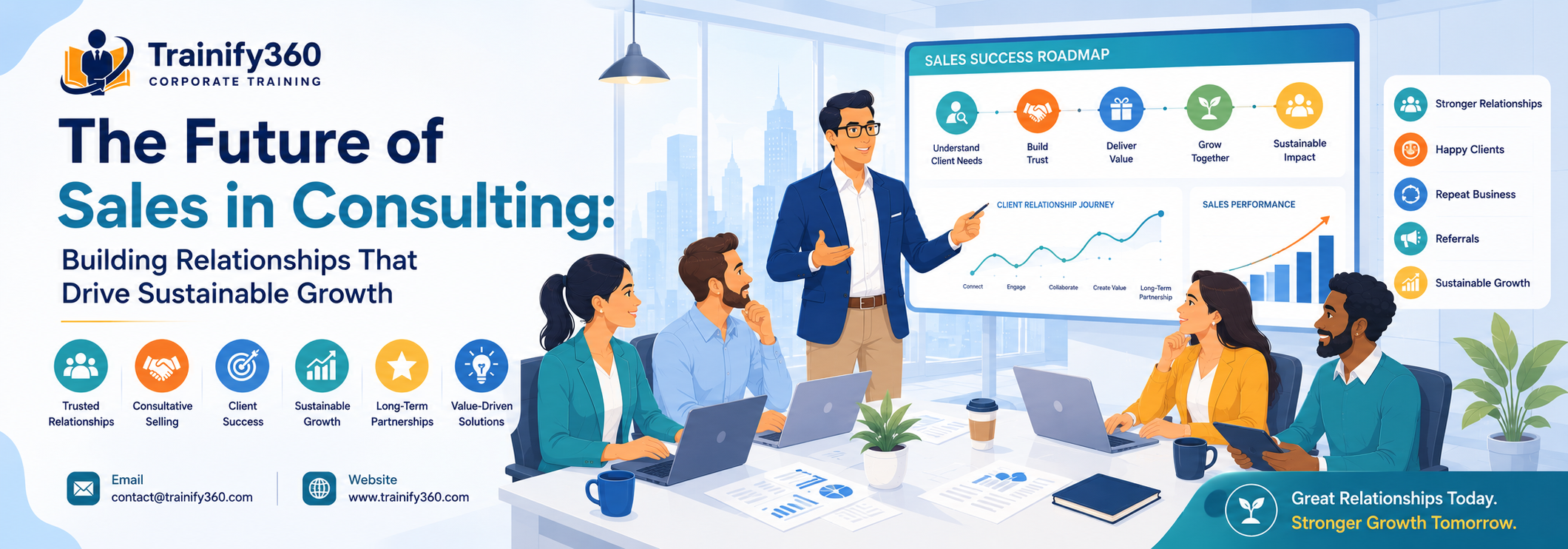
The Future of Sales in Consulting: Building Relationships That Drive Sustainable Growth
Most consulting firms still train business development the way software companies train account executives: pipeline stages, objection handling, a close at the end of every call. It's borrowed wholesale from a world where the product is fixed, the demo is repeatable, and the buyer is evaluating a feature list against a competitor's feature list. None of that describes what actually happens when a client decides to bring in a consulting firm, and the mismatch shows up constantly in how badly this kind of training lands with the partners and directors who are supposed to be doing the selling.
A client hiring a consulting firm isn't buying a product. They're buying trust in a specific person's judgment, usually built over months or years, often starting long before any formal engagement gets discussed. Compress that into a sales script with a defined close, and you get exactly what I see in firm after firm: partners who feel awkward "selling," associates who avoid business development entirely because it feels like something slightly beneath the work, and a firm that treats growth as an event rather than the ongoing output of how relationships get built and maintained.
Why the Software Sales Model Doesn't Transfer
Software sales works because the thing being sold doesn't change much from buyer to buyer, and the buying decision is largely rational and comparable. Consulting engagements are almost the opposite. Every client relationship is genuinely different; the value delivered depends heavily on the specific people doing the work, and the decision to hire often comes down to something much less measurable than a feature comparison: whether the client believes this particular person or team will actually solve their problem and not embarrass them internally in the process.
That's why the strongest business developers in professional services rarely look like traditional salespeople. They look like trusted advisors who happen to also bring in revenue, almost as a byproduct of being genuinely useful over a long period. The distinction matters more than it sounds, because it changes what actually needs training. Teaching someone to handle objections doesn't help much if the real skill gap is knowing how to stay usefully present in a client's world during the eighteen months between engagements when there's nothing formally being sold at all.
The Relationship Gap Firms Don't Train For
Here's where most business development training in this sector falls short. It focuses almost entirely on the pursuit, the pitch, the proposal, the close, and almost nothing on the much longer period before and after, where the actual relationship gets built or quietly erodes. A partner who's brilliant in a pitch meeting but never follows up with a useful piece of thinking six months later, when there's no active opportunity on the table, is leaving most of the relationship value on the ground.
The consultants who consistently bring in sustainable, repeat business tend to do a handful of unglamorous things well. They stay genuinely informed about what's happening in a client's world even when nothing's being sold, which means reading the trade press their clients read, not just their own industry's. They share something useful unprompted, an insight, an introduction, a piece of analysis relevant to a problem the client mentioned in passing months earlier, without attaching it to an immediate ask. They ask better questions in ordinary conversation than most people think to ask, the kind that make a client realise they hadn't fully thought through a problem themselves, rather than questions clearly aimed at uncovering a sales opportunity.
None of that appears in a typical sales training curriculum, largely because it's genuinely harder to teach than a pitch structure. It's closer to a way of operating than a technique, and building it requires a different kind of development entirely.
What Actually Builds This Capability
The firms getting this right have stopped treating business development as a separate skill bolted onto technical expertise and started treating relationship-building as part of how consultants are developed from the very beginning of their careers, not something introduced once someone reaches partner level and suddenly needs to bring in revenue.
Shadowing matters more here than almost any classroom session. A junior consultant sitting in on how a senior partner handles an ordinary check-in call, not a pitch, an ordinary call, learns more about sustainable relationship-building in that hour than in most formal training. It's the tone, the pacing, the willingness to talk about something other than the current engagement, that's genuinely difficult to transmit through a slide deck.
Firms also need to reward the behaviour they actually want, which sounds obvious and is routinely ignored. If the only recognised business development activity is closing a new engagement, staff quite reasonably conclude that maintaining an existing relationship without an active sale doesn't count for anything, and they stop investing time in it. Recognising and rewarding the unglamorous maintenance work, the useful email sent for no immediate reason, the introduction made without an ask attached, changes what people actually prioritise day to day.
And training needs to give people explicit permission to be direct about value without being transactional about it. A lot of technically excellent consultants avoid discussing fees, scope, or future work entirely because it feels uncomfortably close to selling, and that discomfort often means opportunities go unmentioned until a client raises them first, if they ever do. The skill isn't pushing harder. It's being able to raise the possibility of further work naturally, inside an existing relationship of trust, without it feeling like a pivot into a different mode of conversation.
Measuring Growth Sustainably
Pipeline value and win rates matter, but they measure the wrong end of the process if a firm wants to understand whether it's actually building sustainable growth. Better indicators include how much revenue comes from existing relationships versus net-new pursuit, how long client relationships last on average before drop-off, and whether junior staff are building their own independent relationships with client contacts or remaining entirely dependent on the partner who originally won the account. That last one in particular predicts a firm's growth trajectory five years out far better than this quarter's pipeline numbers do.
Where to Start
Stop calling it sales training and start calling it relationship capability, because the language shift changes how people engage with it. Build shadowing into how junior consultants are developed from year one, not just around promotion to a client-facing role. And look honestly at what actually gets recognised and rewarded in the firm today, because if maintaining a relationship without an active sale isn't valued anywhere in the system, no amount of training will convince people to prioritise it.
Frequently Asked Questions
Why does traditional sales training often fail in consulting firms? Because it's built for products with fixed features and comparable buying decisions, while consulting is sold on trust in a specific person's judgment, built over time, which a scripted pitch process doesn't reflect.
What actually drives sustainable growth in professional services firms? Ongoing relationship maintenance during the periods between active engagements, not just pitch and pursuit skills. Firms that reward only new-business closing tend to under-invest in this.
Should junior consultants be involved in business development early in their careers? Yes. Shadowing senior partners in ordinary, non-pitch client interactions teaches relationship-building far more effectively than waiting until someone reaches partner level and is suddenly expected to bring in revenue.
What metric best predicts long-term growth in a consulting firm? Whether junior and mid-level staff are building their own independent client relationships, rather than remaining entirely dependent on the partner who originally won the account.